
Discover Suzhou silk, embroidery, Pingtan and Kunqu through museum visits, beginner craft sessions and relaxed cultural itineraries, with practical booking advice.
Suzhou’s gardens show how carefully a landscape can be composed. Its silk, embroidery and performing arts reveal another side of the same cultural world: attention to materials, fine detail, expression and the patient development of skill.
A worthwhile cultural visit can be simple. Start with the Suzhou Silk Museum, choose a short performance or a beginner-friendly craft session, and leave time for a neighbourhood walk and tea. If embroidery is a particular interest, arrange a more focused visit to Zhenhu rather than trying to add it to an already full city itinerary.
You do not need to buy silk or understand every word of a performance to enjoy these experiences. Knowing what you are seeing, how much time to allow and what to confirm before booking makes the visit far more rewarding.
This guide explains the main choices, how they differ, where to begin, and how to fit them into a practical Suzhou trip.
Suzhou Silk and Culture at a Glance
| Experience | Main appeal | Suggested planning allowance |
|---|---|---|
| Suzhou Silk Museum | An introduction to silk history, textiles and production | 60–90 minutes |
| Suzhou embroidery exhibition or demonstration | Fine needlework, shading and artistic craftsmanship | 45–90 minutes, depending on the visit |
| Beginner embroidery or other craft session | Participation and a closer understanding of the process | 60–120 minutes for a suitable introductory class |
| Short Pingtan performance | Local voices, storytelling and string accompaniment | Around 30–60 minutes for a selected introductory programme |
| Kunqu excerpts or a full performance | Theatre, singing, costume and expressive movement | Follow the actual programme length |
| Zhenhu embroidery-focused outing | A deeper look at an embroidery community and specialist work | Half a day or longer, including transport |
| Neighbourhood walk with tea | Time to connect the formal experiences with everyday surroundings | 60–90 minutes or more |
These are suggested allowances, not published session lengths. Museums, studios and performances have separate schedules and booking arrangements.
Which Experiences Should You Choose?
For a first visit, choose one place to learn and one activity to experience. A museum followed by a performance or a craft class gives you a useful balance without filling the day with similar stops.
Consider what most interests you:
- Textiles and design: begin with the Silk Museum, then look for an embroidery demonstration or a specialist exhibition.
- Music and local atmosphere: choose a short Pingtan programme with a clearly explained format.
- Theatre and costume: look for Kunqu excerpts or a production with a synopsis you can read beforehand.
- Hands-on participation: arrange a beginner class with confirmed materials, language support and a realistic project.
- A deeper embroidery visit: reserve time for Zhenhu and arrange the specific gallery or studio you want to see.
- A family outing: choose a shorter museum visit and a simple, age-appropriate activity.
A complete cultural day does not require every option. One well-explained encounter can be more memorable than several hurried demonstrations.
Understanding Silk, Brocade and Embroidery
The terms can be confusing because shops and visitor descriptions sometimes group very different products together.
Silk Is a Fibre
Silk refers to the fibre used to make a textile. A silk fabric may be woven in different structures, printed, dyed or decorated after weaving.
The word “silk” alone does not tell you whether an item was handwoven, machine-woven, embroidered or made locally. Those are separate questions.
Brocade Is a Woven Textile
In brocade, pattern is created through weaving. Song brocade — 宋锦, Song Jin — is an important textile tradition associated with Suzhou.
Look at how the pattern belongs to the structure of the fabric. Comparing it with a printed fabric or an embroidered surface makes the distinction easier to understand.
Kesi Is Silk Tapestry Weaving
Kesi — 缂丝 is a demanding tapestry technique in which coloured weft threads are worked in sections to form the design. It is weaving rather than embroidery, even when the finished image resembles a painting.
If a display includes both techniques, compare how the image is constructed. A guide or demonstrator can help you identify the process without needing specialist vocabulary.
Embroidery Adds Stitches to a Ground Fabric
Suzhou embroidery — 苏绣, Su Xiu — uses needlework to create decoration or images on an existing fabric.
It is known for refined stitches and carefully controlled effects. Works can include flowers, landscapes, animals and portraits, as well as decorative objects and contemporary designs.
Fine embroidery may use changes in thread direction and colour to suggest texture, shading and depth. When viewing it, look closely where permitted, then step back and compare the overall image.
| Term | What it describes | A useful question to ask |
|---|---|---|
| Silk | Fibre content | What is the exact material composition? |
| Song brocade | A patterned weaving tradition | How is the pattern formed in the fabric? |
| Kesi | Tapestry weaving | Which parts are woven separately to create the image? |
| Suzhou embroidery | Needlework on a ground fabric | Is this hand embroidery, machine embroidery or a combination? |
Start with the Suzhou Silk Museum
The Suzhou Silk Museum — 苏州丝绸博物馆 is a practical introduction for visitors who want cultural context before looking at products or specialist craftwork.
Address: 2001 Renmin Road, Suzhou — 苏州市人民路2001号.
Allow 60 to 90 minutes for a selective visit. You may prefer longer if textiles are a particular interest or a temporary exhibition appeals to you.
What to Look For
Use the visit to follow a few clear questions:
- How does silk move from a natural fibre into a usable textile?
- How do weaving, dyeing and embroidery differ?
- What can a garment or fragment reveal about its use and period?
- How do historical patterns appear in contemporary design?
You do not need to read every panel. Choose several objects or sections and examine them carefully.
The museum is associated with the preservation of Song brocade and Zhang satin techniques. Exhibits can help you recognise that “Suzhou silk” covers several kinds of material and craftsmanship rather than a single standard product.
Demonstrations and Activities
Check what is scheduled for your date. A loom, video or educational display does not guarantee a live demonstration, and a demonstration does not necessarily include visitor participation.
If you want a guided tour or a workshop, ask about the booking, language, age suitability, duration and whether materials are included.
Do not build the day around seeing live silkworms or a particular production stage without confirming its availability. Living displays and activities can be seasonal or programme-dependent.
Opening and Admission Planning
The museum’s published general information gives Tuesday-to-Sunday hours of 9:00 a.m. to 5:00 p.m., with last admission at 4:00 p.m. and Monday closure except for statutory-holiday arrangements. Some museum sections have different Monday arrangements, so confirm the part you intend to visit.
Check current admission and reservation requirements, temporary closures and holiday notices before setting out. Special activities may have separate bookings even when ordinary exhibition entry is available.
Use the exact museum name and address in your map. A commercial showroom with “silk museum” in its description is not automatically the same institution.
Getting There
Check a current metro or walking route to 2001 Renmin Road. If using a taxi, show the Chinese museum name and confirm the correct entrance.
Leave time for the transfer to your next activity. The Silk Museum and the performance museums around Pingjiang Road are separate stops, rather than parts of one building.

How to Appreciate Suzhou Embroidery
Embroidery becomes easier to understand when you look at the decisions behind the image.
Compare the Whole Image with Its Details
Step back first. Notice the subject, colour and overall effect. Then look closer at a small area, such as fur, a leaf or a transition from light to shade.
Ask how the embroiderer created that effect. Thread direction and the relationship between neighbouring colours are often as interesting as the subject itself.
Watch the Process When Available
A demonstration can show how slowly a small area develops. It may also reveal thread preparation, the use of a frame and the sequence of stitches.
Ask permission before photographing the maker or recording the process. Avoid interrupting detailed work simply to obtain a close-up.
Understand Double-Sided Work
Some embroidery is designed to be viewed from both sides. If an example is displayed for that purpose, compare the two surfaces and ask how the finishing is handled.
Do not assume every work with a neat reverse is a specialist double-sided piece, or that all Suzhou embroidery uses the same technique.
Ask Specific Questions
Useful questions include:
- Which parts of the work are hand-stitched?
- What fibre is used for the thread and ground fabric?
- Who designed and made the piece?
- How was this particular effect achieved?
- What can a beginner realistically try in a short lesson?
A clear explanation often adds more to the visit than an impressive claim about the number of hours a piece took to make.
Zhenhu: A More Focused Embroidery Visit
Zhenhu — 镇湖 is an embroidery-related area in western Suzhou, near Taihu Lake. It is a separate excursion from the central old town.
The China Embroidery Art Museum — 中国刺绣艺术馆, at 1 Xiuguan Street — 绣馆街1号, is a useful venue to investigate when planning a specialist visit. Confirm its current exhibitions, operating hours and admission arrangements directly.
Allow half a day or longer, including travel, if you want an exhibition and a confirmed studio encounter. Your actual allowance should reflect the journey from your accommodation and the length of the activity.
Who Should Make the Trip?
Zhenhu is particularly suitable for visitors who already enjoy textiles, needlework, art or design. It can also work for families if a suitable activity has been arranged in advance.
For a short general Suzhou stay, a city museum and one central activity may be more practical. Do not add Zhenhu as a brief detour between the Humble Administrator’s Garden and an evening train.
Arrange the Encounter You Want
Decide whether you want to view finished work, watch a demonstration, visit a working studio or participate in a lesson. These are different experiences.
Confirm the specific host and meeting point. A neighbourhood associated with embroidery does not guarantee that every studio accepts walk-ins or provides English-speaking instruction.
Ask whether the appointment includes time with a maker, whether a guide will interpret, and whether any part of the visit takes place in a retail space.
A commercial setting can still provide an informative encounter. What matters is that you understand the format, learning time and any optional purchasing opportunity before booking.
Plan Transport Separately
Use a current route planner for the exact gallery or studio. A car transfer can simplify the journey for a group, but travel time varies with the starting point and traffic.
Agree on return arrangements before arrival. If you also want to explore the Taihu area, give that additional time rather than assuming it fits into the embroidery session.
Try a Hands-On Craft Experience
A short workshop can help you appreciate how much skill sits behind an apparently simple object.
Beginner Embroidery
Choose an introductory project suited to your available time. A small motif or a few stitches is a reasonable outcome for a first lesson; a complex artwork is not.
Confirm whether you take home a finished item, a partly completed piece or a practice sample. Ask whether a kit is supplied if you want to continue later.
For children, check needle supervision, minimum age and the expected level of concentration. For adults, mention any needs relating to eyesight, hand movement or seating.
Textile and Design Activities
Museums and cultural spaces may offer textile-related educational sessions, pattern activities or demonstrations. Check the actual technique rather than relying on a broad “silk experience” label.
Ask what you will do yourself and what is a demonstration. This is especially useful when booking through a tour provider rather than the venue directly.
Woodblock Printing and Other Crafts
Suzhou’s cultural activities extend beyond textiles. Taohuawu woodblock New Year prints — 桃花坞木版年画 are one example to investigate if you enjoy graphic design and printmaking.
A beginner session may involve printing from a prepared block rather than carving a new one. Confirm the method, materials and take-home result before booking.
Fan-related crafts, calligraphy or other workshops can also complement a visit when a suitable session is available. Ask what connection the activity has with the local tradition and who will lead it.
Questions to Ask Before Booking
| Booking detail | What to confirm |
|---|---|
| Actual activity | What will you make or practise yourself? |
| Duration | How much time is instruction, demonstration and participation? |
| Language | Is the instructor fluent in English, or is an interpreter included? |
| Group size | How many participants share the instructor? |
| Materials | Are tools, materials and a take-home item included? |
| Suitability | What are the age, access and dexterity requirements? |
| Location | Is it a working studio, museum activity room or retail venue? |
| Changes | What happens if the instructor or venue becomes unavailable? |
A confirmed beginner class with clear expectations is easier to enjoy than an open-ended promise of a “masterclass.”
Pingtan: Storytelling and Music in the Suzhou Dialect
Pingtan — 评弹 is a collective term covering Suzhou spoken storytelling and sung storytelling traditions. Musical programmes commonly feature instruments such as the pipa and sanxian, while spoken storytelling has a different format.
The language is an important part of the experience. Much of the storytelling, humour and vocal expression depends on the Suzhou dialect, so an overseas visitor should not expect to follow the narrative automatically.
Can You Enjoy It Without Understanding the Words?
Yes, particularly in a short musical programme. Listen to the relationship between voice and instrument, the timing of phrases and the performers’ interaction.
For a longer storytelling session, an introduction to the plot can make a substantial difference. Ask for a synopsis or choose a programme with English explanation where available.
A familiar melody performed in a tea room is not necessarily a full traditional storytelling presentation. Both can be enjoyable, but check the format so that you know what you are booking.
Where to Begin
The China Suzhou Pingtan Museum — 中国苏州评弹博物馆, at 3 Zhongzhangjia Lane — 中张家巷3号, offers context in the Pingjiang historic area.
Treat exhibition admission and performance attendance as separate arrangements. A museum visit does not guarantee a concert at the time you arrive.
Tea rooms and performance venues around the old town may offer programmes, but their schedules, prices and seating conditions vary. Confirm the exact venue and session rather than assuming music will accompany every tea order.
Choosing a First Performance
For many first-time overseas visitors, a 30- to 60-minute introductory programme is a comfortable choice if such a session is available. This is a recommendation about format, not a standard duration offered everywhere.
Check whether the event is a short selection, a continuous series of songs or an episode from a longer narrative. Ask about the language, seat location, tea charges and whether late arrival is allowed.
Read a brief explanation before entering. You will often enjoy more by knowing one story or theme than by trying to identify every tune.
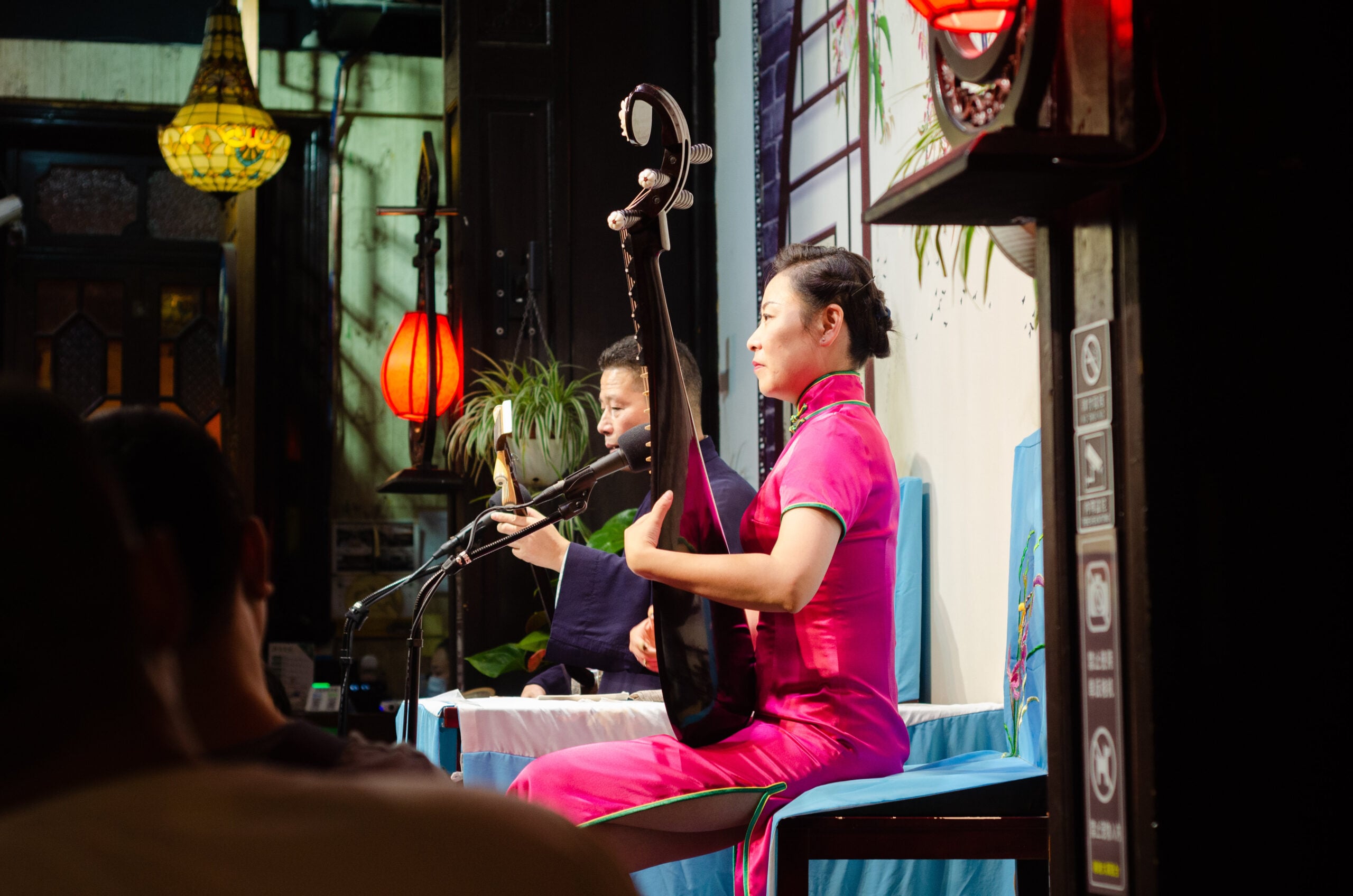
Pingtan performers with pipa and sanxian, photographed with venue permission
Kunqu: Theatre, Voice and Movement
Kunqu — 昆曲 is a theatrical tradition associated with the Suzhou and Kunshan region and recognised by UNESCO as intangible cultural heritage.
It combines singing, dramatic action and carefully shaped movement. Costume and gesture can communicate character and feeling even when the spoken or sung language is unfamiliar.
Kunqu and Pingtan Are Different Experiences
| Feature | Pingtan | Kunqu |
|---|---|---|
| General format | Spoken or sung storytelling | Theatre with singing and dramatic movement |
| Main focus for a first visitor | Voice, narrative delivery and musical interaction | Voice, gesture, costume and the unfolding scene |
| Helpful preparation | A story introduction or explanation of the programme | A synopsis and explanation of the characters |
| Comfortable first choice | A short musical or introductory session | Selected excerpts or a programme with accessible interpretation |
Some visitor shows combine several art forms. Read the programme to see whether you are attending a Kunqu performance, a mixed cultural presentation or a contemporary production inspired by traditional arts.
The China Kunqu Museum
The China Kunqu Museum — 中国昆曲博物馆, at 14 Zhongzhangjia Lane — 中张家巷14号, is close to the Pingtan Museum in the Pingjiang historic area.
An exhibition visit can introduce the tradition before a performance. Choose how much museum time fits your interest, particularly if you are also visiting the Silk Museum that day.
Check the current venue notice for opening hours, admission and any separately ticketed programme. A historic stage in a museum does not mean a performance takes place continuously.
Choosing a Performance
A programme of excerpts can be a practical first introduction. A full production suits visitors who want a deeper theatrical experience and are comfortable with its length and language arrangements.
Ask about subtitles or surtitles and which language they use. Chinese text alone may not resolve the language barrier for an English-speaking visitor.
Check whether the production is seated, standing or involves moving between spaces. Mention mobility needs before booking an immersive event.
How to Prepare
Read the synopsis and identify the main characters. During the performance, notice movement, changes in voice and the relationship between music and action.
Give the scene time to develop. You do not need to understand every line to appreciate the performance, but preparation helps you recognise what is happening.
Connect the Experiences with Suzhou’s Neighbourhoods
A cultural itinerary works better when you leave room between appointments.
Pingjiang Road and Its Side Lanes
The Pingjiang area is convenient for combining the Pingtan and Kunqu museums with a canal walk and a meal. Follow public lanes and allow time to find the actual museum or performance entrance.
A nearby tea stop can give you a break before a booked session. Do not assume every café or tea room presents the same kind of performance.
Shantang Street
Shantang Street can suit an evening walk, particularly if it fits your accommodation and transport plans. If you book music or a show there, check its own programme and location.
There is no need to cross the city simply to add another canal street after a full cultural day. Choose the neighbourhood that fits the confirmed activities.
A Garden as Part of the Day
A garden visit can complement textiles and performance by giving you another way to look at composition and craftsmanship.
Keep the combination selective. A large garden, several museums, a class and a full evening show can be too much for one day.
Suggested Cultural Itineraries
Option 1: A Relaxed Half Day
Silk Museum → lunch or tea → one confirmed short performance or beginner activity
Spend 60 to 90 minutes at the museum, take a break and allow a separate transfer to the next venue. Choose the order around actual opening and session times.
This is a useful introduction if you have already devoted another part of your trip to gardens.
Option 2: A Full Day in the City
Morning: visit the Silk Museum selectively.
Lunch: take a seated break before changing neighbourhoods.
Afternoon: explore the Pingjiang area and choose one performance museum or a booked craft session.
Evening: attend a confirmed short programme or take a canal walk, depending on your energy and interests.
You do not need to attend both Pingtan and Kunqu on the same day. Choose the one you most want to experience and give it your attention.
Option 3: An Embroidery-Focused Day
Morning: travel to Zhenhu and visit the confirmed exhibition or studio.
Midday: have lunch and a proper break.
Afternoon: take a scheduled beginner lesson or return to the city, depending on the appointment.
Treat this as a specialist day. Check the full transfer before adding any Taihu sightseeing or evening commitment.
Option 4: Two Days with Gardens and Culture
Day one: one major garden, a neighbourhood walk and an optional short performance.
Day two: the Silk Museum and a booked craft activity, or an embroidery-focused Zhenhu outing.
Choose between the city route and Zhenhu according to your interests. Trying to complete both versions may leave too little time for the activities themselves.
Booking Practicalities for Overseas Visitors
Reserve the Activity You Actually Want
A museum reservation, a performance ticket and a studio appointment are three different bookings. Admission to one does not automatically include the others.
Ask for a written confirmation with the date, start time, address, meeting point, inclusions and contact details.
For an activity arranged by a tour provider, confirm whether the provider books the session directly or only plans to inquire after arrival.
Check English Support
“English-friendly” can mean different things: translated signs, a guide accompanying you, an instructor speaking English or subtitles during a show.
Ask which applies. If interpretation is important, confirm that it covers the teaching or performance introduction rather than only the transfer.
Bring Identification When Required
Carry the original passport for bookings that require identity verification. Enter the same document details used to make the reservation.
If a platform does not support foreign documents, seek the appropriate operator procedure rather than entering someone else’s identity details.
Check Mondays and Holiday Notices
Many museum schedules include a weekly closure, while holidays can bring exceptions or extended opening. Check each venue individually.
Do not assume an old holiday announcement applies to your date. Studios and performances may follow a different calendar from museums.
Leave Time Between Appointments
Include venue exits, walking, transport and time to find the next entrance. A lunch break should be a real part of the itinerary rather than something squeezed into the transfer.
For an evening show after a day trip, consider dinner and the return to your accommodation as well as the performance itself.
Buying Silk or Embroidery: Practical Questions
Buying is optional. A cultural visit can be complete with learning, observation and participation alone.
If you want a souvenir or artwork, give yourself time to understand what you are purchasing.
Read the Material Information
Ask for the fibre composition of the item. “Silky,” “silk-style” and “silk blend” do not mean the same thing as a stated pure-silk composition.
Check separate components where relevant. For a quilt, for example, the filling and outer cover may use different materials.
Separate Material from Craftsmanship
A silk item can be machine-made, and a hand-embroidered item can use different materials. Ask independently about fibre, weaving, stitching, maker and place of production.
Touch and shine alone do not establish all of those details. Do not rely on a quick visual demonstration as proof of origin or value.
Ask About the Exact Piece
For embroidery, request information about hand and machine work, the artist or workshop, dimensions, framing and care.
If the work is expensive, take time to compare and obtain written details. A general story about the tradition is different from documentation about the object in front of you.
Check Packing and After-Sales Arrangements
Confirm what you will carry home, how a delicate item will be protected, and whether a framed work is practical for your luggage.
If shipping is offered, clarify the packing, delivery arrangements, charges and responsibility for damage. Check destination import requirements separately where relevant.
Keep the receipt and written description, and read any return or exchange conditions before paying.
Set Your Own Pace
A demonstration may take place inside a commercial venue. That does not oblige you to purchase.
If shopping is not part of your intended itinerary, tell the organiser before booking. Ask how long is devoted to interpretation and how much to browsing.
For a private cultural visit, a clear agreement about optional shopping helps everyone use the time as intended.
Experiences for Families and Older Travellers
With Children
Choose shorter sessions and a clear practical task. A simple printing activity or introductory stitch exercise can be easier to enjoy than a long sequence of technical explanations.
Ask about tool supervision, minimum age and whether the child needs an accompanying adult. Confirm what the child will actually do during the lesson.
For performances, a short programme with a story introduction may work better than a lengthy production. Follow the venue’s age and seating rules.
For Older Travellers
Plan seating, comfortable transfers and enough time for meals. Museum visits and performances can provide a useful change of pace from longer garden walks.
For a craft class, ask about lighting, magnification if available, and whether the task can be adjusted to the participant’s eyesight or hand movement.
Access Needs
Historic venues may have steps, thresholds or narrow routes. Check access to the exhibition, classroom, toilets and performance seating rather than assuming the whole building is accessible.
A venue with level entry may still offer an event that involves stairs or moving through several spaces. Explain your needs when reserving.
Photography and Visitor Etiquette
Follow photography signs in museums and exhibition spaces. Avoid flash where prohibited and do not lean on displays to obtain a closer view.
Ask before recording a craft demonstration or photographing an artisan closely. Some working processes, designs or commissions may not be available for public recording.
During a performance, follow the rules for photography and video. A short permitted snapshot is different from filming the programme.
Keep phones silent and arrive on time. If you need to leave during a performance, use an appropriate break or follow staff guidance.
Respect private homes and working spaces when exploring nearby lanes.
Common Planning Mistakes
- Treating all silk-related attractions as the same type of visit.
- Confusing woven patterns with embroidery.
- Assuming a museum includes a live demonstration or workshop every day.
- Booking a long storytelling programme without considering the language.
- Expecting every Kunqu show to provide English subtitles.
- Adding Zhenhu to a packed city day without calculating the transfer.
- Choosing a workshop without checking its actual project and materials.
- Assuming a cultural demonstration requires a purchase.
- Following temporary opening or festival notices from an earlier date.
Frequently Asked Questions
What is the best introduction to Suzhou silk?
The Suzhou Silk Museum is a useful starting point for history and context. Follow it with a confirmed demonstration or class if you want to understand the making process more closely.
Is silk the same as Suzhou embroidery?
No. Silk describes a fibre, while embroidery is needlework added to a ground fabric. A product’s fibre content and craftsmanship should be checked separately.
Is Kesi embroidery?
Kesi is tapestry weaving. Its images are constructed through the weaving process rather than stitched onto a finished ground fabric.
Can you try embroidery as a beginner?
Yes, when a suitable introductory session is available. Confirm the project, instructor, language, materials and realistic take-home result before booking.
Do you need to visit Zhenhu?
It is worthwhile for a focused interest in embroidery. For a short first Suzhou stay, a city museum and one central activity may be more practical.
Can overseas visitors enjoy Pingtan without speaking Chinese?
A short musical programme can be enjoyable through voice and instrumentation. A synopsis or introduction helps, particularly for narrative-heavy sessions in the Suzhou dialect.
Are Pingtan and Kunqu the same thing?
No. Pingtan covers spoken or sung storytelling traditions, while Kunqu is theatre combining singing and dramatic movement.
Are performances included in museum admission?
Do not assume so. Check the specific venue and programme; exhibitions, performances and workshops may have separate booking arrangements.
Will a museum visit include live silkworms or weaving?
Only if the relevant display or demonstration is available. Confirm seasonal living displays and scheduled activities before planning around them.
Are workshops offered in English?
Some may provide English instruction or interpretation, but this needs confirmation. Translated promotional text alone does not prove that the instructor speaks English.
Do you have to buy silk during a cultural tour?
No. Agree on the purpose and format of the visit when booking, especially if any part takes place in a retail venue.
Is this a good rainy-day plan?
Museums, classes and performances can work well in wet weather, provided venues are operating. Allow for the outdoor transfers and any severe-weather changes.
How much cultural sightseeing should you fit into one day?
One museum and one performance or hands-on activity usually provide a balanced first introduction. Leave time for a meal, transport and a neighbourhood walk.
Plan Your Suzhou Cultural Experience
Suzhou’s cultural traditions become more engaging when you give them time. Examine a textile closely, watch how a maker handles the material, or read a short story introduction before listening to a performance.
Choose a few experiences that match your interests and confirm what each one includes. A museum, a craft session and an unhurried canal walk can reveal a different side of the city from a day focused entirely on landmark sightseeing.
For help arranging an English-speaking cultural guide, a family-friendly workshop, an embroidery-focused outing or a wider Shanghai–Suzhou–Hangzhou itinerary, plan your trip with Discover East China Tours using the button below.