
Plan a comfortable Wuzhen visit with children or older travellers. Compare accommodation locations, check bridge steps and room access, organise luggage and build a flexible route with regular breaks.
Wuzhen can be a rewarding stop for a family travelling through East China. Canal views, traditional buildings and short cultural visits give different generations something to enjoy together. An overnight stay can also make space for a gentle evening walk and a slower morning before continuing to Shanghai, Hangzhou or Suzhou.
The practical challenge is the journey between those enjoyable moments. Stone paving, bridge steps, entrance queues, luggage transfers and the walk back to your room can take more energy than a sightseeing list suggests. A child who is happy after breakfast may need a nap by lunchtime. An older traveller who enjoys walking may still find repeated bridge crossings uncomfortable.
Plan Wuzhen around the least comfortable part of the journey: reaching the hotel, crossing steps and returning for a rest. Once those are manageable, choose a few experiences that fit comfortably around them.
This guide explains how to select an area and hotel, assess walking routes, use a stroller or mobility aid, organise luggage and build a visit that works for children, parents and grandparents.
Is Wuzhen a Good Choice for Your Family?
Wuzhen is worth considering if your group enjoys canal scenery, unhurried meals, traditional streets and the opportunity to stay somewhere with a different atmosphere from a large city.
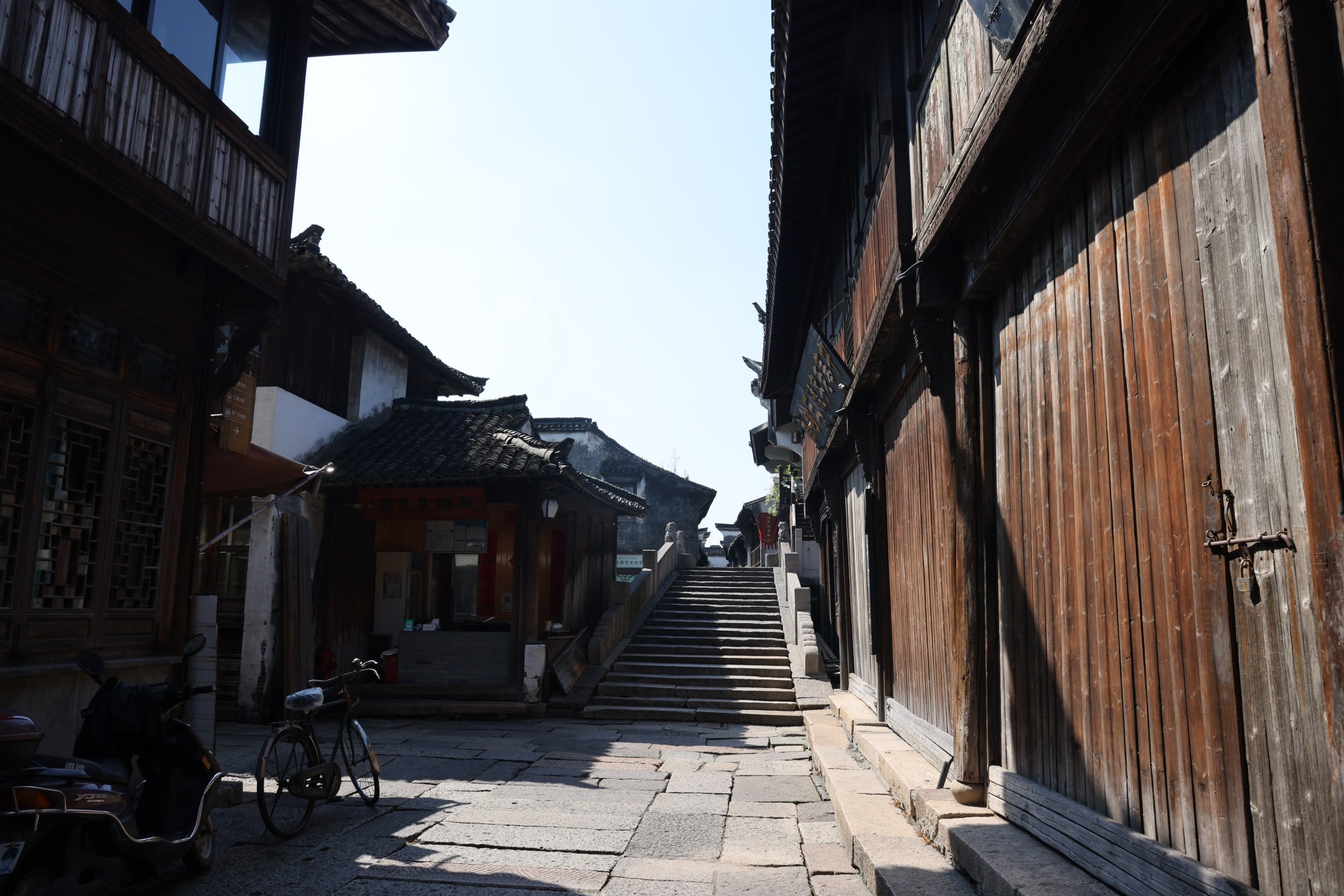
Check bridge steps as well as walking distance.
It is less straightforward when a traveller requires a continuously step-free route, cannot transfer from a wheelchair, or needs a particular accessible bathroom arrangement. Those needs require property-specific and route-specific confirmation before booking.
Age alone is a poor guide to suitability. Some grandparents will happily walk for longer than their adult children. Some younger travellers need frequent breaks or cannot use stairs. Ask about actual needs rather than assuming everyone of the same age wants the same itinerary.
Before choosing Wuzhen, discuss:
- How long each person enjoys walking before sitting down.
- Whether repeated short flights of steps are manageable.
- Whether uneven paving affects balance or comfort.
- Whether a child still needs a stroller or daytime sleep.
- Whether the group needs to return to the room during the day.
- Whether anyone needs a verified step-free route or accessible bathroom.
Treat the answers as booking requirements. A scenic room is less useful if reaching it makes the rest of the visit tiring.
The Main Planning Decisions at a Glance
| Your group’s needs | A useful starting plan | What to confirm before booking |
|---|---|---|
| Baby or toddler with a stroller | One main scenic area, short walks and a dependable nap break | Room access, stroller storage, cot availability and route steps |
| School-age children | Canal walks with one or two focused cultural stops | Age suitability, toilets, meal options and any activity booking requirements |
| Older travellers comfortable with some steps | A relaxed Xizha visit with frequent seated breaks | Hotel approach, staircase arrangements and transport stops |
| Traveller who finds stairs difficult | A limited route designed around verified access | Every important bridge, entrance, room and bathroom on that route |
| Wheelchair user requiring step-free access | Confirm suitability before committing to the visit | Continuous access, door widths, bathroom layout and vehicle boarding |
| Family carrying several large suitcases | Direct transfer or a simple rail journey with a planned final road transfer | Vehicle capacity, luggage handling and collection procedures |
| Several generations with different interests | Shared meals and a short common route, with optional separate outings | Meeting points, room proximity and communication arrangements |
These are planning starting points, not accessibility certifications. Adjust them to the individual traveller and the specific accommodation.
Choose One Main Area Before Adding More
Xizha for a visit built around an overnight stay
Xizha, also called the West Scenic Area, is a useful starting point if the family wants accommodation, dining and sightseeing arranged around the same part of Wuzhen. Staying within the scenic area can make a room break practical, provided the room is conveniently reached from your chosen route.
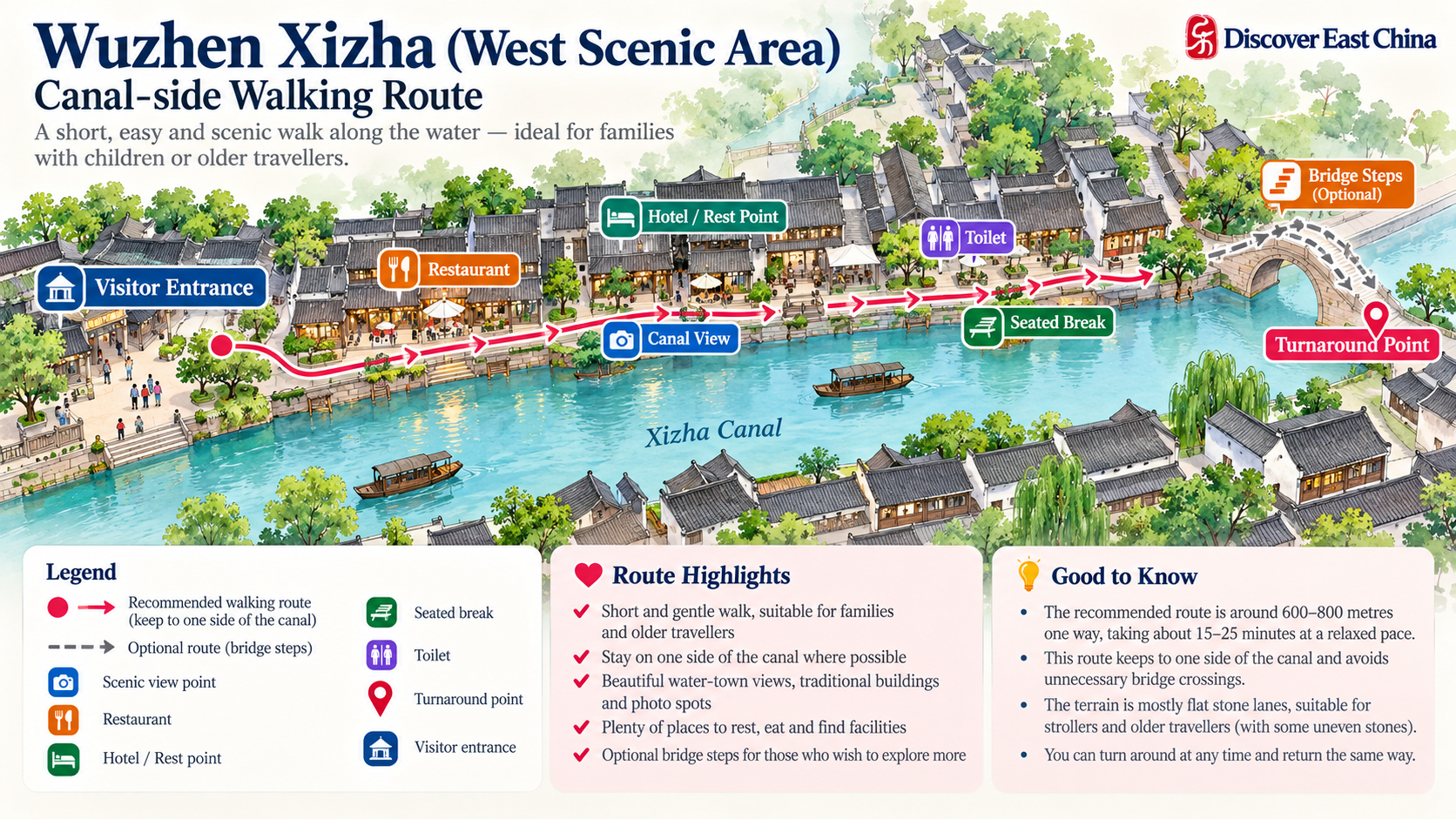
Choose a manageable canal-side section and allow time to return for a rest.
For children who need a nap, that can be more valuable than covering a second scenic area. For older travellers, it can allow daylight sightseeing, a proper rest and a short evening outing without a late journey back to another city.
Xizha is still a historic water-town environment. Do not interpret its visitor services as a promise that all paths, bridges or accommodation entrances are accessible.
Dongzha for a focused daytime visit
Dongzha, the East Scenic Area, can suit a family interested in traditional streets and selected cultural displays. Its smaller scale does not automatically make every part easier for a stroller or someone who finds steps difficult.
Choose the displays that interest your group and check their entrances. A short visit with a comfortable lunch afterwards may work better than trying to follow an entire recommended route.
You do not need to visit both
For a first family visit, one well-paced scenic area can be enough. Add Dongzha to an Xizha stay only if the group wants its particular displays and has the energy for another admission process and transfer.
An extra area adds more than its sightseeing time. It can involve packing up, finding transport, queueing, locating toilets and settling everyone into a new route.
Other resort or rural activities, including Wucun, should also be treated as separate choices with their own booking and access arrangements. Do not assume they are included in a standard scenic-area ticket or hotel booking.
Understand Bridge Steps and Walking Distance
A short route can still be demanding
A map mainly shows horizontal distance. It may say little about bridge steps, thresholds, uneven surfaces or the effort of pushing a stroller.
Two walks of the same length can feel very different. One may stay on a relatively direct stretch of street. The other may cross several bridges, enter buildings and require repeated lifting or careful stair use.
For a family route, assess three things together: walking distance, changes in level and the distance to the next reliable rest point.
Choose the next comfortable stop
Start with a short section connecting the hotel or entrance to a canal view, an interesting display and a suitable place to sit. Continue only if everyone is comfortable.
At each decision point, ask whether the next stop is worth the additional effort, including the return journey. Reaching a distant landmark is only half the task if the family must then retrace the route.
Avoid crossing a bridge simply because it appears on a suggested sightseeing circuit. It is reasonable to enjoy a view from one side and continue along a manageable route.
Ask about the route you will actually use
A general answer that an area is “accessible” is not enough when stairs are a concern. Ask the hotel or visitor service team about the specific route from your arrival point to the room, breakfast, a restaurant and the places you want to visit.
Useful questions include:
- Are there steps before reaching reception or the room?
- Can the route avoid arched bridges?
- Is any alternative route much longer?
- Are there raised thresholds at the selected buildings?
- Where can the traveller sit during the return journey?
A current photograph or short video can be more informative than a broad description. Ask for the approach as well as the inside of the room.
Keep a return reserve
Do not use all of the group’s energy on the outward walk. Leave enough for toilets, dinner and returning to the room or exit.
For someone who is unsure of their stamina, begin with less walking than you expect them to manage at home. Travel, unfamiliar paving and waiting can change how the day feels. Let the first outing show you whether a longer second outing is sensible.
Strollers: Helpful, but Not a Complete Solution
A stroller can help a child rest and reduce the need for an adult to carry them throughout the visit. It can also become awkward at steps, narrow entrances and boarding points.
Consider how you will use your own stroller before relying on it for the whole route. A model that folds easily may simplify transfers, while wheels suited to uneven paving can improve comfort. The best choice depends on your child, the equipment you already use and your ability to handle it.
Do not overload the handles with shopping or bags. Keep essential items in a small day bag that can be carried separately when the stroller needs folding.
Plan each step crossing
Where a stroller cannot roll through, arrange a safe alternative. Remove the child before carrying or moving the stroller across steps, and have another adult supervise the child when possible. Avoid lifting an occupied stroller over a bridge or balancing it on an escalator.
If one adult is travelling alone with a small child, the route deserves particular attention. A bridge that is manageable for two adults may be difficult when one person must supervise the child and move the equipment.
A familiar, appropriate carrier may help for selected sections, but it adds weight and heat for the adult. It should be an option you are comfortable using, not the only solution to an uncertain route.
Confirm loan equipment rather than depending on it
Visitor-service information has described stroller and wheelchair loans in Wuzhen. Before travelling, confirm the collection point, availability, equipment type, deposit, identification requirements and return arrangements.
A borrowed stroller may not suit every child’s age or size. If the child needs a particular model or dependable nap support, bringing familiar equipment can be easier than adapting to whatever is available.
Wheelchairs and Other Mobility Aids
A wheelchair loan and a step-free sightseeing route are different things. Equipment can reduce fatigue on suitable sections while bridges, thresholds and vehicle boarding remain barriers.
For a traveller who uses a wheelchair throughout the day, establish whether there is a continuous usable route between the arrival point, room, bathroom, dining and chosen sightseeing stops. Ask about surfaces, gradients and narrow sections as well as steps.
Clarify the traveller’s needs directly. Someone who can walk a few steps and transfer independently may have different options from someone who must remain seated in their own chair.
Do not leave essential access questions until arrival
If a booking description says “wheelchair available” or “accessible facilities,” ask what that means for the actual room category. It may refer to equipment or a public area rather than the guest room and bathroom.
Where relevant, request details of:
- Entrance and lift access, including any steps before the lift.
- Room and bathroom door widths.
- Space beside the bed and toilet.
- Shower access, seating and grab rails.
- The route to breakfast and the nearest usable toilet.
- Vehicle access and whether a passenger must transfer.
If the necessary conditions cannot be confirmed, change the property, shorten the proposed visit or choose another stop. A travel companion’s willingness to help does not replace suitable facilities.
Choose Accommodation by the Whole Journey to Your Room
Inside Xizha: useful when the room is easy to reach
Staying inside Xizha can give the family a convenient base for a midday rest and a short evening walk. It is particularly useful when you want to avoid travelling back to another city after sightseeing.
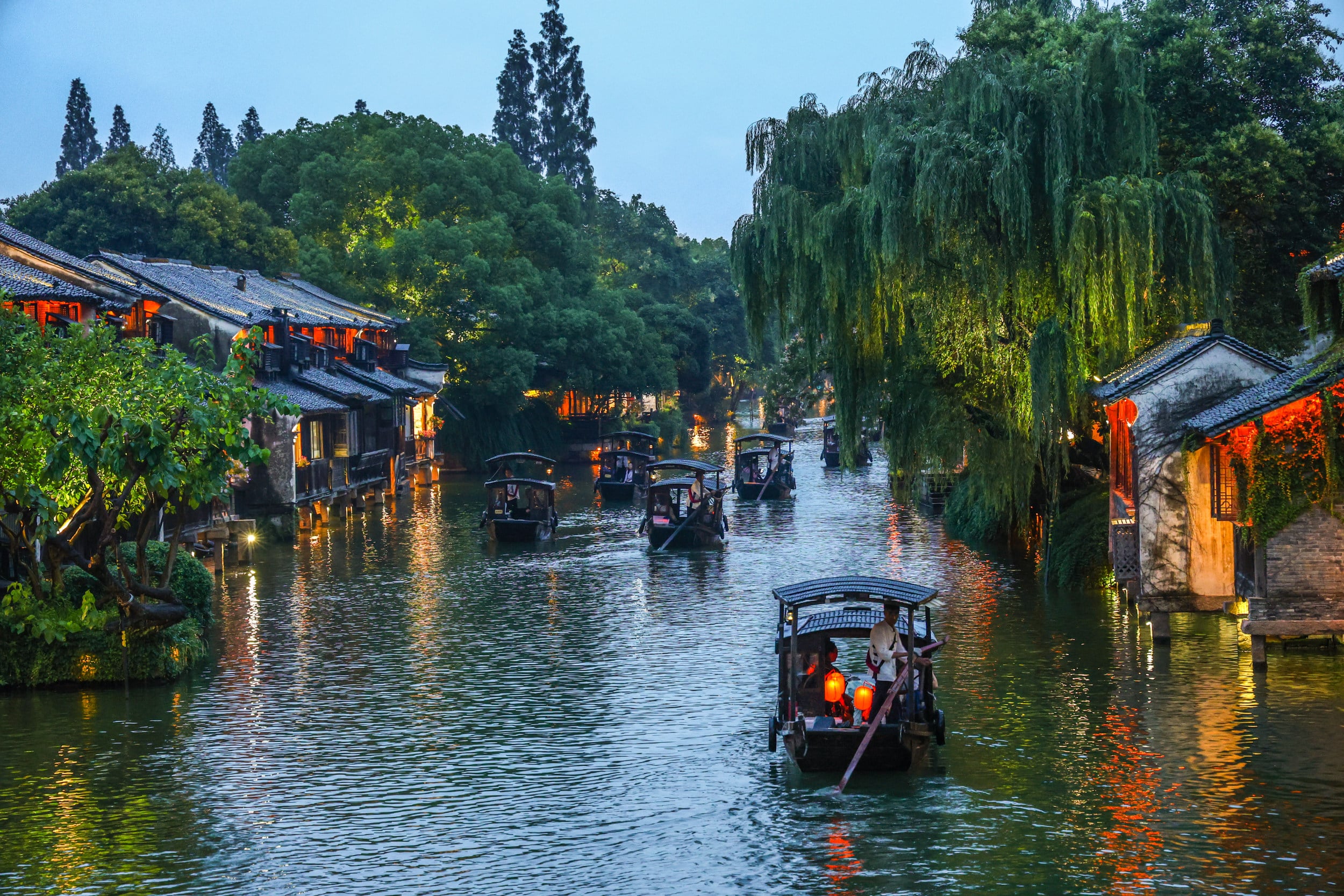
Keep evening sightseeing within a comfortable journey of the room.
However, properties differ. A traditional guesthouse may have stairs or thresholds. A larger hotel may offer a different layout, but its name or size does not establish access to a particular room.
The important location is the one connecting your room to the places you will actually use. A room near a manageable walking section and dinner can be more practical than a beautiful room far from your planned route.
Outside the scenic area: assess gate access and re-entry
An outside hotel may offer the room layout, lift, price or road access that suits the group. Check how you will reach the correct visitor entrance and return after an evening visit.
“Near Xizha” does not necessarily mean inside its controlled admission boundary. “Walking distance” does not explain whether the walk is comfortable with children, luggage or mobility needs.
If the family needs to leave for a nap and return later, confirm the ticket’s re-entry conditions before choosing an outside base. Do not assume a ticket, hotel stay or package includes unlimited entry.
Ground-floor rooms still need checking
A ground-floor room can avoid an internal staircase, but there may still be entrance steps, a raised doorway or a difficult bathroom. Ask for the entire arrival-to-bed route.
For a traveller who finds bathing difficult, bathroom design deserves as much attention as bed size. Request an actual photograph and a clear description of the shower arrangement.
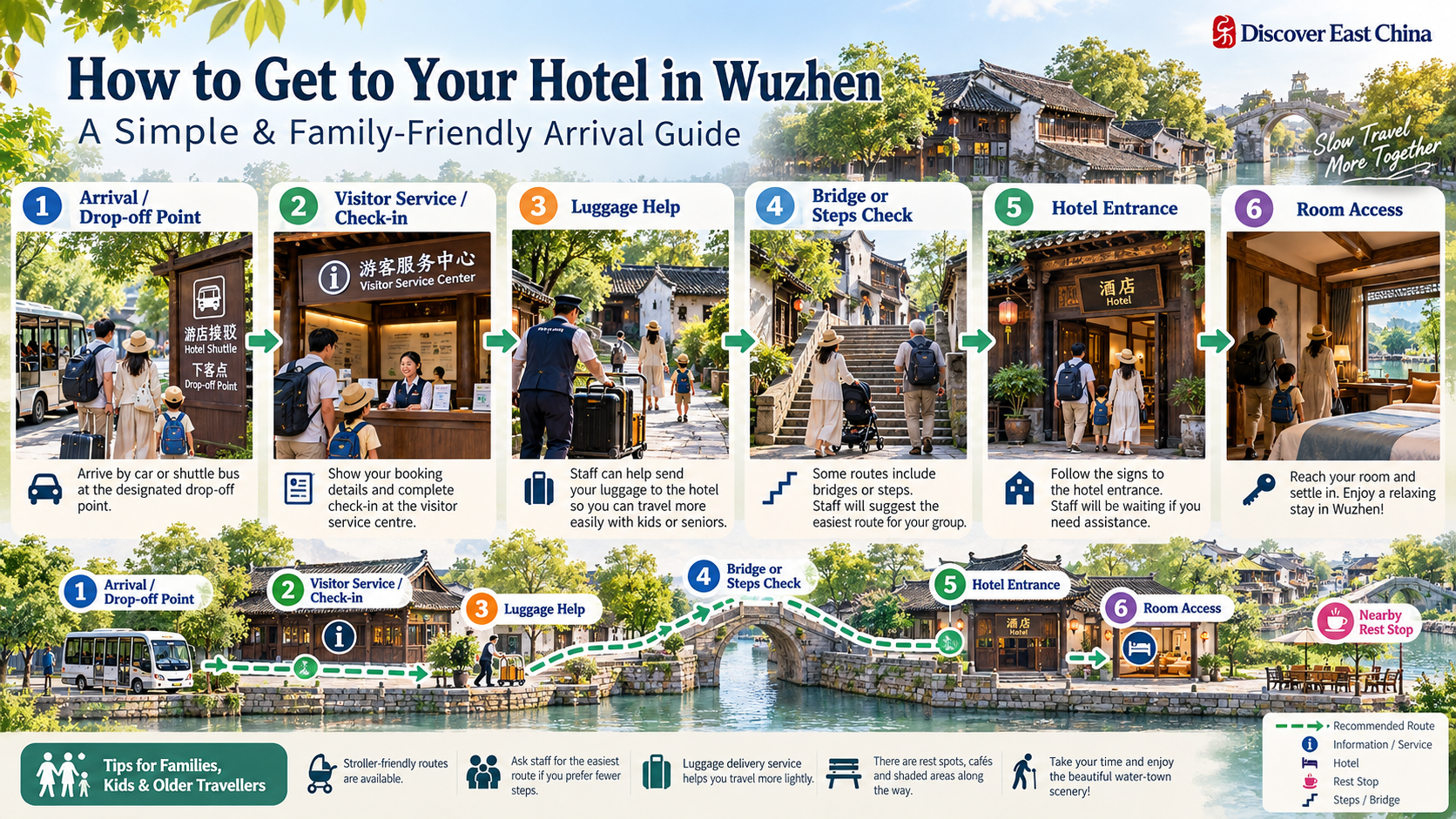
Check the whole room approach; a photograph alone does not confirm step-free access.
Quiet and convenience are separate requirements
A central waterside location may be convenient for sightseeing without being the best place for an early bedtime. Ask about nearby dining, evening activity, corridor noise and room orientation.
Similarly, a quiet room may sit farther from breakfast or require a longer walk. Decide which trade-off matters most to your family.
Confirm family room arrangements
Before paying, check the permitted number of occupants, bed configuration, cot or extra-bed availability, associated charges and breakfast arrangements for children.
Connecting rooms and adjacent rooms are not the same. If grandparents need to be close to the children, ask what can be confirmed and what remains a request. Request a non-smoking room when appropriate, and check the property’s current policies.
For overseas visitors, ensure the booking uses the correct passport details and that the property can complete check-in for everyone travelling.
Arrival, Luggage and Departure
Include the final road journey
If arriving by train through Tongxiang, remember that the station is separate from Wuzhen’s scenic areas. The family still needs a road transfer and an arrival procedure before sightseeing begins.
Compare the complete journey from your current hotel to the Wuzhen room. A short train ride can still involve a city transfer, station walking, security, luggage handling and another vehicle at the far end.
A pre-arranged direct road transfer may be worthwhile when it reduces changes for a larger family. Allow for traffic and confirm the correct drop-off point; an ordinary vehicle should not be assumed to deliver you to every accommodation door inside the scenic area.
Book a vehicle for people and luggage
Provide the number of adults and children, suitcase sizes and whether you have a stroller or mobility aid. A vehicle’s advertised passenger capacity does not establish that it can also carry all your bags comfortably.
Where a child requires an appropriate restraint, arrange it explicitly in advance and confirm the equipment available. Do not assume a standard taxi or transfer includes it.
Use luggage services with a clear collection plan
Xizha’s accommodation arrangements can include luggage handling for eligible stays. Confirm whether your property and booking qualify, where to hand over bags, expected delivery and how departure collection works.
Do not base the first outing on immediate access to a delivered suitcase. Keep passports, essential personal items, a change of clothing for children and anything needed for the next few hours with you.
Label bags, retain the receipt and confirm how many pieces were accepted. At departure, allow time to collect them before meeting the driver or leaving for the station.
Avoid sightseeing with large suitcases
Rolling luggage along stone streets while managing children or supporting another traveller makes a visit harder. Arrange hotel storage or an appropriate luggage service before starting the walking route.
If Wuzhen is a day trip from a city hotel, take a small day bag and leave larger luggage at that hotel where agreed. If it is an overnight stop between cities, choose a transfer plan that handles the luggage once rather than repeatedly moving it during sightseeing.
Rest, Toilets and Meals
Plan a seated break before fatigue becomes the problem
A good rest stop needs a usable seat, a comfortable environment and a location that does not add much walking. A photogenic café with a staircase may be less useful than an ordinary restaurant reached directly from your route.
Build a longer break into the middle of the visit. For an overnight family, this might mean lunch followed by a room rest. For a day trip, choose a suitable seated meal and shorten the afternoon route.
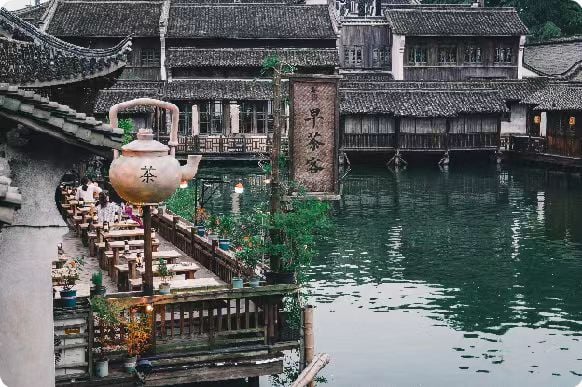
Plan a comfortable seated break before the group becomes tired.
Breaks are part of the day, not time left over after sightseeing. They allow everyone to enjoy the next section.
Find toilets before they are urgent
On arrival, ask for current toilet locations near your chosen route. Families with a baby should also ask about changing facilities rather than assuming every public toilet has them.
If someone needs a particular toilet layout, identify a suitable option before starting the walk. A nearby toilet on the map may involve steps or have a layout that does not work for that person.
Keep a small supply of tissues and familiar changing items in the day bag. Use a suitable toilet before a boat trip, transfer or longer walk.
Prefer a reliable meal to a long search
Choose a main meal near the route or room, and keep snacks as a supplement. Children and older travellers may find it tiring to walk between several busy restaurants looking for the ideal menu.
Ask about seating, access and dishes the group can comfortably eat. For a family meal, a mixture of familiar items and a few local dishes often works well.
Communicate dietary requirements specifically. “Vegetarian,” “no seafood” and “no nuts” need clear explanation, and serious food allergies require direct confirmation of ingredients and preparation. Do not rely only on a menu translation.
Carry drinking water and pause in shade or a suitable indoor space in warm weather. Keep the day flexible rather than pushing through a meal or rest time to reach another attraction.
Sightseeing That Works Across Generations
Canal views without a long circuit
Choose a canal-side section that your group can reach comfortably. Watching boats, noticing traditional buildings and taking a few photographs can provide a satisfying introduction without a comprehensive walking tour.
For children, give the walk a small focus: look for different bridge shapes, observe reflections or notice how buildings face the water. Avoid turning every stop into a lesson.
One cultural display with a clear interest
Select a display or demonstration that matches the family’s interests and has suitable access. Textiles, traditional household objects or craft processes may be easier to enjoy together than a long succession of exhibitions.
A demonstration is not automatically a hands-on workshop. Confirm age limits, duration, language support and booking conditions before promising a child that they will make something.
Keep shopping optional. A family can enjoy a cultural visit without adding a long souvenir-shopping session or buying anything.
Boats are an option, not the mobility plan
A canal boat ride can offer a different view and a seated experience. Boarding and disembarking may still involve steps, changes in level or a transfer into a low seat.
Before buying tickets, ask about the boarding point, route, whether the boat returns to the same place, and the walking required afterwards. A ride that ends elsewhere may add an inconvenient return journey.
Confirm arrangements for children, infants, strollers and mobility aids directly with the operator. Check suitable safety equipment and follow staff instructions. If boarding is uncomfortable or unsuitable, watching boats from the bank is a worthwhile alternative.
Do not assume a leisure cruise serves the same purpose as a shuttle boat or delivers you to the hotel.
Keep evening sightseeing short
Evening canal views can be a highlight of an overnight visit. Choose a nearby stretch and return while the children and older travellers still have energy.
Allow extra care at steps and canal edges after dark. A well-lit view does not mean every surface on the route is equally visible. Stay together through narrow or busy sections.
There is no need to make the evening walk as long as the daytime outing. A pleasant meal and a short stroll can be enough.
A Relaxed Overnight Plan
The following sequence is a flexible framework, not a timetable or a verified step-free route. Select the actual paths with the accommodation or visitor-service team.
Day 1: Arrive, settle in and explore one section
Arrive with time to complete check-in and organise luggage. If the room is not ready, choose a nearby seated meal or short outing rather than immediately beginning a long walk.
Once settled, explore one manageable canal-side section. Add a cultural stop if it interests the group and access is suitable. Return for a proper rest before dinner.
Have dinner within an easy journey of the room. If everyone feels comfortable afterwards, take a short evening walk. End the day early when a child needs sleep or another traveller has had enough walking.
Day 2: A gentle morning and an unhurried departure
Start with breakfast. A morning stroll is optional; families do not need to get up early simply to follow a suggested itinerary.
Choose one nearby section or revisit a favourite view. A familiar route can be more relaxing than finding another attraction before checkout.
Return with enough time to pack, use the bathroom, collect luggage and reach the departure point. Add Dongzha only if there is a genuine interest, sufficient time and a workable luggage arrangement. Otherwise, continue to your next city after a comfortable meal or short final walk.
A Practical Day-Trip Plan
A day trip works best when the total journey is manageable and the family can return before becoming overtired.
Choose one scenic area and arrange the arrival and return transfers first. On arrival, locate toilets and confirm the walking route. Follow a short first section, have a seated lunch and decide whether everyone wants another outing.
Leave a generous margin between finishing sightseeing and any booked train or onward transfer. Allow for the walk to the exit, equipment returns, luggage collection and boarding the vehicle.
If evening views are essential, compare an overnight stay with a late return trip. Staying can make the evening easier, but the additional hotel move may outweigh the benefit for a family already changing bases frequently.
Do not choose a day trip or overnight stay solely because one appears to offer more sightseeing hours. Choose the version with the more comfortable complete journey.
Adjust for Different Needs
Babies and toddlers
Prioritise naps, changing, familiar food and a manageable stroller route. Keep the day near the room or a dependable rest location.
Carry essentials separately from checked or transferred luggage. If the child sleeps poorly or becomes unsettled, shorten the outing rather than trying to catch up with the original plan.
School-age children
Offer a few choices within the route: a cultural display, canal views or a suitable activity. A small amount of participation helps them enjoy the visit without filling every hour.
Leave space for an ordinary snack or quiet break. A boat ride or workshop should remain optional until suitability and availability are confirmed.
Older travellers who enjoy walking
Plan around their preferences. They may value architecture, photography, food or a cultural visit as much as anyone else.
Keep opportunities to rest and shorten the route, without assuming that age requires a minimal programme. Ask which experiences matter most and spend the available energy there.
Travellers who find steps difficult
Remove optional bridge crossings and check accommodation access carefully. Base the route on confirmed usable sections, with the possibility of returning early.
Do not make a boat ride, a staircase or an uncertain shuttle connection essential to completing the day.
Several generations together
Agree on a short shared programme and meal times. Adults who want a longer walk can take one separately while others rest, provided meeting points and communication are clear.
Nobody needs to attend every optional outing. A comfortable family visit can include different activities between shared moments.
Rain, Heat and Busy Periods
Rain can make stone surfaces and steps more difficult. Shorten the route, avoid unnecessary crossings and choose indoor stops that are genuinely easy to enter. An umbrella does not solve slippery paving or a challenging hotel approach.
In hot weather, reduce exposed walking, use shaded or indoor breaks and keep the room rest substantial. For stroller users, use appropriate shade while maintaining ventilation; avoid covering the stroller with a blanket that traps heat.
During holidays and busy periods, queues and movement through narrow sections can add to the day’s effort. Stay flexible about boat trips and popular viewpoints, and agree on a clear meeting point in case the group separates.
A school holiday or national holiday does not automatically rule out Wuzhen. It does make convenient accommodation, early arrangements and a modest sightseeing plan more valuable.
A Message to Send Before Booking
Use a specific request that gives the property enough information to answer:
We are travelling with [number] adults and [number] children, aged [ages]. One traveller can comfortably walk for approximately [time] but finds repeated steps difficult. We will have [stroller or mobility aid] and [number and size of suitcases]. Please confirm the steps and surfaces between the arrival point, reception, our proposed room, breakfast and the nearest suitable toilet. Please also confirm the bathroom layout, luggage arrangements and any transport service that applies to this booking. Current photographs of the approach and bathroom would be helpful.
Adapt the message to the individual’s actual needs. Ask the provider to distinguish confirmed arrangements from requests that depend on availability.
Common Mistakes to Avoid
- Booking a scenic room before checking how everyone will reach it.
- Assuming a wheelchair loan means the whole area is step-free.
- Using distance alone to judge a route with bridge steps.
- Counting a boat trip as a guaranteed replacement for walking.
- Taking large suitcases into the sightseeing route.
- Adding both Dongzha and Xizha because a combination ticket is available.
- Assuming hotel bookings include admission, re-entry or every transport service.
- Leaving a room break, lunch or toilet stop until someone is exhausted.
- Planning a late return simply to include night views.
- Adding Wuzhen as another hotel move without considering the wider family itinerary.
Frequently Asked Questions
Is Wuzhen suitable for young children?
It can be, especially with short walks, regular meals and a reliable nap break. Check the stroller route and accommodation approach, and keep close supervision near canal edges and steps.
Is Wuzhen suitable for older travellers?
Suitability depends on walking ability, comfort with steps and the chosen hotel and route. Plan around the individual’s needs rather than age alone.
Is Wuzhen wheelchair accessible?
Do not assume the entire historic scenic area is continuously step-free. Confirm the precise route, room, bathroom and vehicle arrangements needed by the traveller before booking.
Can we bring a stroller?
A stroller can be useful on suitable sections, but steps and thresholds may require folding it or changing the route. Plan crossings and transfers in advance, especially if only one adult is travelling with the child.
Can we borrow a stroller or wheelchair?
Visitor-service information describes equipment loans. Confirm current availability, suitability, deposit, collection and return arrangements before depending on them.
Should families stay inside Xizha?
An inside stay can make rest breaks and a short evening outing easier. The benefit depends on the actual room location and access, so compare the whole approach rather than the accommodation label alone.
Is an outside hotel a poor choice?
An outside hotel may provide a more suitable room layout, easier road access or a better price. Check the route to the correct entrance, evening return transport and admission or re-entry conditions.
Are scenic-area shuttles included with accommodation?
Some accommodation arrangements include transport benefits. Confirm eligibility, routes, boarding requirements and current operating conditions for your booking. A shuttle stop may still leave a walk to the room.
Can hotel staff handle our luggage?
Luggage services can be available for eligible accommodation. Ask where bags are handed over, how delivery works and when to collect them at departure. Keep essential items with you.
Do we need to visit Dongzha and Xizha with children or grandparents?
No. One area with time for a meal, rest and a few enjoyable stops may be a better family visit. Add the second only if its particular attractions interest the group.
Will a boat ride make the visit easier?
It can provide a seated experience, but boarding and disembarking may be difficult for some travellers. Confirm access and the ending point before treating it as part of a low-walking plan.
How much walking should we plan?
There is no useful single distance for every family. Start with a short section and consider steps, surfaces, standing time and the return journey. Add more only when the group is comfortable.
Is one night enough?
One night can allow an afternoon outing, a rest, evening views and a gentle morning. A longer stay makes sense when your family wants additional rest or specific activities, rather than simply more attractions.
Can we include Wuzhen between Shanghai and Hangzhou?
Yes, if the transfers and extra hotel move suit the group. Compare the complete journey, luggage handling and check-in time with a day trip or another night in your existing base.
Plan a Wuzhen Visit Around Your Family
A good family visit gives everyone time to enjoy the canals without making bridges, luggage or the journey back to the room the main memory of the day.
Discover East China Tours can help you consider Wuzhen within a wider Shanghai, Hangzhou and Suzhou itinerary. Tell us the children’s ages, walking preferences, mobility requirements, luggage and the experiences your group most wants to enjoy. We can discuss a manageable route, accommodation requirements and transfer arrangements to confirm before travelling.