
Build on Jingdezhen's two-day city itinerary with a distinct third day. Compare a more focused workshop with Yaoli or Hanxi, and plan transfers, finishing arrangements and departure time.
Three full days in Jingdezhen give you a useful choice: keep the city’s core porcelain experiences and add a countryside day, or use the extra time for a more focused ceramic workshop. The value of the third day lies in that choice, rather than in adding another round of similar shops and exhibitions.
The two-day foundation remains straightforward. Start with porcelain history and the imperial kiln area, then explore contemporary creative life and, if it suits your route, try an introductory ceramic activity. A third day can take you into the village and production landscapes around Yaoli, or give a studio session enough time for individual instruction and a clearer learning goal.
For most first-time visitors, the countryside version offers the broadest contrast: two city days followed by one rural day. Choose the studio version when making ceramics is a main reason for the trip; move the main workshop to Day 3 instead of repeating a similar beginner session on Day 2.
This guide assumes three full sightseeing days. It explains how to build on the two-day core, choose the right third day and leave enough time for transfers, meals and departure. Specific workshops and rural services must be confirmed for your dates; the itinerary is a planning guide rather than a fixed package.
What Does the Third Day Add?
A third day can change the trip in three useful ways.
First, it gives the city visits more breathing room. You can absorb what you saw, keep a proper lunch break and avoid treating every creative district as compulsory.
Second, it lets you pursue one interest more deeply. A longer workshop can centre on a realistic project or technique, with individual feedback and a discussion of how the piece will be finished.
Third, it opens up the countryside without sacrificing the main city experiences. Yaoli can add village walking and a selected heritage or nature stop; Hanxi can offer tea-growing scenery and rural art.
The extra day is worthwhile when it creates one of these changes. It does not need to become a list of attractions that did not fit into the first two days.
Choose between Two Three-Day Routes
| Day | Countryside version: city, making and village scenery | Studio version: history, creative observation and focused making |
|---|---|---|
| Day 1 | China Ceramics Museum, then Imperial Kiln Museum and Taoyangli | The same historical foundation, paced to your interests |
| Day 2 | One introductory workshop, then selected Taoxichuan venues | Taoxichuan and one relevant exhibition or maker visit; gather ideas for the workshop |
| Day 3 | A full countryside outing, usually Yaoli with one selected addition | One longer, prearranged workshop or studio programme, followed by a modest local visit |
| Best for | First-time visitors wanting a varied city-and-country trip | Travellers who particularly want to learn, make or discuss ceramics |
| Main arrangement to confirm | Rural vehicle, route, lunch and return | Instructor, project, language, session structure and finishing |
Choose one version before booking the activities. Do not plan a full studio day and a full countryside circuit on the same third day.
If you want both in depth, allow another day or consider a multi-day stay built around the studio’s actual programme. Three days can be rich without trying to contain everything.
Is This Really a Three-Day Trip?
Three full days
Arriving the previous evening gives you the clearest version of this itinerary. Use three days for sightseeing, then leave after Day 3 only if the selected programme and departure allow a comfortable buffer.
For a countryside Day 3, a further night in Jingdezhen is often convenient. It lets you return for dinner and depart the following morning without tying the rural journey to an essential train.
Three calendar days with a midday arrival
A midday arrival removes a substantial part of the historical first day. Check in or store luggage, have lunch and choose one afternoon priority.
You can keep the countryside day, but you will need to reduce city sightseeing elsewhere. Alternatively, retain the city core and use the last day for a studio programme that fits the actual departure.
A departure morning is not an activity day
If you arrive on the evening of Day 1 and leave on the morning of Day 3, you have one full sightseeing day. Follow a shorter itinerary rather than borrowing the three-day title for a schedule that cannot support it.
Count the usable hours first. Booked entries, studio appointments and station procedures take precedence over a sample route.
Days 1 and 2: The City Core
The first two days provide the foundation for either route. For the full city schedule, introductory workshop choices and arrival-day alternatives, see the two-day Jingdezhen itinerary.
| Core experience | Suggested planning block | Purpose in the three-day trip |
|---|---|---|
| Jingdezhen China Ceramics Museum | About 2–2.5 hours | A broad collection-based introduction |
| Imperial Kiln Museum and nearby Taoyangli heritage area | About 2.5–3.5 hours combined | Production archaeology and a historical setting |
| Introductory workshop, countryside version only | About 2–3 hours including arrival and finishing discussion | A first encounter with making before the rural day |
| Selected Taoxichuan venues and public spaces | About 2–3 hours, with dinner additional | Contemporary work and the former industrial setting |
| Focused creative visit, studio version | A separately confirmed block | Observe a relevant technique or maker before the main workshop |

The imperial kiln area provides the historical foundation for either three-day route.
These are itinerary allowances, not official visit durations. Keep meals and transfers separate rather than letting them disappear into the activity blocks.
Day 1: establish the historical context
Visit the China Ceramics Museum — 景德镇中国陶瓷博物馆 — on an available day with entry confirmed. Choose a few objects or techniques to remember instead of trying to examine every display.
After lunch, continue to the Imperial Kiln Museum — 景德镇御窑博物馆 — and the surrounding Taoyangli area — 陶阳里. Look at the relationship between archaeological material, making and the finished objects introduced earlier.
Keep the late afternoon flexible. A nearby walk, a seated break or an early return to the hotel can help you enjoy the next two days.
If two museum visits are too much for the group, choose one as the main stop and shorten the other. Do not use the extra day as a reason to increase every day’s intensity.
Day 2 in the countryside version: one introductory activity
Book one suitable morning workshop. Wheel throwing, hand building or decorating a prepared piece can each work, provided the session and language arrangements fit your needs.
Use the afternoon for selected Taoxichuan venues and a short architecture walk. Dinner can lead into an evening outing if the shops or event you want are operating.
Finish at a reasonable time if you have an early rural departure the next morning. A late market is optional, and should not make the third day uncomfortable.
Day 2 in the studio version: observe before making
Move the main hands-on session to Day 3. Use Day 2 to look more closely at contemporary work, a relevant exhibition or one confirmed maker visit.
Notice forms, surfaces and decorative choices that relate to the project agreed with your instructor. A small selection of observations can be more useful than browsing many unrelated shops.
A maker appointment is different from ordinary retail browsing. Confirm access and whether someone can discuss the work with you; do not assume every studio welcomes unscheduled visitors.
If you already used Sanbao on Day 2
Sanbao — 三宝 — can be a good studio setting, but the third day should still add something different. Choose the rural version, a clearly distinct specialist activity or more traditional production context.
Do not label another general Sanbao visit a deeper experience solely because it occupies more hours. Define the new purpose first.
Day 3, Route A: Yaoli and One Countryside Focus
For many first-time visitors, this is the strongest extension of the two-day city route. A village walk and one selected surrounding area provide a contrast in setting while keeping the porcelain story connected.
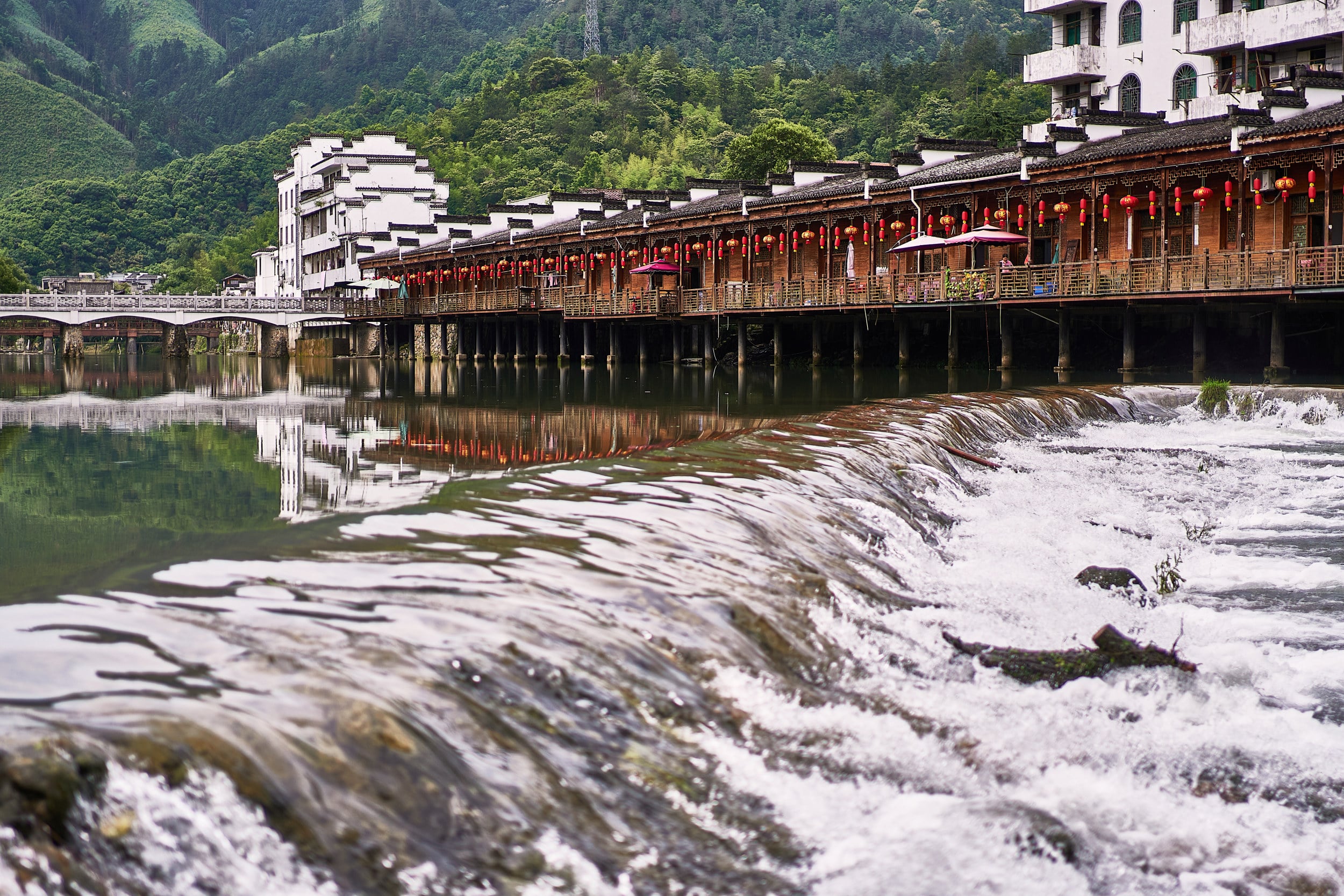
Allow time for a riverside village walk before choosing one surrounding stop.
What Yaoli adds
Yaoli Ancient Town — 瑶里古镇 — offers riverside lanes, historic architecture and a village-centred meal stop. The wider destination includes separate ceramic-heritage and natural areas.
The visit can explain that Jingdezhen’s porcelain story extends beyond museum collections and urban workshops. Materials, production and transport also belong to a rural landscape.
At the same time, you can enjoy the village without turning the whole day into a technical lesson. Choose the balance that suits your group.
Morning: transfer and a village walk
For an arranged car from central Jingdezhen, use approximately one to one-and-a-half hours each way as an initial transfer allowance. Obtain a current estimate from your actual hotel before finalising the day.
Leave after breakfast and allow around two to three hours for a public-path village walk, photographs and a short break. Start with the river and a selection of lanes rather than trying to complete every possible circuit.
If an open heritage building interests you, visit it selectively. Respect residential spaces and ask permission before close-up photographs of residents.
Midday: a proper lunch
Allow around an hour for a seated meal in or near the ancient town. Choose an open restaurant that fits the route and can prepare suitable food for the group.
Explain chilli preferences and any ingredients you avoid. Keep a familiar option available for children or travellers who prefer a simpler meal.
Lunch is part of the day, not spare time between transfers. Arrange it before the group becomes hungry, particularly when the afternoon involves a forest route.
Afternoon: choose heritage or nature
| Addition | Why choose it? | Initial on-site allowance | Main question to confirm |
|---|---|---|---|
| Raonan — 绕南 | Ceramic-production remains and water-powered material processing | About 1–1.5 hours | What is accessible and whether interpretation is available |
| Dongbu — 东埠 | A shorter historic wharf and village stop connected with material transport | About 45–90 minutes | The relevant public route and vehicle access |
| A selected Wanghu route — 汪湖 / 汪胡 | Forest and waterfall scenery | About 2–3 hours | Trail length, steps, conditions and entry requirements |
| More time in the ancient town | A lighter day with less driving | Flexible | A comfortable return time and pickup point |
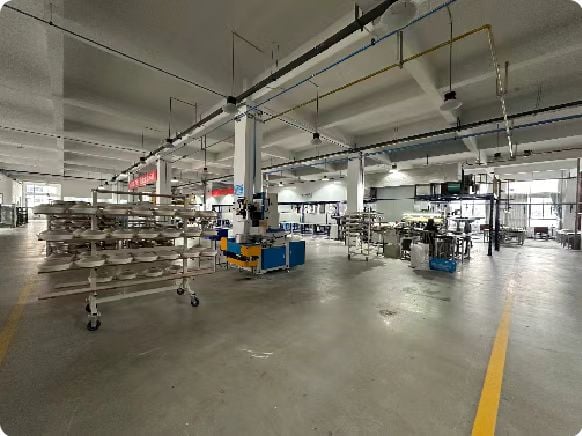
Raonan adds a production-heritage focus; current access and interpretation need checking.
The allowances exclude transfers between areas. The ancient town and these additions are separate stops; obtain a combined route estimate.
For a full village visit and a longer Wanghu walk, the day can become substantial. Reduce the morning programme or consider an overnight stay rather than trying to keep every element at full length.
Late afternoon: return to Jingdezhen
Agree the pickup and departure time in advance. Reserve time to walk back, use toilets and meet the vehicle without rushing.
For Yaoli plus one addition, allow roughly eight to ten hours hotel to hotel as a starting framework, adjusted to the chosen route. An ancient-town-only outing can be shorter, often around six to eight hours with lunch and the return drive.
These are private-vehicle planning ranges, not guaranteed timings. Keep the evening flexible and leave a substantial buffer if travelling onward.
Alternative Rural Day: Hanxi for Tea Landscapes and Art
Choose Hanxi village — 寒溪村 — and the Shiziyuan area — 史子园 — when you want tea-growing countryside and rural art rather than a full ancient-town programme.
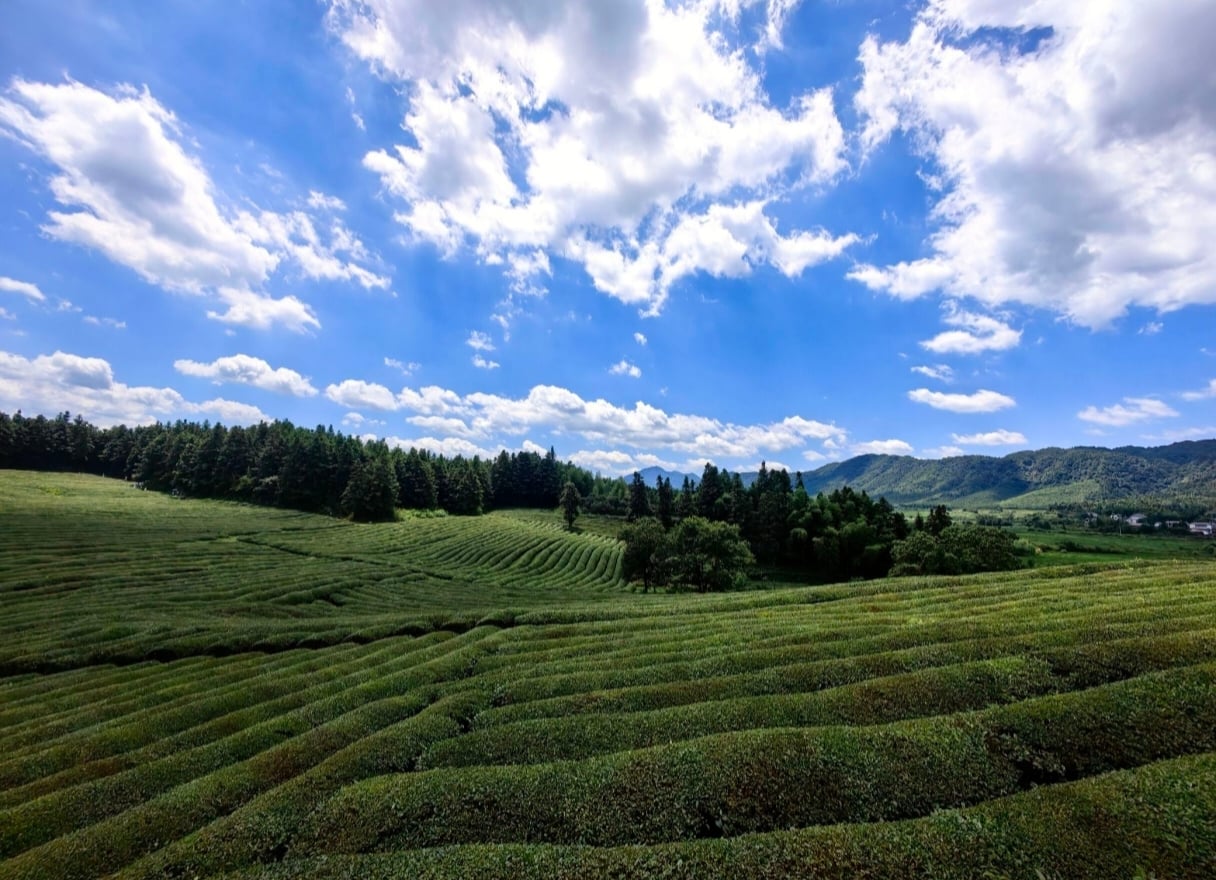
Choose a permitted route through the tea-growing countryside near Hanxi.
What makes this a different third day?
After city museums and ceramic making, a landscape-led outing provides space to walk and look. Art in a rural setting can offer another perspective on contemporary creative activity without repeating Taoxichuan’s former-factory environment.
Check the art and public routes that are currently accessible. A past exhibition image is not a guarantee that a particular installation can be visited during your stay.
A manageable sequence
Travel after breakfast, take a permitted village and tea-landscape walk, and include the accessible art that interests you. Have lunch and leave time for rest or a separately confirmed tea activity before returning.
Allow roughly five to seven hours hotel to hotel for a focused visit with lunch and arranged transport. Confirm the actual route, starting point and transfer before adopting that estimate.
Tea harvesting, tastings and guided farm access need their own arrangements. Do not enter planted areas or assume that a countryside walk includes an organised tea experience.
Should you also include Yaoli?
A combined route is possible, but it reduces time in each place and adds another transfer. Choose it only after reviewing the full day and deciding what will be shortened.
For most first-time visitors, either Hanxi or Yaoli can provide enough contrast. The third day should feel different because of the experience, not because of a longer list of village names.
Day 3, Route B: A More Focused Workshop
A deeper workshop should change what you learn or make. A second session repeating the same beginner activity is not automatically a better use of the third day.
Choose this version when ceramics are a main interest and a suitable instructor can confirm a realistic programme. Move the main workshop from Day 2 to Day 3 unless the two sessions form an explicitly planned course.
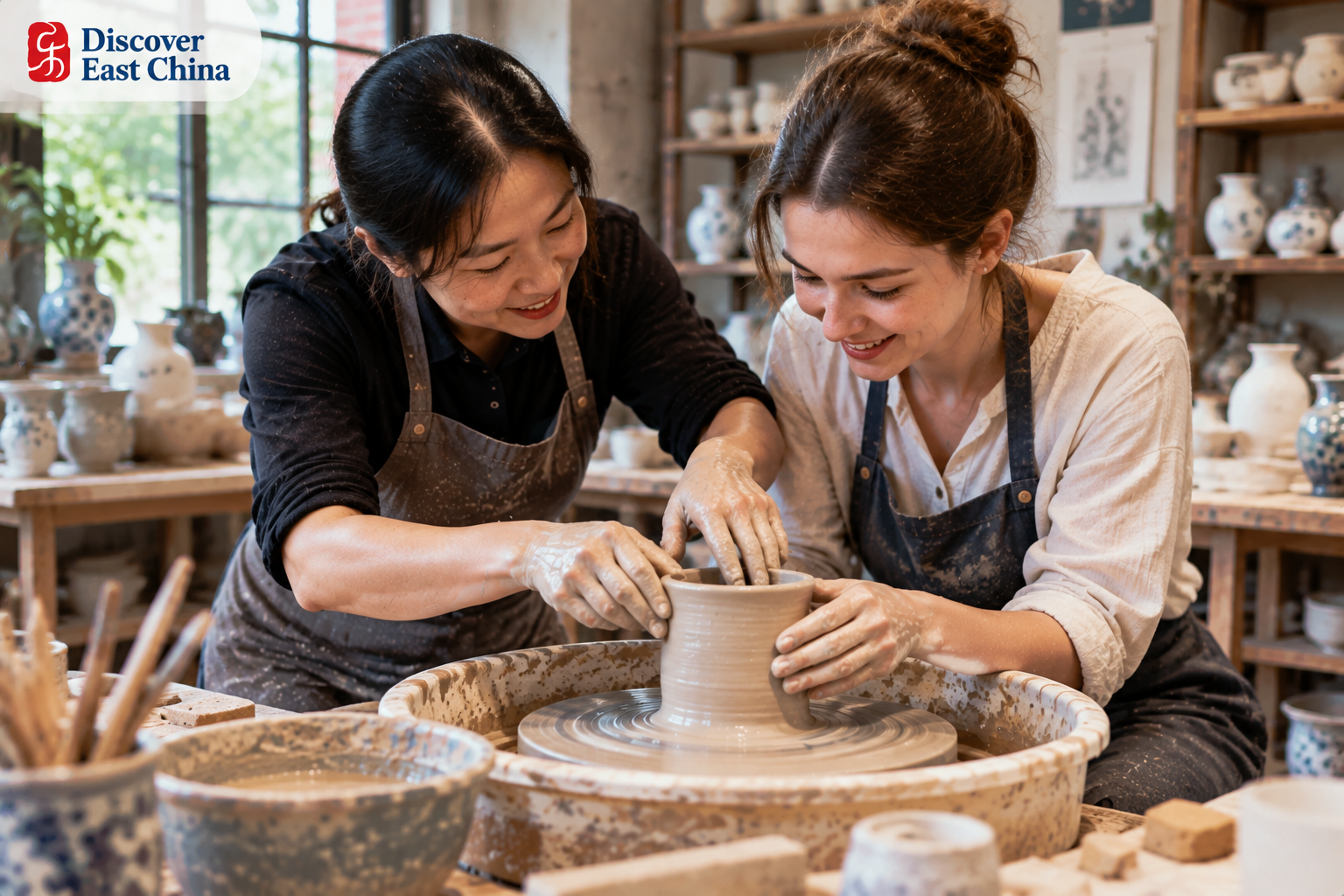
A focused studio day needs an agreed learning goal and suitable instruction.
Define a learning goal before choosing the studio
A useful booking request explains what you want to attempt and your previous experience. Possible goals include making a more controlled simple form, building a small hand-built project or exploring a decorative approach on an appropriate prepared surface.
The instructor should decide what is realistic within the available time. A longer session can provide more practice and feedback, but it does not make a visitor proficient in every stage of porcelain production.
| Interest | A possible session focus to discuss | What must be agreed |
|---|---|---|
| Shape and control | Guided practice making a simple vessel | Clay, equipment, assistance and the intended result |
| A small personal project | Hand building with a defined form or theme | Project size, technique, tools and achievable completion stage |
| Decoration | An introduction to a suitable painting or surface process | The prepared form, materials and subsequent firing requirements |
| Understanding a maker’s process | A studio conversation and a relevant demonstration | Access, interpretation, photography and whether making is included |
| Some previous ceramic experience | A session tailored to one skill | Prerequisites and the instructor’s ability to support that goal |
These are programme ideas for enquiry, not confirmed classes at a named provider.
A suggested studio-day structure
Begin with a short briefing and demonstration, then spend the main morning block on guided practice. Take a proper lunch break if the programme continues afterwards.
The afternoon can include further practice, feedback or a discussion of the next production stages. Allow a total studio-day block of around five to seven hours including lunch and practical discussions, subject to the actual programme.
Some providers may offer a shorter session that suits you better. The learning goal matters more than meeting a particular hour count.
Keep any later visit modest: a nearby exhibition, a short walk or time to compare the maker’s finished work with what you attempted. Do not add another full museum programme simply because the studio closes early.
Sanbao or another city-area studio?
Sanbao can suit a studio-led day if the chosen provider and surroundings support the experience. Its destinations are scattered, so use the exact address and agree the return pickup.
A city-area studio can also be suitable and may simplify meals, transfers and departure. Do not choose by district reputation alone: the instructor, teaching language and programme are more important.
If you already spent considerable time in Sanbao, choose a different studio only for a clear difference in activity or instruction.
Confirm What the Workshop Actually Includes
Teaching and group size
Confirm the instructor, language, participant numbers and how individual help will be provided. A bilingual booking message does not establish that the session itself will be taught in English.
For mixed experience levels, ask how the instructor will adapt the programme. Families also need age guidance, supervision requirements and suitable project choices.
Materials and the completion stage
Ask what material you will use and what you will complete during the booked time. Shaping, trimming, decorating, glazing and firing are separate stages; one day should not be presented as a guaranteed complete production cycle.
A studio may use prepared forms or work completed earlier to demonstrate later stages. That can be useful, provided it is explained clearly and not mistaken for your own freshly made piece.
A third sightseeing day does not guarantee that work made on Day 2 will be dry and ready for the next process. A planned two-session programme must have realistic drying and preparation arrangements.
Finishing and delivery
Before paying, clarify which pieces will be kept, who completes the remaining work and whether you can choose the finish. Confirm estimated completion, collection, packing and shipping charges.
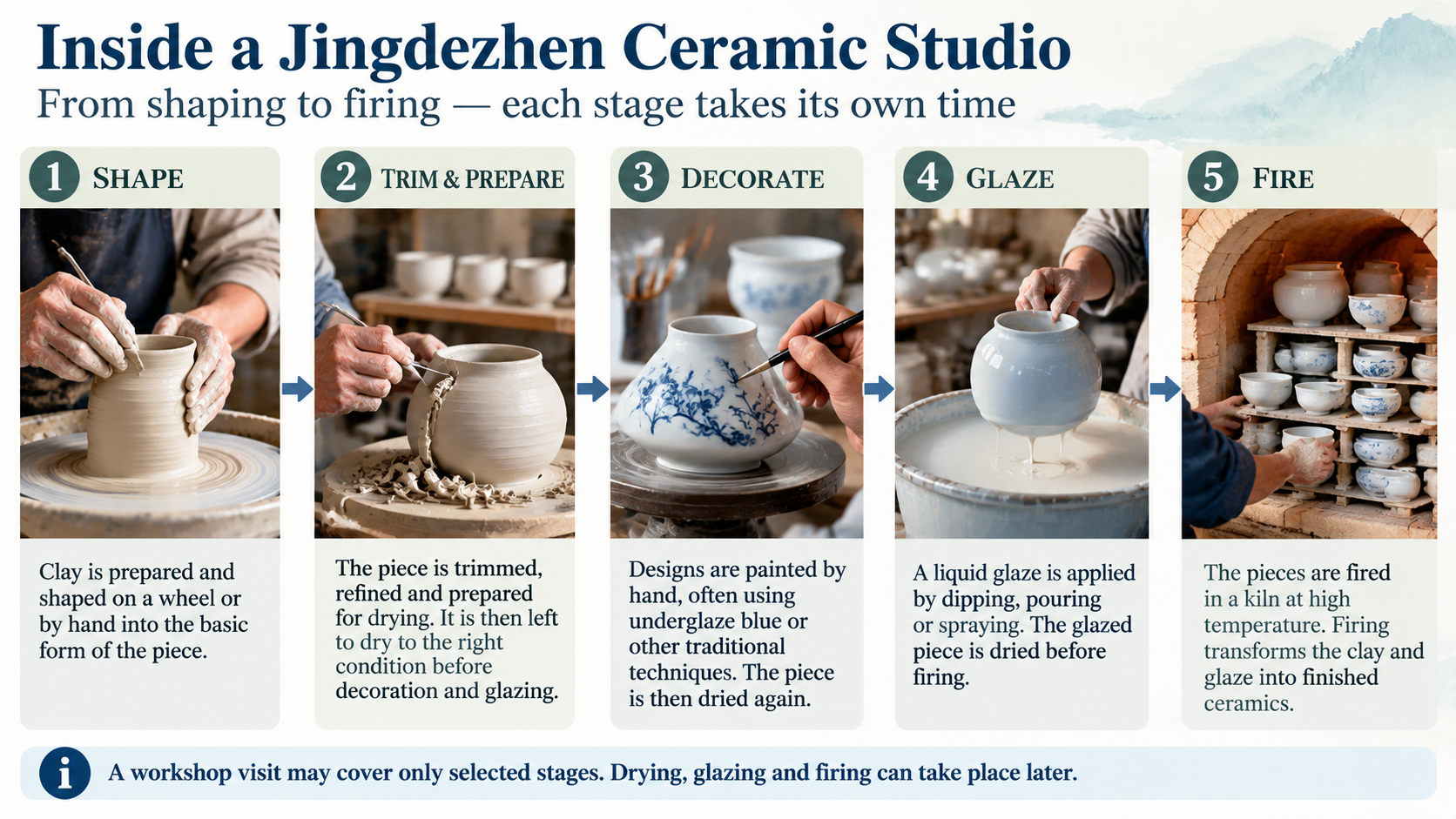
Trimming and later finishing are separate stages; agree who completes them and how the piece is delivered.
International delivery must be agreed specifically. A domestic delivery service does not establish that the provider can send work overseas.
Ask what happens if a piece cracks or fails during firing, and how damage during delivery is handled. Keep the booking record and provider contact details.
What makes the day more than a longer beginner class?
Look for a clear goal, time to practise, individual feedback and an explanation of what follows. A studio conversation can add value when it connects your own attempts with the maker’s work.
More time is useful when the programme uses it well. An expensive or lengthy session without a defined purpose may add less than a well-taught shorter workshop.
A Third-Day Alternative: Traditional Production Heritage
If you want more process knowledge without another hands-on session or a rural drive, consider the Ancient Kiln Folk Customs Museum area — 古窑民俗博览区.
This is a city-based production-heritage option. It can complement collection and archaeology visits through kiln structures and traditional craft context.
Choose it when you want to understand stages and working spaces rather than make another object. Confirm admission, the current visitor route and any demonstration you particularly hope to see.
Allow approximately two-and-a-half to three-and-a-half hours for a selected visit, plus transfers and a meal. A lighter afternoon can then suit travellers who have had two active days.
Do not combine it automatically with a long workshop. Both deserve attention, and any firing or timed activity must be verified separately.
How to Choose Your Third Day
| Your situation | Best starting choice | Why |
|---|---|---|
| First visit, with no strong specialist preference | Yaoli village-centred day | Adds a clear rural contrast to the city core |
| Particularly interested in tea scenery or outdoor art | Hanxi-focused day | Keeps the outing landscape-led |
| Making ceramics is a main reason for the trip | Focused studio day | Allocates time to instruction and practice |
| Already completed a substantial workshop | Rural day or production-heritage visit | Avoids repeating a similar activity |
| Already used Day 2 for Sanbao | A different rural or process focus | Adds a new purpose rather than another general studio visit |
| Prefer less travel or have limited stamina | City-based studio or Ancient Kiln visit | Simplifies transfers and gives greater control over pace |
| Leaving early on Day 3 | A shorter confirmed city activity | Protects the departure rather than forcing a full-day excursion |
The choice is about the trip as a whole. If the first two days already feel full, use the third day to give one experience more space rather than increasing the total activity count.
Book the Fixed Parts before Filling the Gaps
Start with your arrival and departure details, then identify the activities with the least flexibility: museum admission, a studio appointment or the rural return transport.
Confirm the China Ceramics Museum’s current opening days and reservation procedure. Monday arrangements and holiday exceptions need checking. Overseas visitors should establish the passport booking and entry process directly with the museum before fixing this visit. The museum’s official reservation notice specifies physical Chinese identity-card verification; it does not establish the procedure for foreign passports.
Check the Imperial Kiln Museum and the wider Taoyangli area’s admission separately. Save the correct entrance for your intended visit.
For workshops, obtain the actual address and appointment details before arranging the adjacent creative visit. For the rural day, confirm the vehicle, site access and return before making an evening commitment.
The numbered days can be swapped. A countryside day on Day 2 and a workshop on Day 3 may be sensible if museum closures or teaching availability require it.
Do not move a booking-dependent activity without first confirming that the alternative date works.
Hotel Base, Transfers and Luggage
Keep one city hotel for the standard route
A base near Taoyangli or Taoxichuan can work for the three-day plan. Choose according to the city experiences and evenings you most want, then arrange transfers between clusters.
Keeping one hotel simplifies the rural excursion: take a small day bag and leave large luggage behind. Confirm storage if you check out before an activity.
A Sanbao-area stay can suit a studio-led trip, but compare the transfers to your historical visits and departure point.
Rural transport is a separate arrangement
An arranged car can simplify Yaoli or Hanxi because the return and any local connections can be agreed in advance. Confirm waiting time, route, total cost and additional charges.
A driver and an English-speaking guide are different services. Decide whether you need interpretation as well as transport, particularly for ceramic-production remains.
Public transport may suit a single destination, but confirm the travel-day departure and last return. Add terminal transfers and waiting time to the itinerary; private-car time allowances do not describe a coach outing.
Departure needs its own buffer
Jingdezhen North Railway Station — 景德镇北站 — and Jingdezhen Railway Station — 景德镇站 — are separate stations. Use the exact name on your ticket.
Count luggage collection, the station or airport transfer and entry procedures in addition to sightseeing. A rural return estimate is not a safe substitute for that calculation.
If you have a late departure after a workshop, agree how the session ends and avoid adding discretionary stops when the available time shrinks.
Adapt the Three Days to Weather and Walking Needs
If the countryside day has poor weather
Check whether the planned public paths and trails are open. Shorten exposed walking and replace a forest excursion if conditions require it.
A studio day may be a suitable alternative only when access and teaching can actually be arranged. Do not assume a provider can accept a last-minute full-day booking.
A confirmed city exhibition or production-heritage visit can also work. Keep a practical alternative identified, while respecting booking and cancellation terms.
Families
Choose one hands-on project that suits the children’s ages, and ask about supervision. A longer studio day should include breaks and realistic attention demands.
For the rural version, use a manageable village walk and make the afternoon addition optional. Agree a dependable meal rather than relying entirely on snacks.
Keep children close beside water and around equipment. A successful family trip does not require every person to complete the same quantity of sightseeing or making.
Older travellers and mobility needs
Check route surfaces, steps, toilets and seating separately for each venue. An ancient town, creative district and studio have different access questions.
Request convenient vehicle pickup and choose fewer transitions. A village and lunch can provide a complete rural outing without adding a demanding forest route.
For a studio day, confirm seating, working height and the physical demands of the activity. Wheel throwing is not automatically suitable simply because it is done seated.
When Three Days Are Better than Two
Choose three days when you want the city core plus a distinct extension, or when a particular studio programme justifies the extra time.
Stay with two days if the additional day would only repeat similar browsing, if your main studio activity cannot be arranged, or if the rural drive does not match your preferences.
Three days do not make pottery finishing predictable, eliminate reservation requirements or guarantee access to a maker. What they provide is room for better pacing and a more deliberate choice.
If you want both a substantial studio programme and an unhurried rural visit, consider four full days. That is often a more honest plan than attaching both to the same third day.
Common Planning Mistakes
- Repeating the same beginner workshop on Days 2 and 3 without a learning goal.
- Adding a full rural circuit after a substantial morning class.
- Treating three partial calendar days as three full sightseeing days.
- Assuming an extra night guarantees that pottery will be ready to collect.
- Booking a studio by location alone without confirming the instructor or programme.
- Confusing ordinary shop access with an artist appointment.
- Expecting every countryside heritage site to offer operating equipment or demonstrations.
- Using private-car allowances for a public-transport itinerary.
- Planning a tightly timed train after the rural return.
- Filling the third day before deciding what it adds to the first two.
Frequently Asked Questions
What is the best three-day itinerary for a first visit?
Use the first day for history, the second for a workshop and contemporary creative life, and the third for a focused rural outing. Choose the studio version instead when making ceramics is a main interest.
How does this differ from the two-day itinerary?
It gives the third day a distinct purpose: a substantial countryside experience or a more focused workshop. The studio version also moves the main hands-on session to Day 3 to avoid duplication.
Should we choose the countryside or workshop version?
Choose countryside for variety of setting and village or landscape time. Choose the workshop version for a clearly agreed learning goal and suitable instruction.
Do we need two workshops?
No. One well-chosen workshop is enough for many visitors. Two sessions make sense only when the provider has designed them as a complementary programme.
Can we finish and collect pottery within three days?
Do not assume so. Drying, finishing and firing depend on the actual process and studio schedule. Confirm collection or shipping before booking.
Is a longer workshop suitable for beginners?
It can be if the programme is designed for beginners, with appropriate projects, breaks and individual help. More hours alone do not make a session suitable.
Is English instruction available?
Confirm it with the actual instructor or provider. English booking support does not establish the language used during teaching.
Is Yaoli a realistic third-day trip?
Yes, with a full-day allowance and confirmed transport. Choose the ancient town and one addition rather than every surrounding area.
Should we choose Yaoli or Hanxi?
Yaoli suits a riverside village and nearby heritage or forest options. Hanxi suits tea landscapes and currently accessible rural art. Either can be the main countryside focus.
Can we do a deep workshop and Yaoli on Day 3?
Treat them as alternatives. A substantial studio programme and a full Yaoli outing are better given separate days.
Is Sanbao compulsory?
No. Choose it for a particular studio or setting. A suitable workshop elsewhere can also support the studio version.
What if we already visited Sanbao on Day 2?
Choose a different third-day purpose, such as countryside or traditional production heritage, unless a specific new studio programme adds something distinct.
Can the itinerary work when one day is Monday?
Check closures individually and swap the days around confirmed museum and studio availability. Do not assume the same opening pattern applies to every venue.
What if we arrive around midday?
Reduce the first day’s programme and reassess the whole route. Keeping a full rural day means making choices elsewhere; it does not create more city time.
Can we depart on the evening of Day 3?
Possibly, but leave a comfortable buffer for activity completion, luggage, transfers and boarding. A further city night is convenient after a rural day.
Does this guide describe a bookable tour package?
It is a planning framework. Confirm the provider, access, transport, price and inclusions for your dates before treating any version as a fixed product.
Plan a Third Day with a Clear Purpose
Use the additional day to change the experience: learn more with a suitable instructor, understand a production landscape or spend time in a village beyond the city. Keep the choice focused so the trip has depth as well as variety.
Discover East China Tours can help assess which version fits your interests and travel dates. Tell us your arrival and departure details, ceramic experience, teaching-language needs and preference for a rural outing, so suitable arrangements can be checked before booking.