
Learn how to combine Shanghai’s metro, taxis and walking, with practical guidance on contactless cards, travel codes, tickets, station exits, transfers, luggage and reducing backtracking.
Shanghai is easiest to explore when you combine three methods: use the metro for suitable journeys between areas, walk within a chosen neighbourhood, and take a taxi or app-based car when it reduces awkward transfers or luggage handling.
You do not need to use one method for every journey. A direct metro ride can be convenient during busy traffic, while a short car transfer can make a historic-neighbourhood day more comfortable. Walking is most rewarding when it is part of the experience rather than a long connection between unrelated attractions.
For overseas visitors, the practical details matter: how to enter the metro, which station exit to choose, where to meet a driver and how to keep luggage out of the sightseeing route.
This guide explains those decisions and shows how to arrange attractions without repeatedly crossing the city.
Quick Answer: Which Transport Should You Use?
| Journey or situation | First option to consider | Main reason |
|---|---|---|
| A direct journey between central areas | Metro | Useful when the station approaches are convenient |
| Historic streets or a waterfront section | Walking | Lets you experience the area at street level |
| A short connection with awkward metro changes | Taxi or app-based car | Reduces interchange walking |
| Hotel arrival with several bags | Car or prearranged transfer | Easier luggage handling |
| Busy road traffic with a suitable rail route | Metro | Avoids the road queue |
| Late return after rail service ends | Taxi, ride-hailing or confirmed transfer | A practical alternative |
| Family or mobility requirements | Compare a direct car with an accessible metro route | Comfort depends on the whole journey |
| Airport or railway departure | Planned gateway journey | Requires the correct terminal or station and enough time |
| A regional excursion | Intercity transport plus local connections | A metro map alone does not describe the trip |
The best choice is the one that works from your actual starting point to the entrance you need, not simply the one with the shortest time on a route diagram.
Understand Shanghai’s Geography
The Huangpu River separates Puxi to the west from Pudong to the east.
Puxi contains the Bund, the old-city visitor area and many historic neighbourhoods. Pudong includes Lujiazui, Shanghai Museum East, the airport and many other districts.
Neither side is a single compact area. Lujiazui, the airport and Disney Resort all involve different journeys even though they are associated with Pudong.
Use geography to group your day:
- Combine nearby old-city experiences.
- Give the riverfront its own useful time window.
- Treat Wukang–Anfu and Sinan–Fuxing as separate walking clusters.
- Arrange a Pudong day around actual locations.
- Put meals near the current route.
A famous district name is not an exact destination. Search for the attraction, hotel or entrance you actually need.
Shanghai Metro: A Practical Starting Point
The metro is useful for many visitor journeys, particularly when a convenient route avoids heavy road traffic.
Its main limitation is that the train ride is only part of the journey. You still need to reach the station, pass through entry procedures, walk to the platform, change lines if necessary and find the correct exit.
A journey with fewer changes can be better than a faster-looking option with long interchange walks.
What to Save Before Leaving the Hotel
Keep these details available:
- Departure and destination station names.
- Line number or numbers.
- Direction of travel.
- Transfer station, if needed.
- The useful destination exit.
- The attraction’s Chinese name and actual entrance.
Save the route or a screenshot, but use current signs and instructions if arrangements differ.
Four Ways to Pay for Metro Travel
Shanghai offers several payment methods. Choose one that works reliably for you rather than setting up every available product.
| Method | Suitable for | Key point |
|---|---|---|
| Eligible contactless bank card | Visitors who want a simple direct-entry option | Use a compatible card at the marked reader |
| Supported metro QR code | Visitors with a working account and payment setup | Use the transport code, not a general shopping-payment code |
| Single-journey ticket | Occasional rides or a fallback when digital setup fails | Keep it for the exit; operation depends on ticket type |
| Stored-value card or suitable pass | Repeated travel or visitors preferring a separate transport product | Check coverage, validity and recharge arrangements |
Payment and ticket guidance checked on 11 October 2026 against the Shanghai municipal government’s metro guide. Recheck current operator instructions before travelling.
1. Eligible Contactless Bank Cards
Shanghai’s rail network supports Tap to Ride with eligible contactless cards, including supported UnionPay, Visa, Mastercard, American Express and JCB cards.
This means you can use a suitable card at the marked gate without first buying a single ticket.
Not every card carrying one of those brands necessarily works. Card technology, issuer settings and payment eligibility can affect acceptance.
Use the same physical card to enter and exit. Keep it separate from other contactless cards so the reader receives the card you intend to use.
Do not switch between a physical card and a phone wallet partway through a journey. Treat them as separate credentials unless the operator explicitly confirms otherwise.
If the gate rejects the card, ask staff or buy a ticket. Repeatedly tapping different cards can make the problem harder to resolve.
2. Metro QR Codes
Metro Daduhui and supported services accessed through Alipay or WeChat provide QR-code travel options.
Complete the setup before reaching the gate. Select the Shanghai metro service and confirm that the payment arrangement is active.
A regular payment QR code used in shops is not automatically a metro travel code.
For a smooth journey:
- Open the active transport code.
- Use the gate’s QR reader.
- Keep the same account available for the exit.
- Maintain enough phone battery.
- Ask staff for assistance if the journey record or exit fails.
Interface labels and account requirements can change. Follow the current prompts rather than relying on an old screenshot.
If setup is unsuccessful, use a single ticket or another supported method. You do not need to resolve an unfamiliar account problem while blocking the gate.
3. Single-Journey Tickets
Buy the ticket for your intended destination at a machine or service centre.
Shanghai service centres provide international-card payment options. Buying a ticket with a bank card is a different process from tapping the bank card directly at the gate.
Follow the instructions for the ticket you receive:
- A traditional IC-card single ticket is read on entry and collected at the exit gate.
- A paper QR-code single ticket is scanned on entry and exit and is not collected.
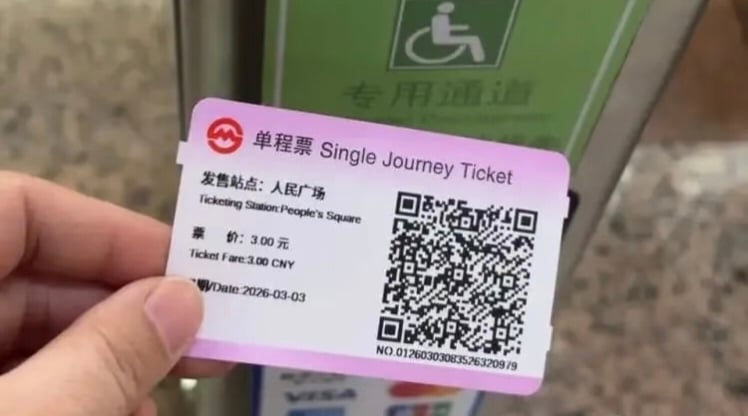
Keep your single ticket until you have completed the journey.
Keep the ticket until you have completed the journey. Do not discard a paper ticket after entering.
Single tickets are valid for the applicable journey on the purchase day and do not provide the same out-of-station transfer treatment as every other transport product.
4. Transport Cards and Passes
A stored-value transport card can suit travellers who prefer a separate payment tool.
One-day and three-day metro passes are also available, alongside other transport products with different coverage.
Compare the journeys you expect to take before buying. A prepaid card is not an unlimited-travel pass, and products with similar names may have different conditions.
Ordinary metro passes should not be assumed to cover the Maglev or Airport Link Line. Ask about the specific product and service.
Using the Metro: From Entrance to Exit
Step 1: Find the Right Entrance
Use the station map to identify a convenient entrance.
The closest entrance may have stairs while another offers a better approach for luggage or a stroller. Check lift access when it matters.
A station symbol can sit some distance from the entrance you actually need.
Step 2: Follow Security Instructions
Expect station-entry security procedures and follow staff instructions about bags and screening.
Keep your group and belongings together. Allow time for a queue rather than treating the train’s running time as the entire journey.
Step 3: Enter with Your Chosen Method
Use the correct reader for your card, code or ticket.
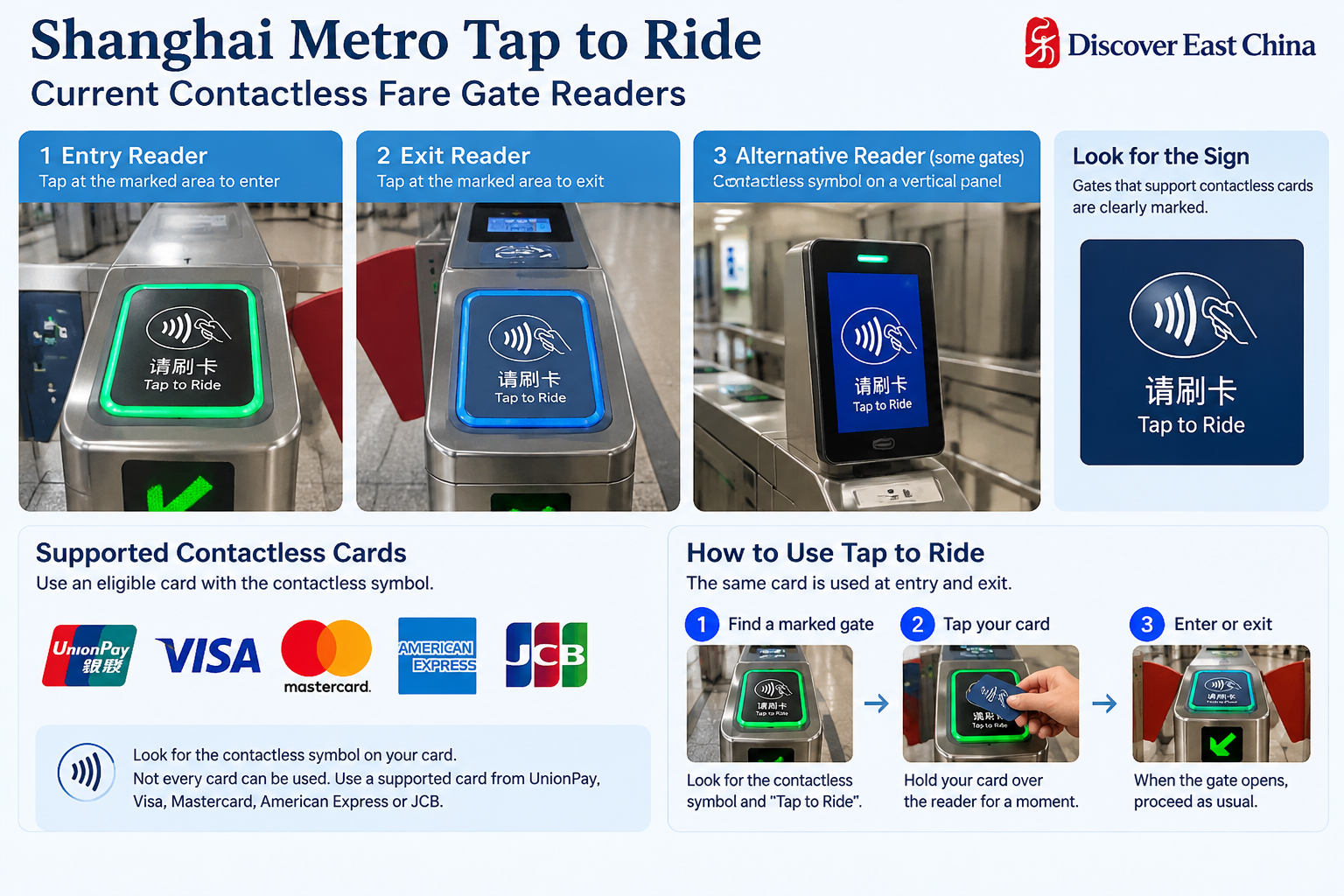
Use the marked Tap to Ride reader with an eligible contactless card.
If travelling as a family, arrange valid entry for each fare-paying passenger. Ask staff about children and the appropriate gate rather than improvising with one ticket.
Use a wider or accessible gate when directed for luggage or mobility needs.
Step 4: Check the Direction
Line colour alone is not enough.
Confirm the line number, destination direction and that your intended station lies along the route. If a service pattern or branch is shown, check that the train serves the stop you need.
Let passengers leave before boarding and keep bags out of doorways.
Step 5: Change Lines if Needed
Follow signs for the next line.
An interchange can require a substantial walk. Leave time to reach the correct platform rather than assuming that every change happens across the same platform.
Step 6: Exit and Choose the Street Connection
Use the same entry credential to complete the journey.
Follow the instructions for your ticket type, then choose the exit that supports the attraction entrance or meeting point.
If you cannot exit, go to staff with the card, code or ticket used at entry. Do not try to bypass the gate.
Station Exits: Why They Matter
Large stations can have exits spread across several streets.
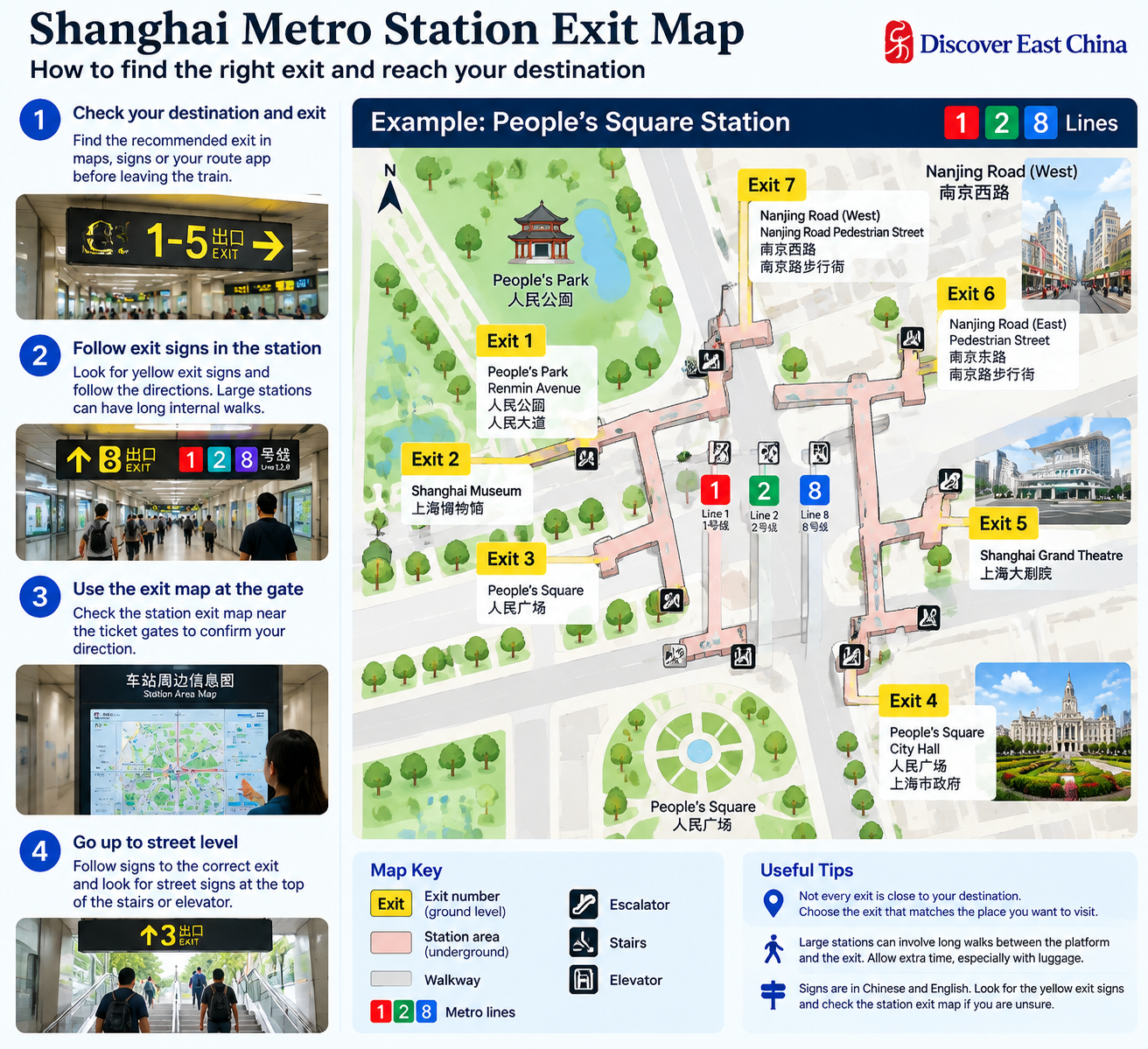
Check the current exit map and the entrance you actually need.
A wrong exit can put you on the other side of a wide road, inside a different building or farther from the visitor entrance.
Check the Final Destination
For a museum, confirm the public entrance rather than the centre of the building on a map.
For a hotel, check the lobby entrance. For a walking route, choose the exit nearest the intended starting point.
Do Not Memorise Exit Numbers Without Context
Exit numbers can be useful, but entrances may be temporarily closed or altered.
A better instruction combines the exit with a street, building or attraction entrance.
Use the current station map and ask staff if the signs do not match your saved route.
Exits and Accessibility
The route with the shortest street walk may not be the best step-free route.
Check both platform-to-concourse and concourse-to-street access. An elevator somewhere in the station does not establish that your chosen route is accessible throughout.
Transfers and Last Trains
Stay Inside for a Normal Interchange
For an ordinary in-station change, follow the transfer signs rather than leaving through the street exit.
If the route specifically requires an out-of-station transfer, check the payment and re-entry conditions before travelling.
A single-journey ticket may require a new ticket after leaving the paid area.
Plan for Interchange Walking
Compare routes by the total effort:
| Route feature | Why it matters |
|---|---|
| One direct line | Often simple if both station approaches are convenient |
| One large interchange | Can add walking and navigation time |
| Several changes | More demanding with children or bags |
| An out-of-station change | Needs extra attention to route and ticket rules |
| Long walks at both ends | May reduce the benefit of a short train ride |
Check the Last Useful Service
Do not assume that every line operates until the same hour.
For a late return, verify the last service in your direction and any onward connection. Reaching the first train does not guarantee that the next line is still operating.
Keep a taxi or ride-hailing option available if an evening plan may run late.
Taxis: When They Make the Day Easier
A taxi is useful when it reduces a difficult connection, carries luggage or provides a straightforward return.
It may be less attractive when road traffic is heavy and a convenient metro route is available.
Hailing or Requesting a Taxi
Use a designated queue at airports and railway stations, or a suitable street pickup where permitted.
A hotel can assist with a taxi if you prefer not to arrange it yourself.
Show the destination in Chinese. Include the entrance or full hotel address when there is more than one possible drop-off.
Payment and Fare
Use the normal metered arrangement where applicable and ask for a receipt if needed.
For a quoted fixed-price transfer, confirm the total and what it includes before departure.
Carry some RMB cash as a backup. Do not assume that every conventional taxi accepts a foreign card directly in the vehicle.
A supported payment app can be useful, but test your setup early in the trip.
Taxi Limitations
Road traffic, pickup access and vehicle availability affect the journey.
A car does not guarantee doorstep access inside a pedestrian area. You may need to walk from a designated drop-off point.
For several suitcases, choose a vehicle with adequate luggage capacity.
App-Based Cars: A Simple Visitor Workflow
Didi and other supported ride-hailing services can help with destination entry, estimated prices and vehicle matching.
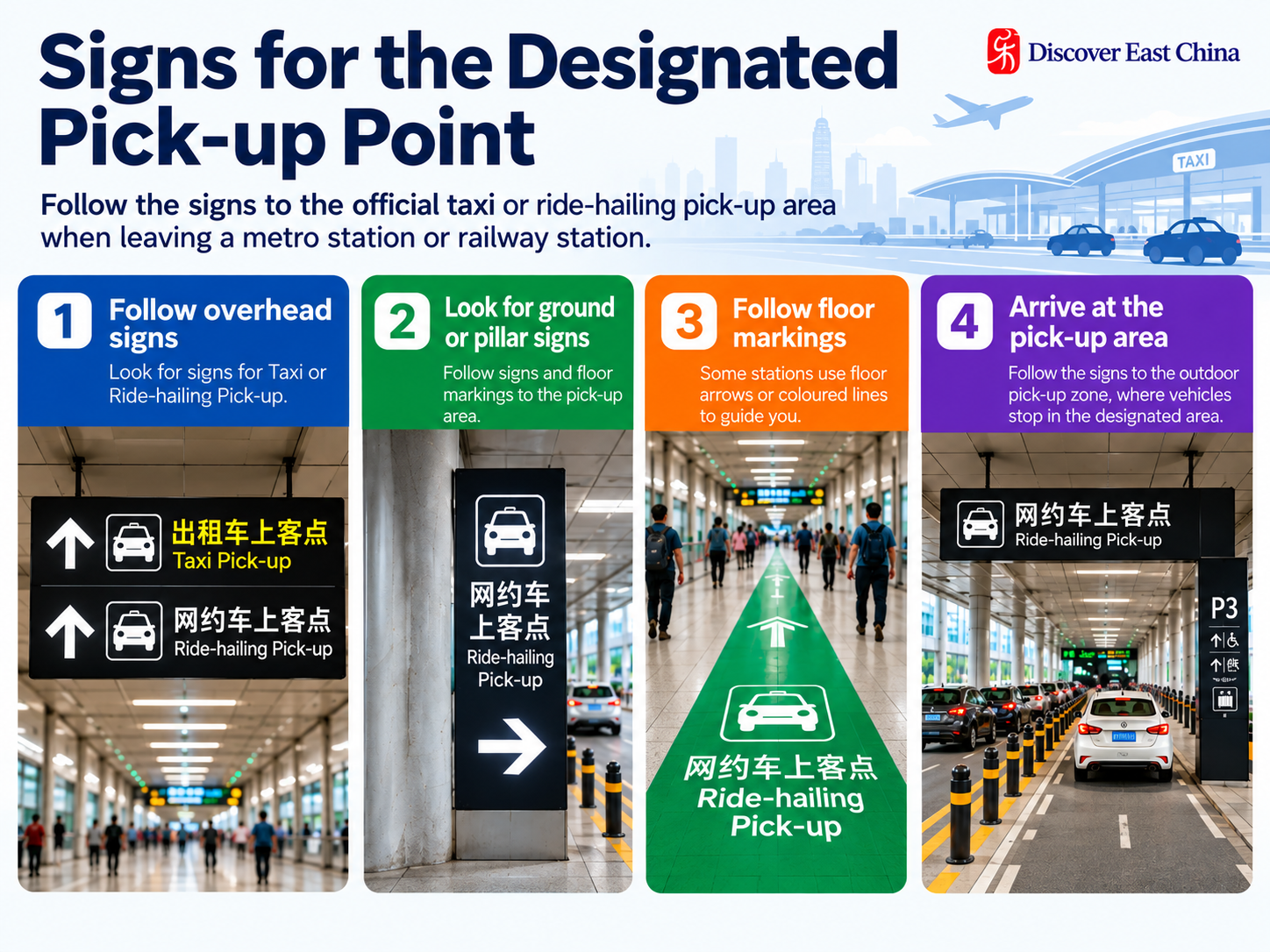
Meet your car at the designated pickup point shown for your booking.
An English interface does not mean the driver speaks English.
Before the First Ride
Set up your account, communication and payment arrangements before you need the car.
Save the hotel’s Chinese name, address and map location. Keep a screenshot in case your connection fails.
Booking a Journey
- Enter the exact destination.
- Check the map pin and entrance.
- Select a vehicle suitable for the group and bags.
- Choose the permitted pickup point.
- Review the price estimate and conditions.
- Confirm and follow the vehicle details.
Meeting the Driver
Match the vehicle registration to the booking before boarding.
Stand at the selected pickup location. If you move, update the driver rather than expecting them to find you around a large site.
Use a short message or photograph of nearby signage if the meeting point is unclear.
Stations, Airports and Busy Attractions
Pickup zones may differ from taxi queues.
Follow the app and local signs. A pin placed inside a station building or pedestrian area may not be reachable by car.
During events, some roads may have restrictions. Use an accessible meeting point instead of insisting on the attraction’s front door.
Families and Assistance
Confirm child seats, mobility equipment and luggage space separately.
A standard order does not establish that specialised equipment or English-speaking assistance is included.
Walking: Use It Where It Adds to the Visit
Shanghai’s historic streets and waterfronts reward walking, but the entire city is not one manageable walking route.
Good Uses of Walking
- A selected Bund promenade section.
- A Wukang–Anfu neighbourhood loop.
- Sinan streets and Fuxing Park.
- A compact old-city outing.
- One selected Suzhou Creek or West Bund section.
Less Useful Uses
A long connection between distant clusters can consume energy without adding much to the trip.
Transfer between those areas and save your walking time for the actual visit.
Crossings and Street Access
Use marked crossings and follow local signals.
A route may involve broad roads, bridges, underground passages or a longer permitted crossing than a simple map line suggests.
Leave space for residents, cyclists and other pedestrians when stopping for photographs.
How to Reduce Backtracking Between Attractions
Group Places by Area
Use these clusters as a starting point.
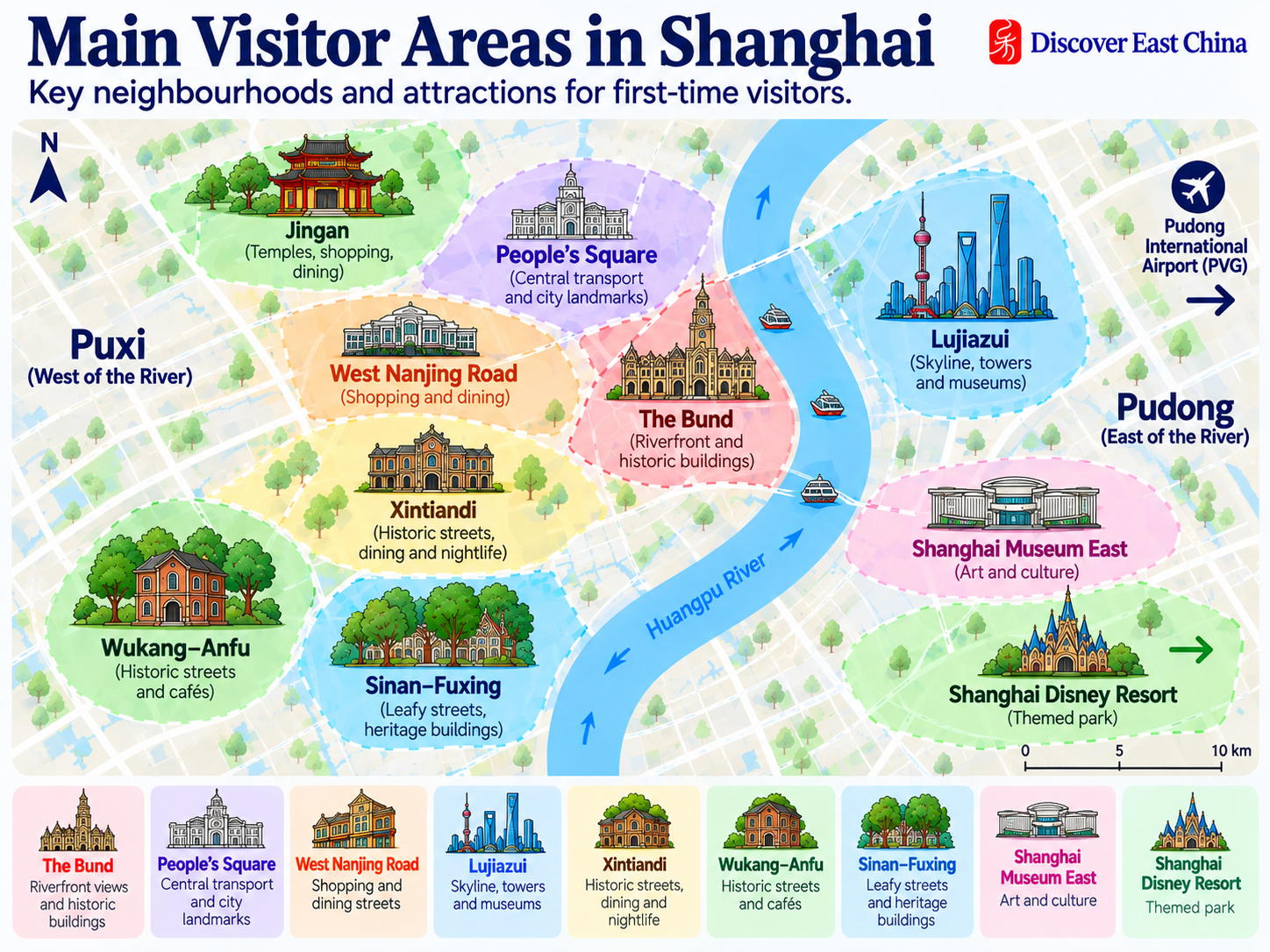
Group nearby experiences and plan deliberate river crossings.
| Cluster | Possible combination | Planning note |
|---|---|---|
| Old-city visitor area | Yu Garden, selected nearby streets and lunch | Garden entry is separate from browsing |
| Bund and nearby central streets | Waterfront, historic buildings and one nearby outing | Do not add distant neighbourhoods as a short walk |
| Wukang–Anfu | Historic streets, cafés and lunch | Choose a clear start and finish |
| Sinan–Fuxing–selected Xintiandi | Park, streets and a meal | Check the actual walking connections |
| Lujiazui | One skyline attraction and a waterfront section | Crossing the river still needs a plan |
| Shanghai Museum East | A collection visit and a light nearby afternoon | Not beside every other Pudong destination |
| M50 / selected Suzhou Creek | Creative spaces and a limited waterfront walk | The creek is a long corridor |
| West Bund | One exhibition and a selected river section | Venues are spread out |
A Practical Two-Day Transport Pattern
Day 1: hotel → old city → Lujiazui if desired → Bund → dinner or hotel.
This involves deliberate river crossings, but it keeps the day focused on the old city and two-bank views.
For less travel, omit Lujiazui and use the Bund as the main skyline experience.
Day 2: hotel → Wukang–Anfu → short transfer to Sinan–Fuxing if desired → optional Xintiandi → hotel.
The transfer between historic-street clusters prevents the day from becoming one long connecting walk.
A Practical Third Day
Choose one main direction: Shanghai Museum East, local neighbourhood life, M50 or West Bund.
Do not combine all of them just because the first two days have covered the landmarks.
Place Meals Along the Route
A lunch close to your current activity can remove an unnecessary cross-city journey.
If a particular restaurant is a priority, treat it as an itinerary anchor and reduce other travel accordingly.
Minimise Repeated River Crossings
Compare the order of booked activities before buying tickets.
Two deliberate crossings can make sense. Repeatedly alternating between Puxi and Pudong for unrelated stops usually adds avoidable travel.
Luggage, Stations and Airport Journeys
Keep Large Bags at the Hotel
Ask about storage before check-in or after check-out.
Avoid taking suitcases through historic lanes or multiple metro interchanges if the hotel can hold them.
Confirm collection hours and include the return to the property in your departure plan.
Using the Metro with Bags
Travel outside the busiest periods when practical.
Choose a route with fewer changes and check elevators. Keep luggage stable and out of doors and walkways.
A slightly more expensive direct car can be worthwhile if it avoids several difficult bag movements.
Know the Difference Between Metro and Intercity Rail
Shanghai Hongqiao Railway Station, Shanghai Railway Station and other rail gateways are different locations.
A metro journey may bring you to a railway complex, but you still need to reach the intercity departure area and complete its entry procedures.
A metro payment method is not an intercity train ticket.
Airport Basics
Pudong Airport and Hongqiao Airport are different gateways.
Check the airport code and terminal. Compare the full hotel-to-terminal journey, including any changes and walking.
The Airport Link Line and Maglev have their own route and fare arrangements. Do not assume that a metro pass covers them or that either provides a direct journey to your hotel.
For a very early flight, check actual operating hours. An all-day route planner result does not establish that the service runs when you need it.
Buses, Ferries and Other Options
Public Buses
Buses can suit a straightforward route with a convenient stop.
Check the direction, payment and where to get off. For a first visit, the metro may be simpler for a cross-city journey, while a bus can work well for a particular connection.
Public Ferries
A ferry can provide an enjoyable river crossing if the pier locations and operating time support your route.
It is not the same as a sightseeing cruise. Check the relevant service rather than assuming every line operates at night.
Consider cycling only if you are comfortable with the route, traffic and parking requirements.
Registration and payment setup can vary. Walking or a short car journey may be simpler for a brief stay.
Do not place a bike in the itinerary as a necessary step before you have confirmed that the service works for you.
Rain, Rush Hours and Busy Evenings
Rain
Direct transfers and shorter walking sections can improve comfort.
Allow extra time for car availability and station approaches. A metro ride avoids some weather exposure, but the walks at either end still matter.
Busy Commuting Periods
If your schedule permits, avoid taking large bags through heavily used routes during busy periods.
A car can also be slowed by road congestion. Compare the current journey rather than assuming one mode always wins.
Festivals and Events
Popular areas may have temporary road, pedestrian or pickup arrangements.
Follow current signs and staff guidance. Keep a little flexibility rather than depending on one exact pickup spot from an old description.
If Something Goes Wrong
| Problem | Practical next step |
|---|---|
| Gate rejects your payment | Step aside and ask station staff |
| You cannot exit | Show the credential used at entry and explain the journey |
| You boarded in the wrong direction | Get off at a suitable station and follow the correct platform signs |
| You chose the wrong exit | Check the street map before walking farther |
| Driver cannot find you | Confirm the designated pickup point and send a clear location message |
| Phone battery is low | Arrange a workable fallback before losing access to the travel code or booking |
| You leave something in a car | Use the booking record or receipt to contact the operator |
| You miss the last useful train | Use a suitable car option rather than assuming another connection is available |
Do not keep changing cards, accounts or pickup locations without resolving the original issue.
Useful Chinese Names and Messages
| English | Chinese |
|---|---|
| Metro | 地铁 |
| Transfer / change lines | 换乘 |
| Exit | 出口 |
| Elevator | 电梯 |
| Service centre | 服务中心 |
| Single-journey ticket | 单程票 |
| Taxi pickup area | 出租车上车点 |
| Ride-hailing pickup area | 网约车上车点 |
| Shanghai Hongqiao Railway Station | 上海虹桥站 |
| Shanghai Railway Station | 上海站 |
| Pudong International Airport | 浦东国际机场 |
| Hongqiao International Airport | 虹桥国际机场 |
| The Bund | 外滩 |
| Yu Garden | 豫园 |
| Lujiazui | 陆家嘴 |
| Wukang Road | 武康路 |
| Which exit should we use? | 我们应该走哪个出口? |
| Is there an elevator to the street? | 有到地面的电梯吗? |
| Please take us to this address. | 请送我们到这个地址。 |
| My ticket will not open the gate. | 我的车票无法过闸。 |
Use the actual address and entrance alongside the general place name.
Frequently Asked Questions
What is the easiest way to get around Shanghai?
Combine the metro for suitable connections, walking within visitor areas and cars for awkward transfers or luggage.
Can I tap a foreign bank card directly at metro gates?
Eligible contactless cards are supported. Check the marked reader and keep a ticket option available if your card does not work.
Is buying a ticket with a card the same as Tap to Ride?
No. One purchases a separate ticket; the other uses an eligible card as the gate credential.
Can I use Alipay or WeChat?
Supported metro travel-code services are available. Activate the correct transport code and payment setup first.
Do all single tickets get collected at the exit?
No. Traditional IC-card tickets are collected, while paper QR-code tickets are scanned and retained.
Should I buy an unlimited pass?
Compare the covered services with your planned journeys. It is not automatically the best value for a trip with few rides.
Do I need my passport for every ordinary metro ride?
Ordinary metro entry uses the valid fare credential. Keep the documents required for your wider travel and any account verification; intercity trains and attraction bookings have separate requirements.
Can I use one metro code for the whole family?
Arrange the appropriate entry for each passenger and ask staff about children. Do not assume one individual travel code can admit the entire group.
Why does the exit matter so much?
Large stations can spread across several streets. The right exit can reduce unnecessary walking and help you reach the correct entrance.
Are taxis always faster?
No. Traffic can make the metro more useful, while a car may be easier for a route with several changes.
Do I need a private driver every day?
Usually not for a normal city itinerary. A private vehicle can help with specific assistance or coordination needs.
Can I use a metro pass for the airport services?
Check the particular pass. Do not assume ordinary metro passes cover the Maglev or Airport Link Line.
Plan Your Shanghai Journeys
A useful transport plan connects nearby experiences, keeps luggage out of the sightseeing day and leaves enough time for real station and street connections.
Discover East China Tours can help coordinate suitable transfers and routes around your group’s pace, including families and travellers who prefer less walking. Share your hotel, main activities, luggage and onward travel details when making an inquiry.