
Plan a manageable Bund walk with historic buildings, skyline views, photography stops and practical connections to nearby Shanghai areas.
The Bund in Shanghai is one of the best places to understand the city on foot. On one side of the Huangpu River, historic banks, hotels and commercial buildings trace the city’s development as a trading and financial centre. Across the water, the towers of Lujiazui show a different period of urban growth. Between them, working boats, sightseeing vessels and the river itself keep the scene moving.
A good visit is more than a quick skyline photograph. Walk a manageable section, pause to look at the buildings behind you and give yourself time to notice how the view changes along the waterfront. Daylight helps with architectural detail; evening brings illuminated façades and river reflections. If your schedule allows, a visit that begins before dusk can offer both.
This guide sets out a practical walking route, explains which buildings deserve attention and compares daytime, twilight and evening visits. It also covers breaks, photography and useful connections to Nanjing Road, the old city, Suzhou Creek and Pudong.
Where the Bund Is in Shanghai—and What Counts as the Core Walk
The historic Bund stands on the western bank of the Huangpu River in central Shanghai, on the Puxi side. Its best-known building frontage follows East Zhongshan No. 1 Road, with the river promenade across the road to the east.
The core historic waterfront is approximately 1.5 kilometres long, running from the East Yan’an Road area in the south towards Waibaidu Bridge in the north. This is a useful scope for a first visit. The broader riverside attractions extend beyond it, so a route described simply as “walking the Bund” may be considerably longer.
| Area | What it means for your visit | Relationship to the core Bund |
|---|---|---|
| Historic Bund | The main heritage façades and riverside promenade | The focus of this guide’s main walk |
| Waitanyuan | Historic streets and buildings near the northern end | A useful architecture extension inland |
| Suzhou Creek | A separate waterway meeting the Huangpu near Waibaidu Bridge | A natural continuation from the northern end |
| North Bund | Waterfront in Hongkou, beyond the Suzhou Creek area | A separate outing or a longer extension |
| Lujiazui | Pudong’s tower district across the Huangpu | Reached by transport across the river, not by continuing along the Bund |
| Shiliupu and the southern waterfront | Riverside facilities and cruise-related areas south of the classic frontage | An extension requiring additional walking time |
| Qiantan, sometimes called the New Bund | A different area farther south | Not another name for the historic Bund |
Waibaidu Bridge crosses Suzhou Creek. It does not take you across the Huangpu River to Lujiazui. Keeping these waterways and neighbourhoods distinct makes onward planning much easier.
How Long Should You Allow?
A brisk walk and a considered visit are different things. The core distance is relatively modest, but photographs, building interpretation, crossings, crowds and stops can substantially increase the time.
The following are suggested planning allowances rather than fixed walking times:
| Visit style | Suggested allowance | What to include |
|---|---|---|
| A brief skyline stop | Around 30–45 minutes at the waterfront | One main viewpoint and a look at the heritage frontage |
| A short first visit | Around 60–90 minutes | A central section, several building exteriors and relaxed photography |
| The core waterfront walk | Around 1.5–2.5 hours | A one-way route with pauses between the northern and southern ends |
| Architecture-focused visit | Around half a day | The core walk, selected inland streets and one confirmed interior or exhibition |
| Late afternoon into evening | Around 2–3 hours, longer with dinner | Daylight detail, a break and the change to the night view |
Include the approach from a station and the journey away afterwards. A “one-hour Bund visit” can easily become a longer outing if you also walk the length of Nanjing Road or cross to Pudong.
For a family or anyone who prefers less walking, a shorter central section is enough to see the essential contrast between the two banks.
Choose Your Walking Direction
North to south works well if you are beginning around Waibaidu Bridge, Suzhou Creek or Waitanyuan. It introduces the river junction, passes the Peace Hotel area and continues towards the central financial buildings and southern frontage.
South to north can be convenient after visiting the old city or approaching from the southern waterfront. It finishes near the northern streets and Suzhou Creek, with opportunities for a further walk or a meal.
If you arrive from East Nanjing Road, you do not need to reach either end before beginning. Start near the Peace Hotel, choose a direction and explore as much as suits your schedule.
Your transport and next stop matter more than completing the route in a particular order. Avoid walking the whole length twice simply to return to your starting point when an alternative departure location would work.
The Main Route: Waibaidu Bridge to the Southern Bund
Use the river promenade for broad views and the street-side pavement for closer architectural observation. Move between the two at designated crossings; East Zhongshan No. 1 Road is a traffic route, not a pedestrian plaza.
The stop order below follows a north-to-south visit. You can reverse it or join partway through.
Stop 1: Waibaidu Bridge and the River Junction
Begin near the point where Suzhou Creek meets the Huangpu. Waibaidu Bridge, also known as the Garden Bridge, gives the northern end of the walk a recognisable steel structure and a different sense of scale from the broad riverfront.
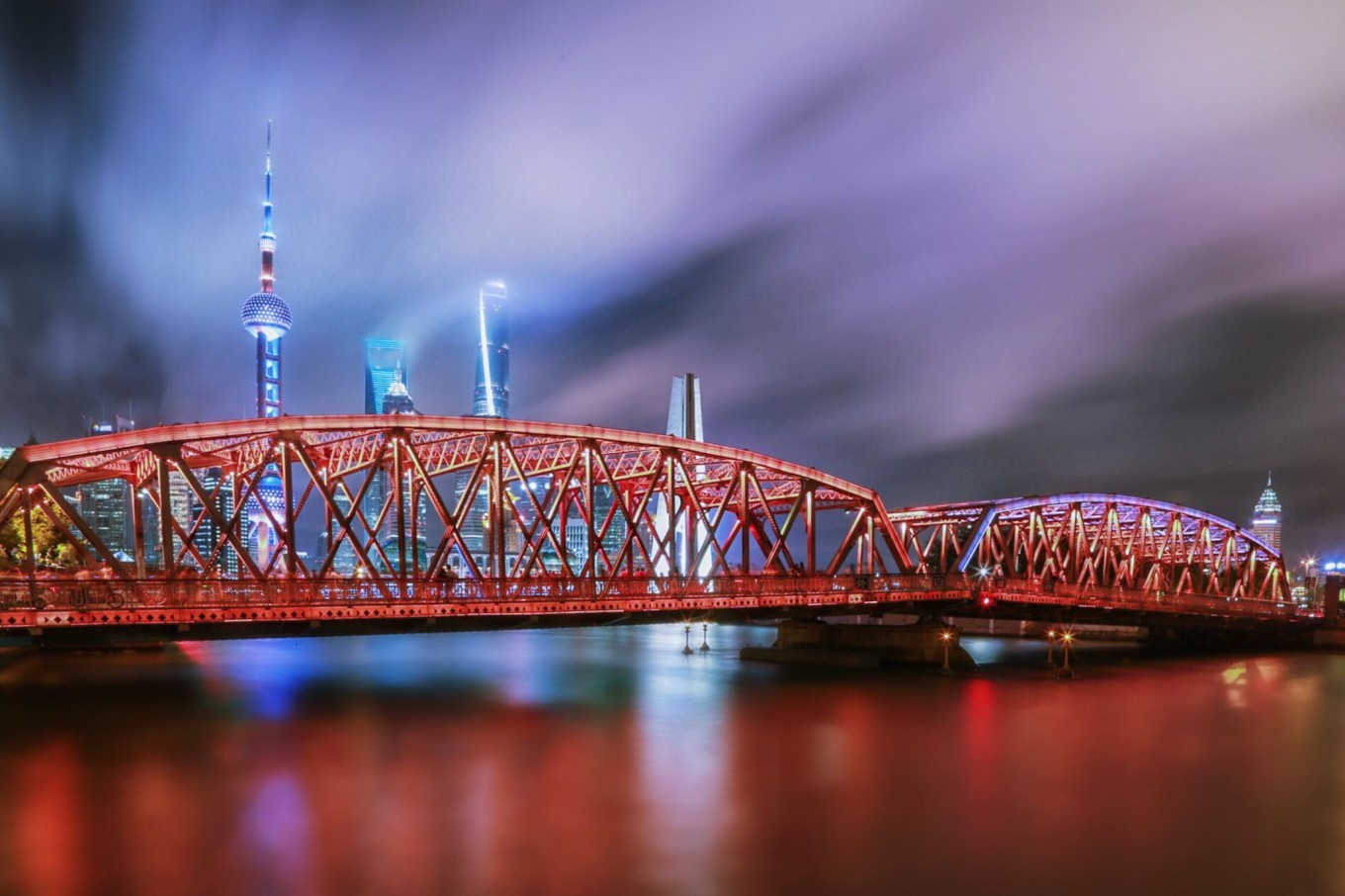
Waibaidu Bridge crosses Suzhou Creek on the Puxi side.
Look first at the geography: the smaller creek entering the larger river, the waterfront curving away and the skyline visible across the Huangpu. The present bridge dates from 1907, connecting this setting with Shanghai’s early twentieth-century development.
You can appreciate it without crossing. If you do walk onto the bridge, keep moving where the pavement is narrow and choose a place to stop that does not obstruct others. Photographing from the nearby waterfront may be more comfortable than trying to assemble a group portrait on the bridge itself.
For the bridge’s history, see the Shanghai Municipal Archives account.
A northern inland detour through Waitanyuan is optional. Decide at this stage whether your priority is the core waterfront or a longer architecture visit.
Stop 2: The Northern Promenade and a First Skyline View
Continue south along the waterfront and take your first unhurried look across the river. The Oriental Pearl Tower, Jin Mao Tower, Shanghai World Financial Center and Shanghai Tower help you identify the Lujiazui skyline.
You do not need to memorise heights or completion dates. Notice how the towers differ in shape and how their positions appear to shift as you walk. This explains why a photograph taken farther along the Bund will not look identical even when it includes the same buildings.
Turn around to look at the historic frontage. The promenade gives enough distance to see façades as compositions rather than only fragments above your head. This is a good place to introduce the relationship between the commercial waterfront and the river that supported it.
Stop 3: The Bank of China Building and Peace Hotel Area
Around the northern-central frontage, look at the Bank of China Building and the Peace Hotel’s north building, historically known as Sassoon House.

The Bank of China Building is especially useful for understanding the Bund as more than a row of foreign institutions. Its design combines a modern vertical composition with Chinese architectural elements. It represents a Chinese bank establishing a prominent position within the city’s competitive financial landscape.
Nearby, the Peace Hotel’s distinctive roof and Art Deco character offer a different story: hotel life, commerce and the ambition of interwar Shanghai. Sassoon House opened in 1929, and its exterior remains a useful landmark for orientating yourself at the river end of East Nanjing Road.
This is also a practical decision point. You can leave for Nanjing Road, continue south or take a planned indoor break. Do not assume that the hotel or a neighbouring venue offers unrestricted interior sightseeing; confirm visitor arrangements or make an appropriate dining reservation if that is part of your plan.
Stop 4: Customs House and the Former HSBC Building
Farther south, the Customs House clock tower and the dome of the former HSBC Building create one of the Bund’s most recognisable architectural pairings.
Look at what each building needed to communicate. Customs administration belongs to the story of river trade, while a large bank façade presents stability, resources and commercial confidence. Their position next to one another makes the connection between shipping, regulation and finance easier to understand.
The former HSBC Building opened in 1923, as recorded in HSBC’s historical collection. Its scale, symmetry and dome reward a pause from across the road before you move closer. The Customs House clock tower provides a contrasting vertical landmark.
Historic interiors may be discussed in architectural guides, but external viewing is the dependable basis of this walk. If an interior visit is important, check the current arrangements separately rather than arriving with an expectation of guaranteed entry.
Stop 5: The Southern Heritage Frontage
Continue towards the former Shanghai Club Building and the southern end of the main historic row. The former club building is now associated with the Waldorf Astoria Shanghai on the Bund; nearby façades provide further comparisons in scale, columns and decorative treatment.
This is a good point to stop trying to name every building and compare a few instead. Which has the strongest entrance? Which uses vertical lines? Which appears most restrained? How does a hotel or club differ from a bank?
Finish around the East Yan’an Road area if you want to keep to the core walk. Continuing south towards Shiliupu or the Bund Finance Center is a separate extension. Add it because you have a reason to go there, such as a confirmed cruise departure or meal, rather than assuming it is included in the original distance.
A Shorter Shanghai Bund Route for a First Visit
For a manageable introduction, start at the river end of East Nanjing Road. Spend time around the Peace Hotel frontage, walk south towards Customs House and the former HSBC Building, and pause on the promenade for the skyline.
This covers several major themes without requiring the full north-to-south route. Finish with a meal or an inland walk, using designated crossings where needed.
A shorter route is particularly useful after a long flight, in hot weather or when travelling with children. It also works for an evening visit when you have already explored other parts of Shanghai that day.
If photography is your main aim, begin with one comfortable waterfront position. Move a little farther along only when you want a noticeably different composition. You do not need to walk the entire frontage to obtain a good skyline photograph.
How to Read the Buildings and Shanghai’s History
Begin with the River, Not the Architectural Labels
Shanghai opened as a treaty port in 1843. The Bund developed within the setting of international trade, foreign concessions and the later International Settlement, attracting financial and commercial institutions along the waterfront.
That history includes both commercial growth and unequal political arrangements. A thoughtful walk should explain how the area functioned rather than presenting the buildings only as attractive relics of a glamorous past.
The city also existed long before the treaty-port period. The Bund is a major chapter in modern Shanghai’s development, not the beginning of all Shanghai history. Visiting the old city can help place the waterfront in a broader context.
Ask What Each Building Was For
Function gives you a useful way into the architecture. Banks needed to convey trust and permanence. Trading companies needed prestigious offices. Hotels and clubs served particular social and commercial worlds. Customs connected the built frontage to the movement of goods through the port.
You can understand these ideas without being an architectural specialist. Look at the entrance, the width of the façade, the use of columns, the roofline and how the building relates to its neighbours.
Compare Styles Rather Than Calling Everything “Colonial”
The frontage includes buildings from different periods and design traditions. Classical compositions, elaborate historical references and Art Deco forms do not all tell the same story.
Compare the former HSBC Building’s monumental symmetry with the Peace Hotel’s more vertical silhouette. Then consider the Bank of China Building’s combination of modern design and Chinese elements. Three carefully chosen examples can teach more than a long sequence of names.
Notice Reuse and Continuity
Historic buildings have continued to accommodate institutions, hospitality, restaurants and cultural activity. Their present use is part of the story, not an interruption to it.
Ask what survives, what has changed and which spaces visitors can actually enter. A restored exterior may be easy to admire while the interior remains a workplace or requires a separate arrangement.
Avoid assuming that every door leads to a public museum. The Bund is a functioning city district as well as a heritage destination.
When a Guide Adds Value
A knowledgeable guide can connect the buildings to trade, finance, urban governance and daily life. For a deeper visit, ask for interpretation of a few selected buildings, with time for questions.
If your main interest is interiors, request a route based on confirmed access rather than a standard exterior walk with vague promises. An English-speaking guide’s ability to explain the subject matters more than simply reading building dates aloud.
Daylight, Twilight or Evening?
| Time of visit | Main advantage | Trade-off |
|---|---|---|
| Early morning | A fresh start and the possibility of more space for walking | Nearby venues may not yet be open; the experience is not an illuminated night view |
| Daytime | Clearer examination of façade details and the river setting | Heat, glare or haze can reduce comfort and photographic clarity |
| Late afternoon | Time to explore buildings before an evening visit | The transition takes time and may coincide with growing crowds |
| Twilight | A chance to balance remaining sky colour with artificial light | The useful light window varies with season and weather |
| After dark | Illuminated buildings, reflections and a different atmosphere | Architecture is harder to study in detail, and crowding can limit movement |
Choose Daylight for Architecture
Daylight is the better choice if you want to compare materials, window arrangements and decorative features. An inland architecture detour also feels more coherent when you can see the details clearly.
In summer, avoid building a long exposed walk around the hottest part of the day. A morning route or a shorter late-afternoon visit with a break can be more comfortable.
Choose Evening for Atmosphere
An evening visit is worthwhile even if you have seen the waterfront by day. Lighting changes the relationship between the façades, towers and water, while boats add movement to the scene.
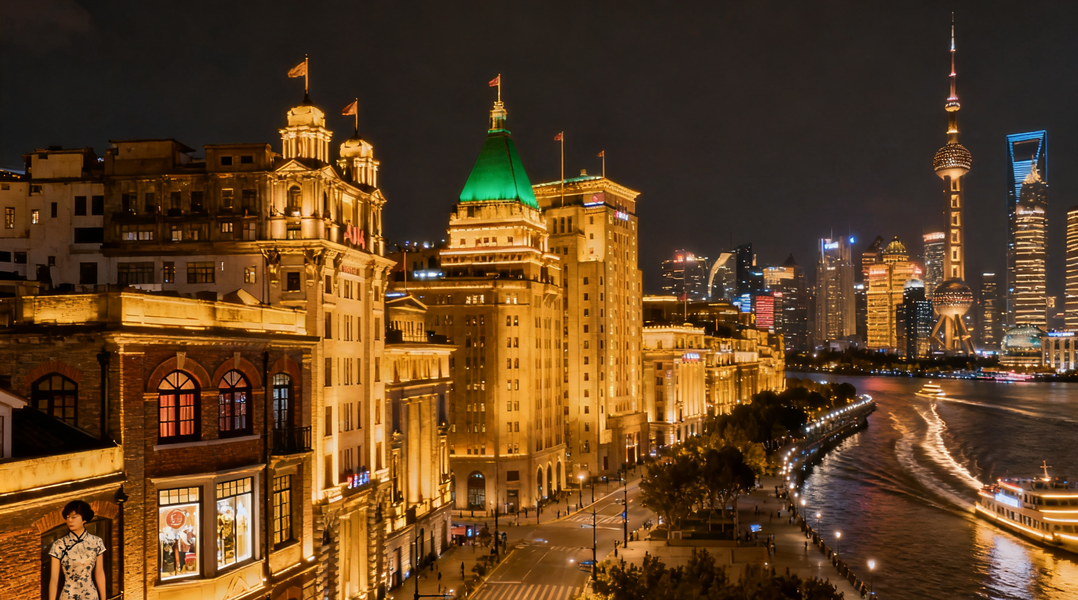
An evening visit offers a different view of the historic waterfront.
Do not plan around a universal daily switch-on time or assume that a special light show happens every night. Regular illumination, seasonal arrangements and event displays are different things. Check current announcements if a particular display matters to your visit.
The same applies to switch-off times. Arriving very late can give a different experience from the brightly illuminated photographs you have seen.
Combine Both with a Break
A practical plan is to walk part of the frontage in daylight, have an early meal or indoor break and return for twilight or darkness. You do not need to stand at the railing throughout the transition.
Check sunset for your date and allow for the season. In winter, darkness arrives earlier; in summer, waiting for the night view can extend the outing well into the evening.
For families, an earlier dinner followed by a short return to the waterfront may work better than delaying food until all photography is finished.
Where to Look for Skyline Views
The public promenade provides the classic view towards Pudong. It is the best starting point because you can move between positions without committing to a restaurant, observation deck or cruise.
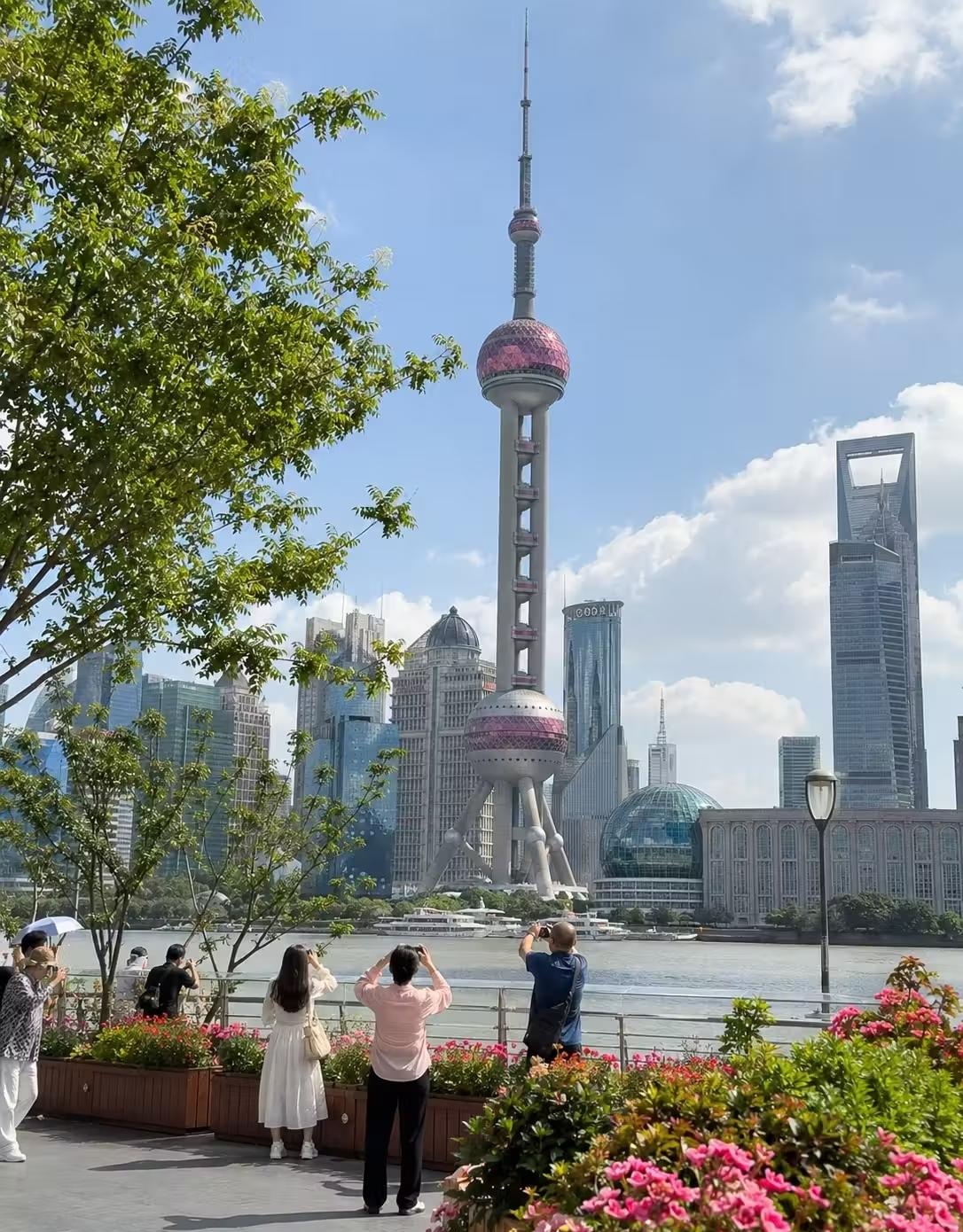
Look across the Huangpu River towards Lujiazui from the Bund promenade.
The central sections offer a broad tower composition. The northern end adds the Suzhou Creek junction and bridge context. Moving south changes the alignment and gives you a different relationship between the buildings and river traffic.
Do not become attached to a single marked “best photo spot”. A position a short distance away may offer more room, a better angle for your subject or a more comfortable place to pause.
For the historic Bund façade itself, remember to face west. Across the Huangpu on Pudong’s waterfront, the historic buildings become a continuous panorama rather than the close-up street scene you see from Puxi.
| What you want to see | Useful viewpoint approach |
|---|---|
| Lujiazui towers across the water | The Bund promenade, looking east |
| The historic building row | The promenade looking inland, or Pudong’s waterfront across the river |
| Bridge and river-junction context | The northern end near Waibaidu Bridge |
| Architectural details | Street-side pavement at an appropriate distance |
| A seated view | A confirmed restaurant, café or terrace with the relevant outlook |
A paid venue can offer comfort and a different perspective, but it is not necessary for the essential Bund view.
Photography: Make the Visit Work for Your Images
Begin with Three Different Subjects
Instead of taking many versions of the same skyline, aim for a broad river view, one architectural detail and one scene showing people or movement. This gives a more complete record of the place.
For a portrait, choose a position where the background is recognisable without requiring the person to stand in a crowded flow. Step aside after taking the photograph so others can use the space.
Use the Light You Have
The Bund faces east across the river. A visit at sunset can provide attractive sky colour and lighting, but the setting sun is not normally behind the Lujiazui towers from this viewpoint. Do not expect every sunset photograph to show the sun dropping between the skyscrapers.
Afternoon light can help with the view towards Pudong, while conditions on the historic façades depend on angle and time. Cloud, haze and reflections matter as much as the hour.
At twilight, take a few frames before the sky becomes fully dark. The balance between the skyline and the remaining sky may be more useful than maximum darkness.
Keep Night Photography Simple
For a phone, steady your hands, avoid excessive digital zoom and take several frames. A moving boat and a still skyline may need different approaches. Check results before leaving rather than assuming a long exposure has kept everything sharp.
If you use a tripod, consider space and local directions. Do not obstruct the walkway, set equipment across other visitors’ route or assume it is acceptable during crowd-control arrangements.
Rain can create reflections but also makes handling equipment less comfortable. Protect your camera and choose stable footing. A clear photograph is not worth standing awkwardly at a busy crossing or on a wet edge.
Adjust Expectations for Weather
Haze may soften distant towers; rain may obscure the upper skyline. You can still photograph façade details, umbrellas, river activity or the atmosphere of the streets.
If the skyline is your main priority and you have several days in Shanghai, retain some flexibility to return in better conditions. A fixed evening cannot guarantee the view shown in promotional images.
Rest, Food and Practical Comfort
Plan a Real Break
The promenade can involve sun, wind and considerable standing. Public seating may not be available where you want it, especially at busy times. Plan a break around an actual café, restaurant or hotel venue if sitting comfortably is important.
A venue’s location does not guarantee a river view. Check the table or seating area, reservation requirements and any minimum spend before booking. Rooftops and terraces may have weather restrictions, age policies or limited availability.
For a casual meal, streets inland towards Nanjing Road provide another direction to explore. A meal without a waterfront view can be a useful rest before returning to the river.
Toilets and Water
Identify public facilities or suitable venues along your route rather than assuming every historic building admits visitors for toilet access. Carry water for an exposed walk and check facility locations if travelling with young children or someone who needs predictable breaks.
A museum or exhibition may provide an indoor pause, but confirm opening and admission arrangements. It should fit the day as an experience rather than being treated as a guaranteed free waiting room.
Children, Older Travellers and Access Needs
Choose a short core section and make extensions optional. Crowds and road crossings can be more tiring than the distance itself.
For wheelchair users or anyone who needs step-free access, check the specific approach, promenade access points and onward route. Do not assume that every underpass, entrance or station exit offers the same facilities.
Keep children close near the river railing and traffic crossings. On a busy evening, agree a simple meeting point and avoid splitting the group casually while looking for a photograph.
Getting to the Bund in Shanghai and Leaving Afterwards
Metro
East Nanjing Road station, on Lines 2 and 10, is a useful approach to the central Bund. It is inland, so include the walk along East Nanjing Road to the waterfront.
Check the exit that fits your route, particularly if lifts or reduced walking are important. Do not rely on an exit number from an old screenshot without checking the current station layout.
For an evening visit, check the last useful train for your complete journey, including any interchange. Major events can bring temporary station or entrance changes. A normal timetable is not a guarantee of normal access on a special-event night.
Taxi or Pre-arranged Vehicle
Use a precise street address or landmark for drop-off and collection. “The Bund” covers too much ground to serve as a reliable meeting instruction.
The most convenient pedestrian position may not be a legal vehicle stopping point. Allow a short walk to an agreed collection location, and follow current traffic arrangements on busy nights.
If your group has limited walking tolerance, plan the departure before starting the route rather than trying to summon a vehicle beside the busiest part of the waterfront.
Walking from Nearby Areas
Nanjing Road, Waitanyuan and the eastern Suzhou Creek area can connect naturally on foot. Other areas may be walkable but add more distance than expected.
Look at the actual route, crossings and weather. A short taxi or metro ride can make a combined day more enjoyable than insisting that every connection must be a city walk.
How to Combine the Bund with Other Shanghai Areas
Nanjing Road and People’s Square
East Nanjing Road reaches the Bund and provides a straightforward link between a shopping street visit and the waterfront. Continue farther west only if you want the additional walking towards People’s Square.
A good arrangement is to explore part of Nanjing Road, have a meal and finish with an evening Bund visit. You do not need to walk the entire shopping route in both directions.
If you begin at People’s Square, count that approach as part of the day’s walking. By the time you reach the river, a short Bund section may be enough.
Yuyuan and the Old City
The old city provides an earlier layer of Shanghai history and a useful contrast to the financial waterfront. Combine the areas with a meal and an appropriate transfer or assessed walking connection.
Distinguish Yuyuan Garden from the surrounding commercial and historic streets. Visiting the garden depends on its own admission and opening arrangements; the neighbourhood has a different pattern of activity.
Avoid planning a late-afternoon garden visit solely as a way to wait for darkness at the Bund. Confirm the garden schedule, then build the waterfront visit around it.
Waitanyuan and Suzhou Creek
This is a strong choice for visitors who enjoy buildings and city history. Begin with a northern inland route, return towards Waibaidu Bridge and continue along the Bund, or finish the waterfront walk with a creek-side extension.
A shorter architecture visit can focus on streets and exteriors. If you want museums, galleries or other interiors, verify each venue and reduce the number of outdoor stops accordingly.
Lujiazui and the Pudong Waterfront
Crossing the river lets you reverse the view: the Bund becomes the panorama, and the towers become the buildings around you.
The metro is a practical way to connect East Nanjing Road and Lujiazui on Line 2. Include the walk to and from the stations. A public ferry may offer another option when its route and operating hours suit the day.
Do not try to see a tower observation deck, the whole Pudong waterfront and a long Bund architecture walk in one rushed afternoon. Choose the experience you most want on each bank.
North Bund
North Bund can provide another river perspective and a different district setting. It requires additional time beyond a quick walk onto Waibaidu Bridge.
Choose it when you want a second waterfront experience, not because the name suggests it is simply the next few metres of the historic Bund. Check the route to the specific viewpoint or venue you intend to visit.
Ferry, Cruise or Sightseeing Tunnel?
These serve different purposes. Select one only if it adds something to your itinerary.
| Option | What it offers | What to check |
|---|---|---|
| Public ferry | A practical crossing and a short time on the river | Route, pier, current timetable and onward walking |
| Sightseeing cruise | A river-based viewing experience, usually returning according to its booked route | Departure pier, duration, boarding time, seating and current operation |
| Bund Sightseeing Tunnel | A paid transport attraction under the river | Price, hours and whether this particular experience interests you |
| Metro | A direct urban transport connection | Station approach, exits and the full onward journey |
The Dongjin public ferry connects East Jinling Road on Puxi with Dongchang Road on Pudong. Confirm the current Shanghai Ferry timetable and any temporary suspension before relying on it after an evening visit. Published timetable information can differ, so keep the metro or another suitable crossing as a fallback.
A ferry is not a guided sightseeing cruise and is not arranged around extended photo stops. A cruise, meanwhile, may depart from a pier south of the classic Bund. The walk to boarding, check-in and queueing need to be included in your schedule.
The sightseeing tunnel does not provide an open-air river view. Choose it for the attraction itself rather than assuming it is the essential way to reach Pudong.
For a first visit with limited time, the public promenade can provide a satisfying evening without any paid river activity.
Suggested Visit Plans
A Short First Evening
Have dinner nearby, approach from East Nanjing Road and spend time on the central promenade. Look across to Lujiazui, then turn towards the Peace Hotel and central historic buildings.
Walk a modest section, take a few photographs and leave by the pre-planned metro or vehicle route. This works well after an arrival day or a full day elsewhere in Shanghai.
Daylight Architecture and an Evening Return
Begin in the north with Waibaidu Bridge and a short Waitanyuan detour. Follow the heritage frontage south, using safe crossings for closer viewing where appropriate.
Take an indoor break or early dinner, then return to a convenient promenade section for twilight. There is no need to repeat the entire route after dark.
Old City and the Bund
Visit Yuyuan Garden, if booked and open, and selected surrounding streets. Have a meal, then make the planned connection to the Bund.
Choose either a full heritage walk or a shorter evening visit according to how much walking the group has already done. Keep a cruise optional unless it is a main interest with a confirmed departure.
Two Banks, Two Perspectives
Explore Lujiazui or the Pudong waterfront during the day. Cross by a suitable current service, rest or eat on Puxi, then visit the historic Bund in the evening.
If using a ferry, plan within its timetable. If using the metro, include station walking. Leave enough time to enjoy both banks rather than spending most of the visit moving between transport points.
Common Planning Mistakes
The most frequent mistake is treating the Bund as a single photo point. Moving a little, looking inland and understanding a few buildings creates a much richer visit.
Other problems come from adding too much: a full Nanjing Road walk, the old city, a cruise, a tower and both riverbanks can overwhelm an otherwise pleasant day. Choose one main combination and keep the remaining options for another visit.
Do not assume that every evening has a special light show, every historic interior is open or every ferry operates late. Those details need current confirmation.
Finally, distinguish walking time from the entire outing. Dinner, station approaches, queueing and the journey back to the hotel all shape how late and how tiring the visit becomes.
Frequently Asked Questions
1. How long is the main Bund walk?
The classic historic frontage is approximately 1.5 kilometres. Inland detours, the station approach and southern or northern extensions add to that distance.
2. How much time should I allow for a first visit?
Around 60–90 minutes can suit a shorter introduction. Allow roughly 1.5–2.5 hours for a considered core walk with pauses, and longer for interiors, dinner or the transition from day to night.
3. Is the Bund better during the day or at night?
Daylight is better for architectural detail; evening is better for illumination and reflections. A late-afternoon visit with a break can offer both experiences.
4. Do I need a ticket for the public promenade?
The public waterfront walk does not require a general sightseeing ticket. Cruises, the sightseeing tunnel, exhibitions and hospitality venues have separate arrangements and possible charges.
5. Which buildings should I focus on?
The Peace Hotel, Bank of China Building, Customs House and former HSBC Building make a useful starting selection. Add the former Shanghai Club Building or northern streets if you want a longer architectural visit.
6. Can I enter all the historic buildings?
No. Many are working institutions or hospitality venues. Confirm public access, exhibition admission or dining arrangements for any interior you want to visit.
7. What time do the lights come on?
There is no single year-round time to rely on for every building or display. Check current illumination announcements if timing matters, and distinguish regular lighting from a special event.
8. Is there a light show every night?
Do not assume so. Special displays are date-specific and may have their own arrangements. An ordinary evening visit can still be worthwhile for the illuminated waterfront.
9. Which metro station is convenient?
East Nanjing Road, served by Lines 2 and 10, is a useful central approach. It is inland, so allow walking time to the river and choose an appropriate current exit.
10. Can I walk across Waibaidu Bridge to Pudong?
No. Waibaidu Bridge crosses Suzhou Creek on the Puxi side. Reaching Pudong requires a separate Huangpu River crossing by an appropriate transport service.
11. Is the public ferry suitable after a night visit?
Only if the specific service is operating at that time. Confirm the Dongjin route’s current hours and any temporary suspension, and plan another option for a late return.
12. Is a river cruise necessary?
No. The public promenade provides the essential views. Choose a cruise if you particularly want to experience the river from a boat and have time for the boarding arrangements.
13. Where is the best place for skyline photographs?
Several promenade positions work well. Compare central, northern and slightly more southern angles, then choose one with a useful composition and enough room to stop comfortably.
14. Is the walk suitable for children and older travellers?
A shorter section with breaks can work well. Assess crowds, crossings, weather and seating rather than considering distance alone. Check specific access points for step-free needs.
15. What should I do in rain or haze?
Shorten the exposed walk, take an indoor break and photograph closer details if distant views are limited. Keep flexibility to return if a clear skyline is an important priority.
16. What is the easiest area to combine with the Bund?
East Nanjing Road connects directly to the central frontage. Waitanyuan and the eastern Suzhou Creek area suit a northern architecture extension; the old city and Pudong work with more deliberate transport and timing.
Make the Bund Part of a Well-Paced Shanghai Day
The Bund rewards attention more than distance. A few buildings understood properly, a good river view and time to enjoy the change in light can make a complete visit.
Choose daylight for detail, evening for atmosphere or a relaxed combination of both. Build the surrounding day around one useful connection, and leave enough time for food, rest and the journey back.
To discuss a Shanghai itinerary combining the Bund with historic neighbourhoods, gardens or other East China destinations, send a trip enquiry to Discover East China Tours. Include your preferred pace, interests and whether architecture, skyline photography or an evening river experience is the main priority.
Prepared for Discover East China Tours. Reviewed: 12 October 2026.