
Plan a slower Shanghai stay with shorter walks, direct transport, convenient hotel areas, rest breaks and specific entrance, lift and wheelchair-access checks.
Shanghai can be an enjoyable city to explore at a measured pace. A short walk beside the Huangpu River, a focused museum visit and a good lunch can make a satisfying day without several Metro changes or a long evening on your feet. The key is to plan the whole journey, including the distance from the vehicle or station to the entrance and the return to your hotel.
Older travellers have different interests and levels of mobility. Some enjoy several hours of walking; others prefer shorter outings, use a walking aid or need a wheelchair. Age alone is not a useful measure of what a person can do. This guide focuses on choices that reduce unnecessary effort while leaving room for architecture, culture, food and the city’s everyday life.
Choose one main experience per day, stay near the activities you value most and protect time for rest. Where access matters, confirm the exact entrance, lift route, toilet facilities and vehicle arrangements before booking. Published accessibility information is a starting point, not a guarantee that every part of a visit will suit your needs.
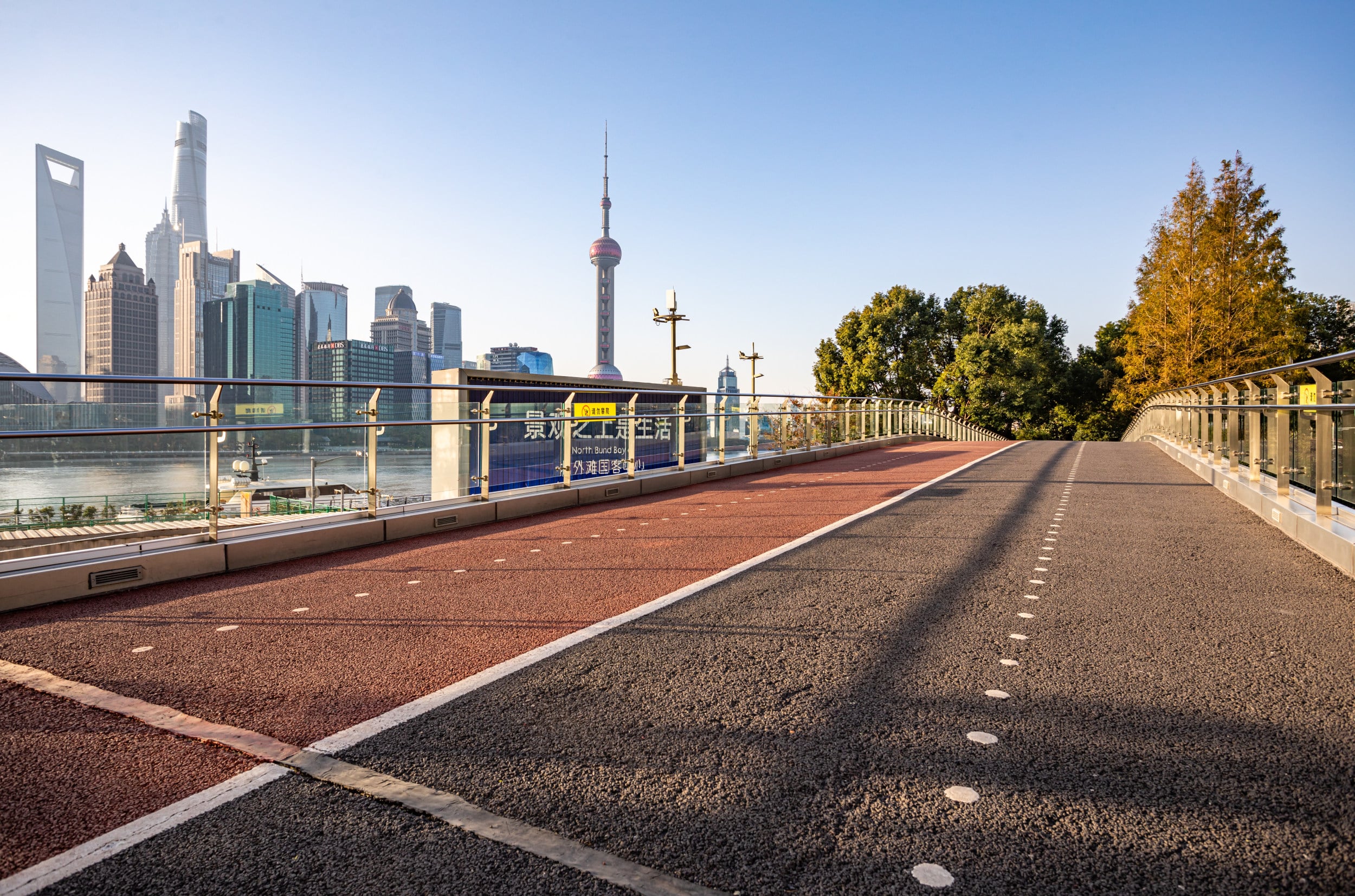
Enjoy a selected section of the Bund rather than planning to walk the entire waterfront.
Plan Around Comfort, Not an Age Category
Start with what feels comfortable on an ordinary day: how long you enjoy walking, whether standing in a queue is difficult, whether stairs are manageable and whether you prefer to return to the hotel after lunch. Discuss these details before choosing the sights.
If travelling with companions, use the pace of the person who needs the most time for the shared route. More energetic members can add an optional walk without making it compulsory for everyone.
| Your preference or requirement | A useful planning approach | Confirm before travelling |
|---|---|---|
| Comfortable walking but fewer complicated journeys | One sightseeing area per day and direct transport where practical | Entrance location and the return route |
| Short walking periods with regular sitting | One main attraction, nearby lunch and a hotel break | Seating, queue arrangements and distance between stops |
| Walking stick or rollator | Avoid unnecessary stairs and uneven historic routes | Lift access, thresholds and where the aid can be used |
| Wheelchair use with transfer into a car | A vehicle with suitable access and room for the folded chair | Seat height, transfer requirements and luggage capacity |
| Remaining in a wheelchair during transport | A specifically arranged wheelchair-accessible vehicle | Ramp or lift, securement system, dimensions and provider capability |
| Sensitivity to heat, crowds or noise | Shorter visits at suitable times, with an indoor alternative | Weather, exhibition demand and quiet areas |
A useful starting rhythm is a morning visit, seated lunch, an afternoon rest and an optional short outing. If you prefer later starts, move the main activity after breakfast and remove the evening stop. The itinerary should serve your routine rather than force you to follow somebody else’s.
Understand Walking Distance Before Choosing a Route
An attraction described as near a station may still require a long underground passage, a road crossing and a walk to a different entrance. A taxi avoids the station corridors, but it may not be allowed to stop beside the ticket gate.
Consider four separate parts of the route:
- The journey from the hotel room to the vehicle or station, including any entrance steps.
- The transport journey, with changes, waiting and access to lifts.
- The route from the drop-off point or station exit to security and admission.
- Walking and standing inside the venue, followed by the complete return journey.
Ask for metres as well as minutes where the distance matters. A five-minute walk estimated for a brisk walker may take much longer with a walking aid, traffic lights or crowded pavements. Check whether the estimate includes the entrance approach and whether there is somewhere to sit before admission.
Instead of prescribing a daily kilometre target, agree a walking limit that works for you. You might prefer short walking blocks with a seated break between them. Tell a guide whether standing is more tiring than walking, and whether stairs are acceptable with a handrail. Those details are more useful than a general request for an easy tour.
The routes below are planning suggestions. They have not been surveyed as continuous wheelchair routes, and exact distances depend on the hotel, entrance, chosen galleries and pick-up point. Where uninterrupted step-free access is essential, ask for a route-specific assessment before committing.
Where to Stay in Shanghai
For a short visit, one well-chosen hotel usually makes life simpler than moving between several properties. Choose the location around your main activities and the ease of returning for rest. A prestigious address or a room with a skyline view does not necessarily give you the most convenient entrance or transport.
People's Square: Useful for a Central City Stay
People’s Square can work well for a visit focused on central Puxi, Shanghai Museum’s People’s Square building and short trips towards the Bund. There are varied hotel and dining options in the wider area.
The station is a major interchange, so proximity to it should not be the only deciding factor. Check the actual hotel entrance, the useful station exit and the lift route rather than accepting a broad near-the-Metro description. A hotel with a practical vehicle entrance may be a better fit if you intend to use taxis most days.
Jing'an and Nanjing West Road: Good for Local Meals and Short Outings
This area can suit travellers who want museums, neighbourhood walks and convenient dining without spending every day at the riverfront. Choose the exact block carefully: the area is large, and a busy road or awkward junction can affect a short walk more than the map suggests.
Check noise, lift access and where taxis collect passengers. Being close to a café is useful only if the route to it is manageable and there is suitable seating once you arrive.
The Bund Area: Choose Access as Carefully as the View
A hotel near the Bund can be appealing for architecture and short waterfront visits. Older buildings, however, differ in their entrances, room layouts and internal access. Modern facilities should be confirmed for the specific property and room category.
Ask about the route to the promenade, whether it crosses a major road and the nearest suitable access point. A riverside address does not mean you can step directly from the lobby onto a level walking route.
Pudong: Choose It for a Pudong-Focused Plan
Pudong is a sensible base if your priorities include Shanghai Museum East, science-related experiences or a particular skyline attraction. Distances within Pudong can be substantial, so decide whether Lujiazui or the Century Avenue/Huamu area better suits the actual itinerary.
Do not assume all Pudong sights are close together. A hotel convenient for an observation tower may still require a separate journey to Museum East. For a mostly Puxi itinerary, weigh the repeated river crossings before choosing a Pudong base.
| Area | Suits a visit centred on | Main check |
|---|---|---|
| People’s Square | Central museums and short city journeys | Hotel entrance and the useful station exit |
| Jing’an/Nanjing West Road | Local dining, museums and neighbourhood time | Actual walking route, road crossings and traffic noise |
| Bund area | Riverfront and historic architecture | Promenade access and the property’s internal layout |
| Lujiazui | Skyline experiences in Pudong | Vehicle access and walks between large buildings |
| Century Avenue/Huamu | Museum East and nearby Pudong activities | Distance to the specific venue entrance |

What to Ask the Hotel Before Booking
Describe the requirement precisely. If you need a step-free room route or an accessible bathroom, ask for confirmation of the actual room that will be allocated, with recent photographs or measurements where necessary.
Useful questions include:
- Is there a step-free route from the vehicle drop-off to reception and the room?
- Is a lift available for every level needed, and will the wheelchair or rollator fit?
- Does the bathroom have a shower threshold, a bath or a genuinely level-entry shower?
- Are grab rails, a suitable shower seat and enough manoeuvring space available?
- How high is the bed, and is there space on the side needed for transfer?
- Can breakfast be reached without stairs, and is there a quiet place to sit?
- Can the hotel arrange transport with the specific vehicle features required?
A room on a lower floor is not a substitute for step-free access. An accessible-room label is also not enough to confirm that the layout suits every wheelchair or transfer method. Ask the hotel to distinguish confirmed features from requests that remain subject to availability.
Transport with Fewer Changes
Taxis: A Practical Choice for Short Direct Journeys
Taxis can remove the need for station transfers and help with the return journey after sightseeing. Keep the hotel’s name and address in Chinese, plus the name of the correct attraction entrance. Ask the hotel to help arrange a vehicle if using an unfamiliar app would complicate the day.
Check the legal drop-off and collection points. Busy roads, pedestrian zones and security restrictions can prevent a vehicle from stopping at the entrance. Agree where to meet and make sure that location is manageable after the visit.
A standard taxi is not automatically a wheelchair-accessible vehicle. If you can transfer into a car, check door opening, seat height and storage for the chair. If you need to remain seated in a wheelchair, arrange the appropriate vehicle in advance and verify the ramp or lift and securement arrangements.
Private Transfers: Specify What the Booking Includes
A booked transfer can be useful for airport arrivals, hotel journeys or sightseeing with a clear pick-up plan. Tell the provider the number of travellers, amount of luggage, mobility-aid dimensions and any assistance required.
Ask whether the driver meets you inside the terminal or at a vehicle collection point, whether waiting time is included and what happens if a flight is delayed. Specify the terminal and flight number. A driver service does not automatically include carrying luggage through the airport, pushing a wheelchair throughout the visit or providing personal assistance.
For a sightseeing vehicle, confirm whether it remains available during the day or provides separate point-to-point rides. Waiting, parking, additional stops and overtime should be clear before travel. The ability to take a direct journey is often more valuable than fitting in another attraction.
Metro: Choose Simple Journeys and Verify the Lift Route
The Shanghai Metro can be convenient when the journey is direct and both ends have suitable access. However, a journey without a line change can still involve long passages or a distant lift entrance.
Check the station’s current accessibility information and ask staff about the full route from street to platform and back to street. Some lift arrangements need staff assistance. If using a wheelchair, ask about platform boarding assistance and the arrangements at the destination station before starting.
Shanghai Metro publishes station lift and toilet information, which distinguishes self-service and staff-assisted facilities. Confirm the live information with the operator; do not treat an old exit plan as a current access check. Confirm current availability for the specific journey; do not rely on an old station plan or assume every exit has a lift. Avoid unnecessary interchanges when a direct taxi or a different attraction achieves the same purpose.
Airport Arrivals: Keep the First Day Light
After a long flight, allow time for airport formalities, luggage collection and reaching the hotel. Book airline or airport mobility assistance in advance if needed and clarify where responsibility passes between the airline, airport staff and transfer provider.
A train connection can be useful, but calculate the whole journey with luggage and the final hotel approach. A direct car may be more comfortable when you want fewer transitions. Do not make a timed museum visit depend on an uncertain arrival process.
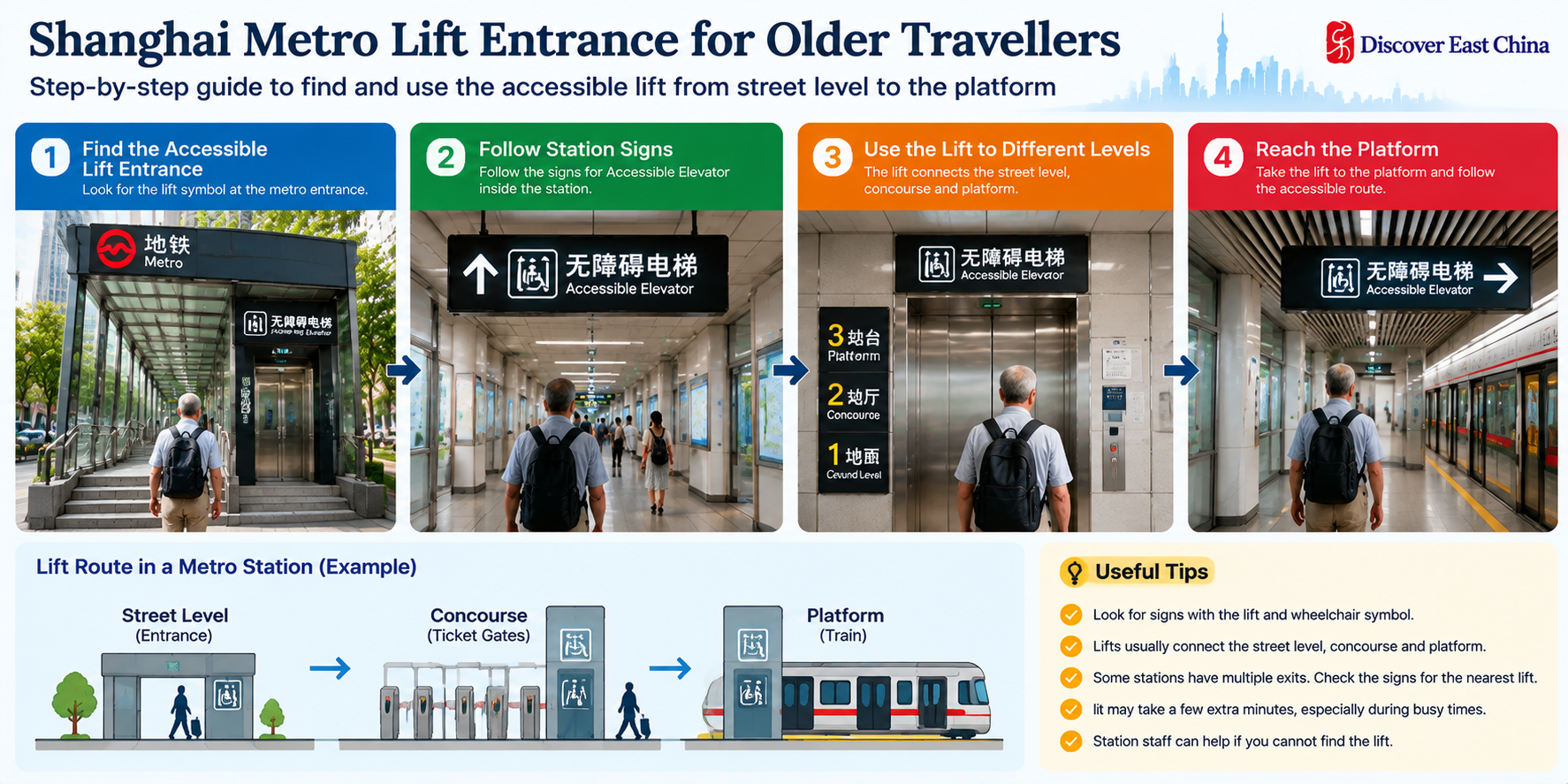
Check the lift entrance for your exact station and confirm the route through to the platform.
Comfortable Shanghai Experiences and Their Access Checks
The Bund: Enjoy a Selected Section
The Bund offers a rewarding view of both historic Puxi architecture and the Pudong skyline. You can appreciate it from a short section without walking the whole riverfront or adding a shopping street afterwards.
Choose an arrival point, a manageable stretch and a return collection point before leaving the hotel. Allow around 30–60 minutes as an initial visit plan, including pauses, and shorten it if conditions are uncomfortable. This is a suggested visit length, not a measured walking route.
Check the specific way up to the promenade. Do not assume every street connection has the same ramps or lift provision. Ask about temporary barriers, crossings, toilets and places to sit. Bring the daytime route forward or replace it with an indoor visit when wind, heat, rain or crowding makes the experience less enjoyable.
For evening views, make the skyline the main evening activity and arrange a straightforward return. There is no need to combine a long walk, dinner across town and a late cruise.
Shanghai Museum: Choose the Branch and a Few Galleries
Shanghai Museum has two principal locations: the People’s Square building at 201 Ren Min Da Dao in Puxi and Museum East at 1952 Century Avenue in Pudong. Confirm where your chosen collection or exhibition is displayed before arranging transport.
Museum East’s official visitor information lists accessible lifts, accessible toilets and free museum-only wheelchair loans; a valid ID or a RMB 300 deposit is required for a loan. Individual admission does not currently require a general reservation, but selected areas and ticketed exhibitions have separate arrangements. Its published hours are 10:00–18:00, with last entry at 17:00 and Tuesday closure except national holidays.
The East venue also publishes a North Gate priority channel for visitors aged 65 and above and certain other eligible groups. Confirm document acceptance and the step-free approach for your circumstances; that channel does not include separately ticketed experiences.
For People’s Square, consult the current branch visitor guidance. During the Americas exhibition, from 9 July 2026 to 14 November 2027, no other exhibitions are shown at this branch; permanent Chinese-art collections are at Museum East. Its service information lists lifts and wheelchair provision, but confirm the route and loan arrangements directly. Do not apply East-branch rules to the other building.
Choose one or two galleries and plan a seated break. Around 60–90 minutes can be a comfortable first visit, with more time if you want it. A large museum still involves standing and walking even when lifts are available.
Yu Garden: Attractive, but Assess the Surfaces First
Yu Garden offers classical garden scenery within the old-city area. It can suit travellers who enjoy traditional architecture and are comfortable with uneven surfaces, but it should not be described as an uncomplicated step-free route.
The garden’s official visitor guidance warns of uneven paths, steps, stone bridges, slopes and other obstacles. It also highlights slippery conditions in rain and notes that the garden is intended for walking visits. Wheelchair or pushchair use requires care; this does not establish access to every part of the garden.
Ask the venue which sections suit your needs and whether an alternative route avoids the obstacles that matter to you. A companion can help with planning, but companionship does not remove a physical barrier. If stairs or balance are a significant concern, choose another main attraction rather than relying on an improvised workaround.
The surrounding bazaar is a separate experience. Crowds, paving and the route to a restaurant still need checking. Avoid promising a garden visit, bazaar walk and distant afternoon attraction as one easy outing.
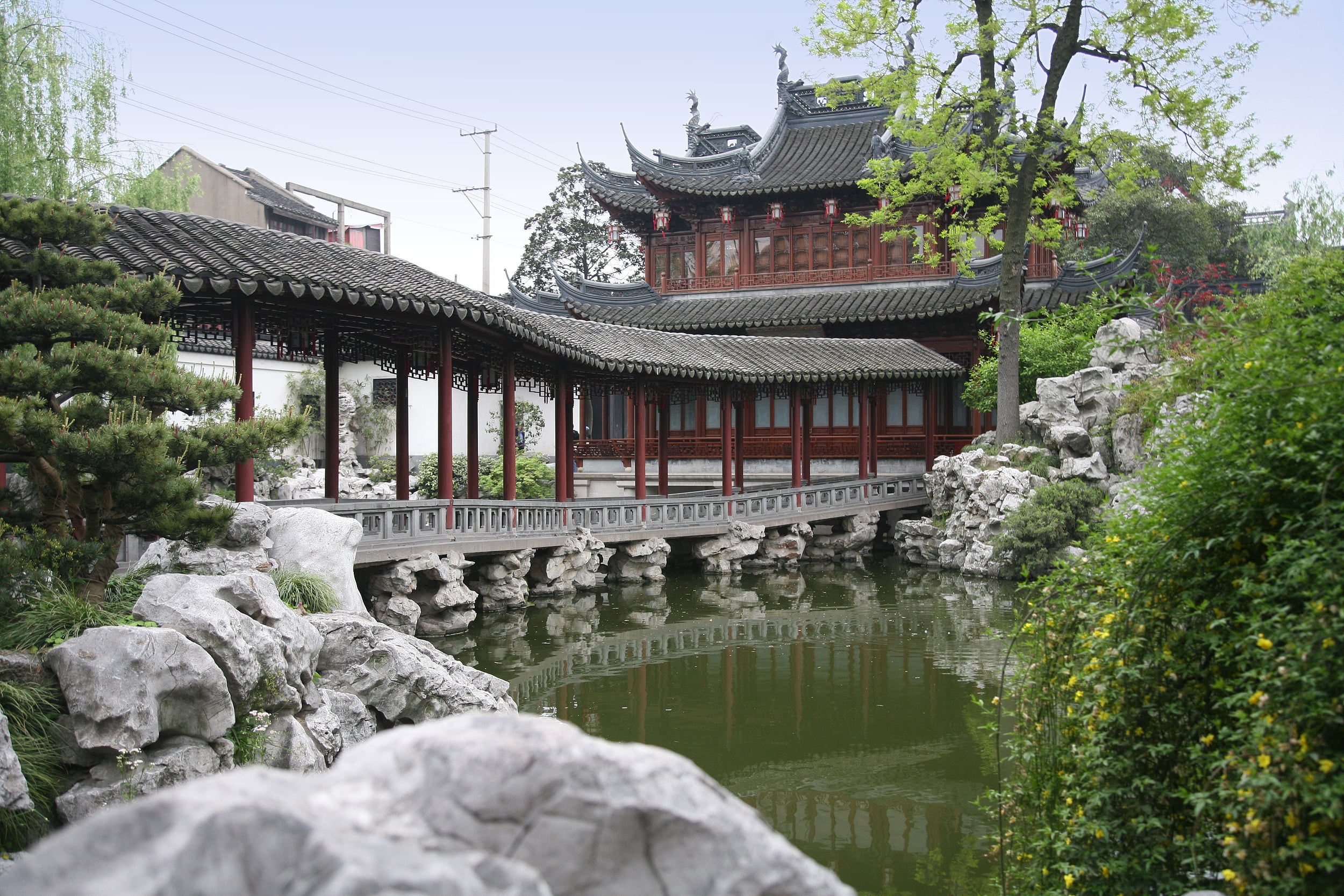
Yu Garden's historic paths and bridges require more careful access planning than a modern indoor venue.
A Skyline Observation Visit: Lifts Do Not Remove Every Queue
A visit to an observation deck can provide a memorable city view without a long outdoor walk. Shanghai Tower’s official observatory information identifies its main observatory on the 118th floor, reached by lift.
Before booking, confirm the actual observation product, visitor entrance, security approach, queue arrangements, toilets and lift access throughout the ticketed route. The tower’s general customer-service information mentions wheelchair rental, but that is not confirmation of observatory-specific availability or access to every add-on.
Check visibility before committing to a skyline-focused visit. Poor weather can reduce the view even if the attraction remains open. Consider a daytime slot that fits your rest routine rather than a late visit after an already busy day.
A Huangpu River Cruise: Check the Boat, Not Just the Pier
A sightseeing cruise can offer a seated way to enjoy the riverfront once on board. Boarding is the part that needs particular attention: the route to the pier, gangway slope, steps, movement between decks and toilet arrangements vary by vessel and operating conditions.
Ask the actual operator whether you can remain in your wheelchair, whether a companion is required and whether the accessible route reaches the seating area you want. Request the vessel details for the booked departure where possible. A daytime sailing may be easier to fit into an unhurried schedule, but crowd levels and boarding arrangements still matter.
Do not treat public ferries and sightseeing cruises as interchangeable. They have different routes and operating arrangements. Senior discounts also depend on the product, documentation and eligibility; confirm them instead of assuming one rule applies to all boats.
Parks and Neighbourhoods: Choose a Small Area
A local park or a short neighbourhood walk can be a pleasant alternative to another ticketed attraction. Choose one that is genuinely convenient for your hotel and has an appropriate entrance and return route.
In leafy streets, look at pavement width, kerbs and road crossings rather than the appearance of the district in photographs. A café can provide a useful pause only if its entrance, seating and toilet meet your needs. Historic interiors may have stairs even where the surrounding pavement is manageable.
Ask about benches and toilets near the chosen park gate. A large park can add considerable walking if the entrance is far from the section you want. You do not need to complete a circuit to enjoy the surroundings.
What Has Been Verified, and What Still Needs Confirmation?
Accessibility is specific to a route and a person. The table below separates published information checked for this guide from operational details that cannot be settled by a general description.
| Place or service | Published information checked | Confirm for your visit |
|---|---|---|
| Shanghai Museum East | Lifts, accessible toilets and wheelchair loans are listed | Entrance approach, lift availability, chair availability and suitability |
| Shanghai Museum, People’s Square | Service information lists lift access and wheelchair provision | Current admission notice, precise entrance and loan procedure |
| Yu Garden | Official guidance identifies uneven paths, steps, bridges and slopes | Which sections are usable for your mobility requirements |
| Shanghai Metro | Station information distinguishes different lift and assistance arrangements | Exact street entrance, transfers, boarding help and destination exit |
| Shanghai Tower observatory | Lift access to the main observatory is described | Full ticketed route, queues, toilets and mobility-aid arrangements |
| Huangpu sightseeing cruises | Public information describes cruise experiences | Actual vessel, gangway, seating, deck access and toilets |
| Hotel rooms | No individual hotel room has been inspected for this guide | Written confirmation for the allocated room and the complete access route |
| Bund and neighbourhood routes | General destination information is available | A continuous suitable route, present barriers, seating and toilets |
This is a desk-based review of published information, not an on-site accessibility inspection. Exact step counts, gradients, door widths and walking distances are not presented as measured facts. Where those details determine whether a visit is possible, obtain current measurements or a recent site assessment.
A Comfortable Three-Day Shanghai Itinerary
The following plan assumes three full sightseeing days and a hotel selected for the routes. Arrival and departure days require separate allowances. Move museum days to match current calendars and confirmed bookings.
Day 1: A Short Bund Visit and an Easy Afternoon
Have breakfast without rushing, then take direct transport to a preselected access point near the Bund. Enjoy a short section of the waterfront, with time for photographs and architecture. End the walk at an agreed point rather than continuing until everyone is tired.
Have lunch within a convenient journey of your hotel and return for rest. In the late afternoon, decide whether to take a brief local walk or stay in. Dinner near the hotel is a complete evening plan.
If the skyline after dark is a priority, keep the daytime visit shorter and arrange an early evening outing as a separate choice. Avoid extending both outings into long walks.
Day 2: A Focused Museum Visit
Choose the Shanghai Museum branch that holds the collection you want. People’s Square may make sense for a central Puxi stay; Museum East may justify a direct Pudong journey for a specific exhibition or collection. These are alternatives rather than consecutive stops.
Arrive with the correct documents and any required admission booking. Select a small number of galleries, use the appropriate lift route and take a seated break. Do not make an all-floor visit the default.
Follow with a nearby lunch if the restaurant access has been checked, then return to the hotel. A second museum or a long shopping street adds effort without necessarily improving the day.
Day 3: Choose One Experience You Value Most
Choose between a short neighbourhood or park visit, a skyline observatory, a suitable river cruise, or Yu Garden if its conditions match your needs. Keep the transport and afternoon arrangements tied to that choice.
For a Pudong observation visit, stay with a practical meal in that area and a direct return rather than adding a different district. For a neighbourhood day, keep the walk brief and choose a café or restaurant with confirmed access. For a cruise, protect the boarding window and remove the optional stop if it would make the timing tight.
Finish with enough time for packing or a relaxed final dinner. If the previous two days have been demanding, a late breakfast and a local outing are a reasonable final day.
| Day | Main experience | Rest arrangement | Optional addition |
|---|---|---|---|
| 1 | A selected section of the Bund | Lunch and hotel rest | A short local outing or an early evening view |
| 2 | One Shanghai Museum branch | A seated museum break, lunch and hotel rest | A nearby meal, rather than another major attraction |
| 3 | One park, neighbourhood, skyline, garden or cruise choice | A break appropriate to the selected activity | Only a nearby stop that still feels comfortable |
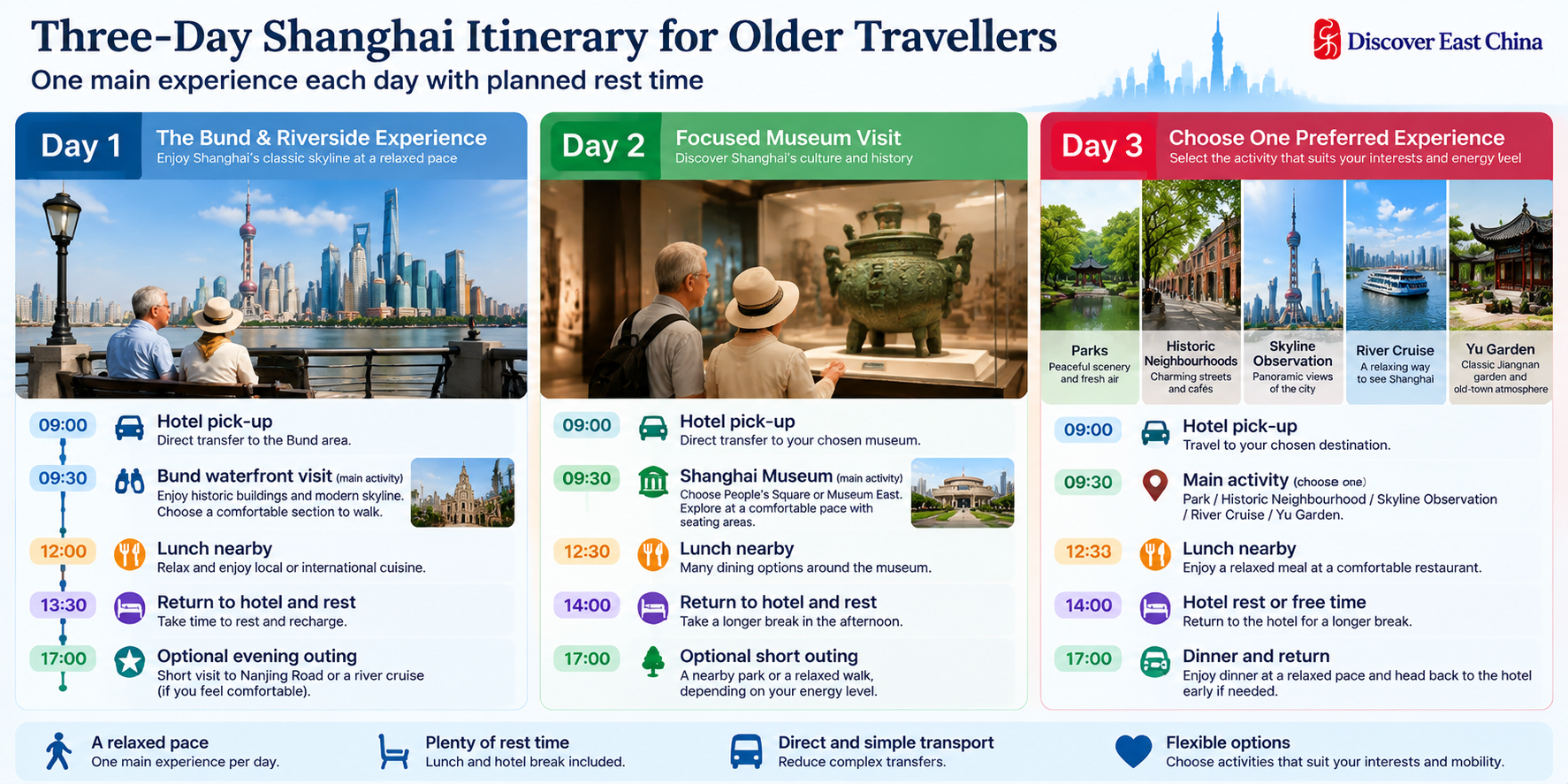
One main experience per day leaves space for meals, rest and a straightforward return.
Reservations, Documents and Senior Concessions
Check the exact attraction, date, admission category and identity-document requirements. An attraction that permits walk-in general admission may still require a separate ticket or booking for a temporary exhibition, film or special session.
Use official channels or a clearly identified authorised seller. If a booking process requires a local phone number or an interface you cannot comfortably use, ask your hotel or travel organiser to help before the travel day. Do not wait at the entrance expecting staff to resolve a sold-out slot.
Senior concessions differ between venues. Eligibility can depend on age, accepted documentation and the specific product. An overseas passport may establish date of birth but should not be assumed to satisfy every concession scheme. Ask whether the stated benefit applies to overseas visitors and whether you still need a reservation.
Priority admission does not necessarily remove security, ticket checks or all queues. It also does not establish access to a separate exhibition. Keep confirmation of what has actually been booked and what remains to be paid or arranged.
For a guided visit, confirm whether the guide accompanies you inside, whether the venue permits that type of guiding and whether the service includes assistance with the entrance process. Transport, admission and guiding are separate items unless the proposal explicitly combines them.
Arrange Pick-ups Around the Real Entrance
Give the driver the branch name, entrance and collection instructions, not just the attraction name. This is particularly important for large museums and buildings with different visitor, group or service entrances.
Agree a practical meeting point and how to contact the driver. Ask whether the vehicle can wait, whether you need to request it before leaving the attraction and what to do if the first collection point is unavailable. Keep the Chinese location details accessible on your phone or on paper.
Allow enough time between admission and the next transport commitment. If a gallery is busy or the accessible route takes longer, you should be able to shorten the visit without missing a prepaid departure elsewhere.
For mobility support, describe tasks plainly. Assistance with a folded wheelchair, a boarding ramp, luggage or navigating an entrance should be confirmed individually. Do not assume a guide or driver is equipped to lift a person or provide personal care.
Meals, Toilets and Rest Are Part of the Route
Choose lunch before starting the morning activity. An appropriate restaurant near the exit is often more useful than a famous one that requires another long journey.
Check the entrance, table spacing and the toilet route. A ground-floor dining room may still have a step at the door, and its toilet may be upstairs. Ask whether there is suitable seating and whether the restaurant can accommodate your mobility aid without blocking circulation.
For a museum break, follow the venue’s rules on food and drinks. Identify the designated café or rest area instead of assuming you can eat in a gallery. Do not rely on finding an empty bench at a busy time; keep a flexible alternative.
If returning to the hotel is important, choose the morning visit accordingly. A lengthy return trip can use much of the rest period. On some days, a comfortable seated lunch near the attraction followed by a direct return is simpler than adding an afternoon programme.
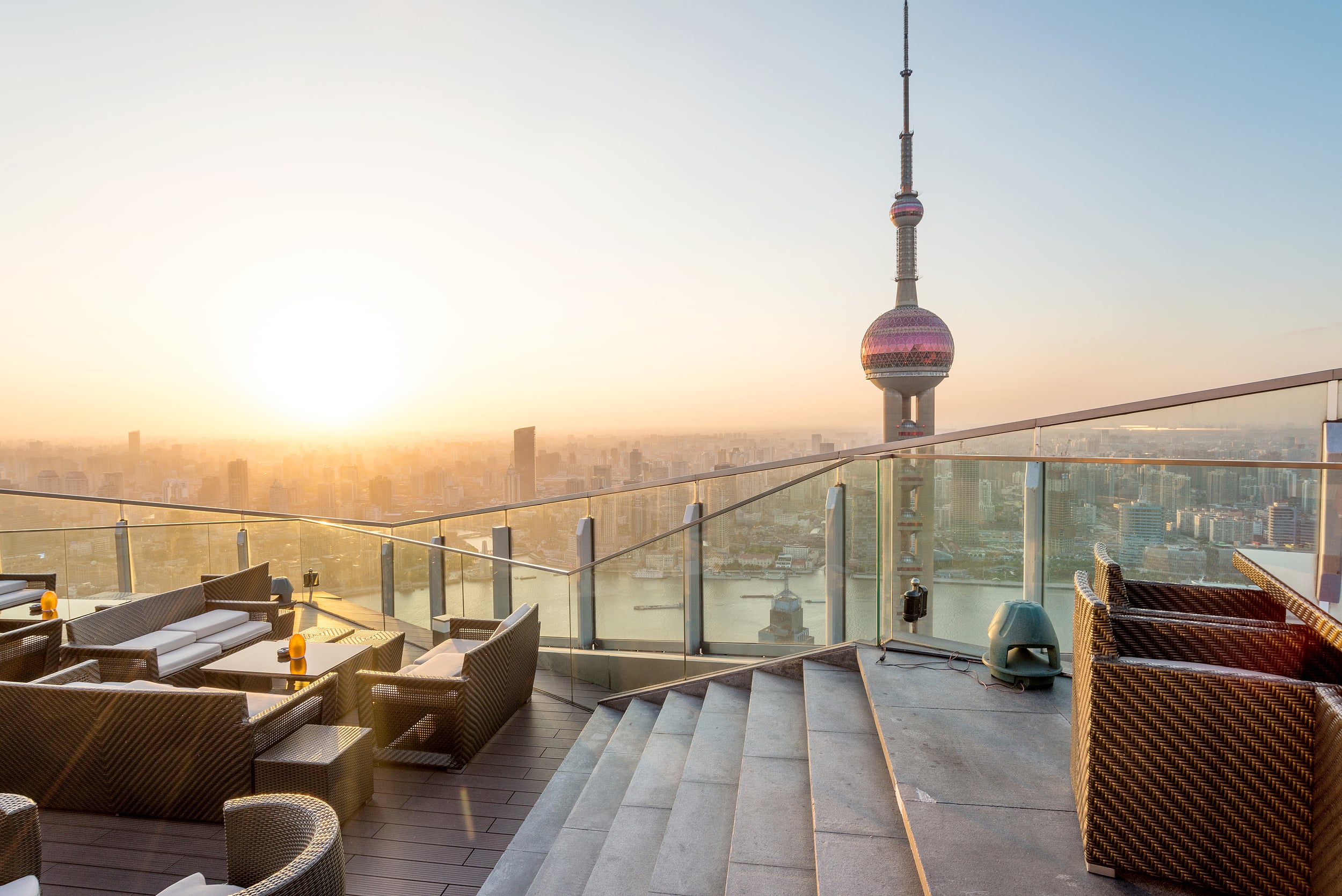
This Shanghai terrace has visible steps. Check the entrance, seating and toilet route before choosing a rest stop.
Rain, Heat and Busy Days
Keep an indoor alternative in the same part of the city. A museum can be useful when admission is available, but it is not automatically a quiet or queue-free rain option. Check the opening calendar and any booking requirement before leaving the hotel.
Rain can make historic paving and bridge approaches more difficult. If your main activity is Yu Garden or a neighbourhood walk, replacing it with a suitable indoor visit may be more comfortable than trying to complete the original plan under an umbrella.
In hot or cold weather, shorten outdoor periods and choose rest locations that suit the conditions. A riverside route can feel very different from a sheltered street. Build the plan around the actual forecast rather than keeping a fixed outdoor timetable.
Public holidays and popular exhibitions can increase crowding. If your dates are fixed, reduce the number of commitments and allow more time for entrance procedures. If an attraction becomes uncomfortable, leave or choose a shorter visit rather than treating the full route as an obligation.
Should You Add a Water Town, Another City or Disneyland?
An extra excursion can be worthwhile when it matches your interests, but it should replace a main day rather than being added to an already full one.
Zhujiajiao offers canals and historic streets within Shanghai’s wider municipality. Its return journey, bridges, steps, uneven paving and boat-boarding arrangements need their own assessment. Being geographically within Shanghai does not make it a short or fully accessible outing. Ask for a specific route, not a general assurance that the town is suitable.
Suzhou or Hangzhou can be rewarding on a longer East China trip. Include the full station journey, boarding process, local transfers and walking at the destination when comparing a day trip with an overnight stay. A fast train does not eliminate those stages. Avoid a different return excursion every day if you want a restful Shanghai base.
Shanghai Disneyland is a personal-interest choice rather than a necessary part of the itinerary. A visit can involve substantial walking, standing, crowds and a long return journey. If you want to include it, give it a separate day, review attraction health and mobility requirements and plan breaks and an early-exit option. Accessibility services do not remove ride-specific rules or guarantee immediate boarding.
A Practical Access Checklist Before Departure
The most useful confirmations are specific and written. For a hotel or attraction, you can ask:
I use [a walking stick / a rollator / a wheelchair] and can comfortably walk about [your own distance]. I can manage [your own limit] steps, or I need a continuous step-free route. Please confirm the entrance, distance from the vehicle drop-off, lift route, toilet access and any assistance that needs to be booked.
For a wheelchair vehicle, add the chair’s width, length and combined occupied weight where requested by the provider. State whether you can transfer to a vehicle seat. Send measurements securely to the supplier who needs them rather than relying on a generic vehicle description.
Before each outing, check:
- The right venue and branch, current opening status and required booking.
- The documents needed for admission or concessions.
- The exact drop-off point and the route to the entrance.
- The availability of required lifts, assistance or mobility equipment.
- Where to sit, eat and use a suitable toilet.
- The agreed return collection point and a contact method.
- An alternative if the chosen route or facility is unavailable.
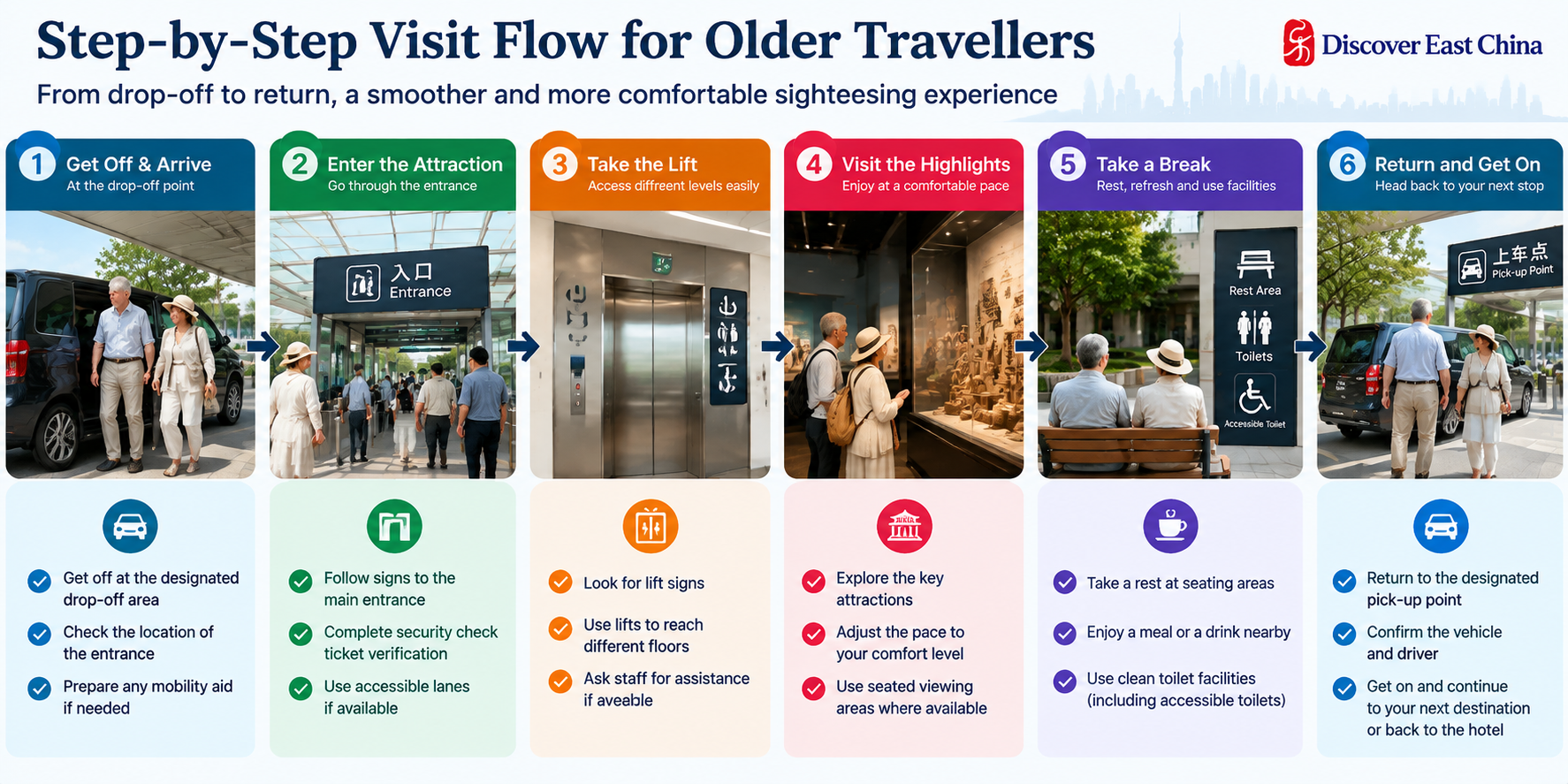
Confirm the whole route: a lift inside the venue does not resolve every stage of the journey.
Frequently Asked Questions
1. Is Shanghai suitable for older travellers?
It can be, with a route matched to individual interests and mobility. Direct transport, a convenient hotel and shorter visits can make the city more comfortable. Age alone does not determine the right itinerary.
2. Which hotel area is best for a first visit?
People’s Square or Jing’an can be useful for a central Puxi stay, while Pudong can suit a Pudong-focused plan. Choose the actual property by entrance access, room layout, meals and the ease of returning for rest.
3. Should we use taxis instead of the Metro?
Taxis can reduce changes and station walking. The Metro remains an option for simple journeys with suitable lift access. Compare the complete journey rather than the transport time alone.
4. Are all Shanghai Metro exits step-free?
Do not assume so. Check the specific station entrance, internal route and destination exit. Some facilities or boarding arrangements may need staff assistance, and current operating conditions should be confirmed.
5. Can a standard taxi take a wheelchair user?
That depends on whether the traveller can transfer, the vehicle layout and storage space. If remaining in the chair is essential, book a suitable wheelchair-accessible vehicle and confirm its equipment in advance.
6. How much walking should we plan each day?
Use your own comfortable limit and include station passages, queues and venue interiors. Short walking periods with breaks may suit better than one long route. The suggested itineraries do not claim a measured universal walking distance.
7. Is the Bund an easy visit?
A short section can be manageable, but confirm the approach, crossings, suitable access point and return transport. Crowd levels and weather affect comfort, and seating should not be assumed at every point.
8. Which Shanghai Museum branch should we choose?
Choose the branch with the collection or exhibition you want and a practical journey from your hotel. People’s Square and Museum East have different addresses and admission arrangements. Do not treat them as interchangeable stops.
9. Can we borrow a wheelchair at a museum?
Some museums publish wheelchair-loan services, including Shanghai Museum East. Confirm availability, identification or deposit requirements and the area where the chair may be used. A loan is not automatically reserved with admission.
10. Is Yu Garden fully wheelchair-accessible?
This guide does not make that claim. The official guidance warns of uneven paths, steps, bridges and slopes. Ask which sections can meet your requirements, or choose an alternative if a continuous step-free route is essential.
11. Is a river cruise easier than a walk?
It can provide seated sightseeing once aboard, but the pier and vessel may introduce access barriers. Confirm gangway, steps, seating, toilets and the particular departure before booking.
12. Do older visitors get free or discounted admission?
Policies vary by attraction and product. Check the age threshold, documents and whether overseas visitors qualify. A concession does not necessarily remove reservation requirements or cover special exhibitions.
13. Can a guide handle attraction reservations and transfers?
Only where those services are included and confirmed. Ask for a clear breakdown of admission, vehicle use, guiding and assistance. Venue rules may also restrict how outside guides operate inside galleries.
14. What should we do when it rains?
Choose an available indoor activity near the day’s area or take a rest period. Avoid uneven historic routes in slippery conditions. Check admission before substituting a popular museum at short notice.
15. Should we add a day trip to Suzhou or Hangzhou?
Add it if the destination is a priority and the full return journey is comfortable. For a longer holiday, an overnight stay may reduce repeated travel, but hotel changes also require effort. Keep the Shanghai schedule light around the excursion.
16. What should we tell a travel organiser before booking?
Explain walking and standing tolerance, stair limits, mobility-aid use, vehicle-transfer needs and preferred rest routine. Ask for specific access confirmations rather than a general promise of an easy or accessible tour.
Build a Shanghai Visit Around Your Preferred Pace
A comfortable itinerary begins with your priorities: the places you most want to see, the amount of walking you enjoy and the support that makes a journey straightforward. Those details can guide the hotel area, attraction choice and daily transport plan.
Discover East China Tours can help shape a Shanghai visit or a wider East China journey with fewer changes and time for rest. Share specific mobility requirements before requesting a proposal. Any accessible vehicle, room feature, wheelchair provision or additional assistance should be confirmed explicitly in the final arrangements.
Prepared for Discover East China Tours. Updated: 13 October 2026.