
Understand Shanghai’s transit visa-free eligibility, onward routing, entry ports and permitted areas before planning an East China stopover.
Policy checked: 14 October 2026. This guide explains the published rules checked on that date. Check the official nationality list, ports, permitted areas and entry conditions again before booking and shortly before departure. Immigration authorities decide whether to grant entry; a flight booking or tour reservation does not establish eligibility.
Shanghai can be a rewarding stop between international journeys: a few days for the Bund, museums and neighbourhood walks, or a longer visit that includes Suzhou, Hangzhou or parts of Anhui. China’s transit visa-free policy can make such a stop possible without obtaining a visa in advance, provided your passport, international route and plans in China meet the requirements.
The key word is transit. The 240-hour policy is designed for travel through mainland China to a different country or region. It is not a general ten-day tourist visa exemption for every visitor, and it does not give permission to travel throughout China without geographic limits.
Start by choosing the correct basis for entry. Some travellers qualify for ordinary visa-free entry, which may be simpler for a return trip to Shanghai. Others can use the 240-hour transit policy only with an eligible onward itinerary. For a short airport connection, the separate 24-hour transit policy may be relevant, but leaving the airport’s restricted area requires permission.
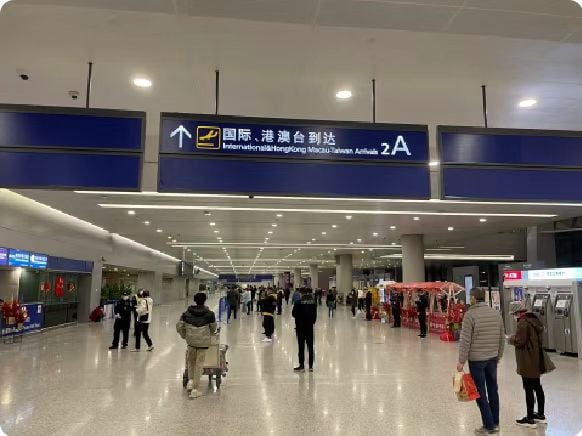
Plan your Shanghai stop around a verified entry basis and a confirmed onward journey.
Shanghai Transit Visa-Free Travel at a Glance
As checked on 14 October 2026, the National Immigration Administration (NIA) lists 57 eligible nationalities, 65 designated ports and permitted travel areas in 24 provincial-level regions for the 240-hour transit policy. Kyrgyzstan and Vietnam were added on 20 August 2026. Older articles may still describe 54 or 55 countries, 60 ports, or the earlier 72-hour and 144-hour arrangements.
Those headline numbers are only a starting point. You must still satisfy every applicable condition.
| Question | Current planning rule |
|---|---|
| Who can use the 240-hour policy? | Eligible nationals holding ordinary passports and meeting the published transit requirements. |
| What international route is required? | Arrival from one country or region and onward departure from mainland China to a different country or region. |
| What onward evidence is needed? | A confirmed onward departure date and seat, with the complete itinerary available for inspection. |
| Where can you enter? | A designated port in the current NIA table. Pudong and Hongqiao airports are included. |
| Where can you travel? | Within the published permitted areas, including authorised travel across provincial boundaries. Some provinces are only partly covered. |
| How long can you stay? | Up to 240 hours under the policy, subject to the temporary entry permission actually granted. |
| Is entry guaranteed? | No. The immigration inspection authority makes the decision on arrival. |
| What activities are covered? | Tourism, business visits, visits and family reunions; activities requiring prior approval still need the appropriate permission and visa. |
Use the NIA’s current visa-free transit policy and port table as the principal reference. If an older FAQ conflicts with a newer announcement, check the effective dates and obtain clarification rather than combining the most favourable parts of different versions.
Which Entry Arrangement Applies to Your Trip?
There are several routes to lawful entry, and their conditions should not be mixed together.
| Arrangement | Main purpose and conditions | Implication for a Shanghai visit |
|---|---|---|
| 240-hour visa-free transit | Eligible ordinary-passport nationality, qualifying third-country or third-region transit, designated ports and permitted areas. | Suitable for a planned stop between international journeys when all conditions are met. |
| 24-hour visa-free transit | Published for nationals of all countries with valid travel documents and confirmed onward international transport; remaining in the port’s restricted area is central to the exemption. | A short connection does not automatically authorise city sightseeing. Obtain a temporary entry permit before leaving the restricted area. |
| Ordinary visa-free entry | A unilateral policy or mutual agreement applicable to your nationality, passport, travel purpose and dates. | A third-country transit route is not normally required under these schemes. The specific agreement or announcement governs your stay. |
| Entry with an appropriate visa | The visa category and its conditions match your journey. | Relevant if your nationality, purpose, routing, duration or intended travel area does not fit an applicable exemption. |
A nationality appearing on the transit list does not necessarily appear on the ordinary visa-free list. Nor does permission for an airport transit establish permission for a holiday outside the airport.
If you qualify for ordinary visa-free entry, check that option before adding an international flight purely to create a transit route. A simpler Shanghai return itinerary may be possible under the ordinary scheme applicable to you.
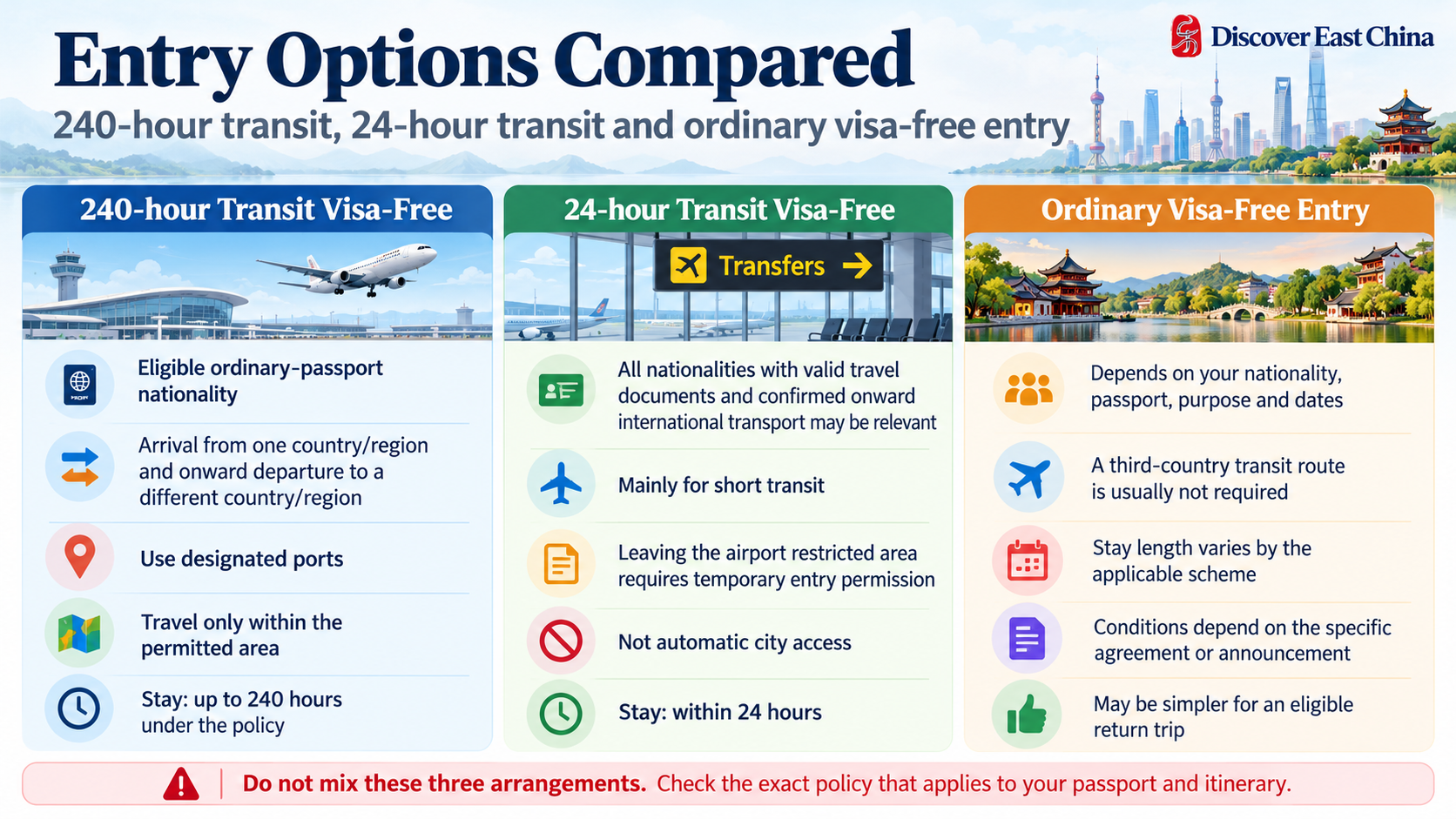
Choose the entry arrangement first: each scheme has its own eligibility, routing and stay conditions.
Who Is Eligible for 240-Hour Visa-Free Transit?
The current nationality list
The following ordinary-passport nationalities are listed by the NIA as eligible on the date of this guide. Citizenship matters: living in an eligible country, holding its residence permit or departing from its airport does not substitute for an eligible nationality.
| Group | Eligible nationalities |
|---|---|
| Europe — 40 | Albania, Austria, Belarus, Belgium, Bosnia and Herzegovina, Bulgaria, Croatia, Cyprus, Czech Republic, Denmark, Estonia, Finland, France, Germany, Greece, Hungary, Iceland, Ireland, Italy, Latvia, Lithuania, Luxembourg, Malta, Monaco, Montenegro, the Netherlands, North Macedonia, Norway, Poland, Portugal, Romania, Russia, Serbia, Slovakia, Slovenia, Spain, Sweden, Switzerland, Ukraine and the United Kingdom. |
| Americas — 6 | Argentina, Brazil, Canada, Chile, Mexico and the United States. |
| Oceania — 2 | Australia and New Zealand. |
| Asia — 9 | Brunei, Indonesia, Japan, Kyrgyzstan, Qatar, Singapore, South Korea, the United Arab Emirates and Vietnam. |
Check every member of your party separately. Children need their own qualifying travel documents and onward arrangements; an eligible parent does not establish a child’s eligibility. For a mixed-nationality family, the entry basis may differ between travellers even when everyone shares the same flights.
Passport validity and onward admission
The published 240-hour conditions specify a travel document with at least three months’ validity, alongside the current policy’s ordinary-passport requirement. Do not treat that minimum as a recommendation to travel with a nearly expired passport. Your onward destination or airline may require a longer validity period.
You must also meet the entry conditions for the next country or region. If it requires a visa, residence permission or electronic authorisation, prepare that evidence as applicable. China’s transit exemption does not waive another destination’s entry rules.
Emergency passports, refugee travel documents, other non-standard documents and complicated nationality circumstances need direct official clarification. Check the exact document you will use rather than relying on a nationality name alone. If you have more than one passport, make sure your bookings and the document presented for Chinese entry form a consistent, verifiable itinerary.
The Routing Rule: Country or Region A → Mainland China → Country or Region B
The usual way to understand the transit condition is A → mainland China → B, where A and B are different countries or regions. This is about your international routing, not whether you are travelling away from or returning to your home country.
For a straightforward non-stop arrival and departure, the comparison is easy. A direct flight from London to Shanghai followed by a direct flight to Tokyo has a different country on either side of the mainland China visit. A direct London–Shanghai–London return does not.
| Example itinerary | Does the basic third-destination routing condition appear to be met? |
|---|---|
| London → Shanghai → Tokyo | Yes: the United Kingdom and Japan are different countries. All other conditions still apply. |
| London → Shanghai → London | No: the country before and after the mainland China visit is the United Kingdom. |
| London → Shanghai → Manchester | No: changing the UK arrival city does not change the country. |
| London → Shanghai → Hong Kong | Yes in principle: Hong Kong is treated as a region for this transit-routing purpose. All other conditions still apply. |
| Los Angeles → Shanghai → Seoul → Los Angeles | The Shanghai transit is between the United States and South Korea. The eventual return to the United States does not itself invalidate that basic comparison. |
| London → Shanghai → Hangzhou → London | No: Hangzhou is in mainland China and does not provide a third-country or third-region destination. |
These examples explain one routing condition, not complete eligibility or an entry approval. The passenger’s passport, onward documentation, permitted area, port and granted stay must also qualify.
Connections can change the answer
Show the whole journey, including connecting airports. The country from which you actually enter mainland China and the country or region you travel to on leaving it can differ from the cities displayed most prominently in a booking summary.
For example, a journey sold as a trip from London to Shanghai may connect through another country before reaching China. The return may also connect through that same country. The ultimate UK endpoints alone do not settle whether the international legs around mainland China meet the transit rule.
Domestic connections raise different issues. The first mainland entry port, any onward domestic sector, the travel areas and the international exit must fit the applicable arrangement. Do not assume that arriving at one airport and flying domestically to Shanghai moves immigration entry to Shanghai or restarts the stay period.
For connecting flights, cruise itineraries, combined air-and-sea travel or multiple mainland entries, give the NIA and airline the exact sequence of ports, dates and flight or sailing details before purchasing a restrictive ticket.
Confirmed onward travel is essential
Prepare ticketed onward travel with the required confirmed date and seat. A plan to buy a flight after arriving, an unconfirmed reservation or a hoped-for standby seat is not the same evidence.
For separately booked flights, keep all confirmations together and ask the airline and immigration authority to assess the complete itinerary. A booking platform’s description of a journey as “transit” does not establish compliance. Equally, do not invent a universal rule that every flight must share the same airline or booking reference: get your actual arrangement checked against the published requirements.
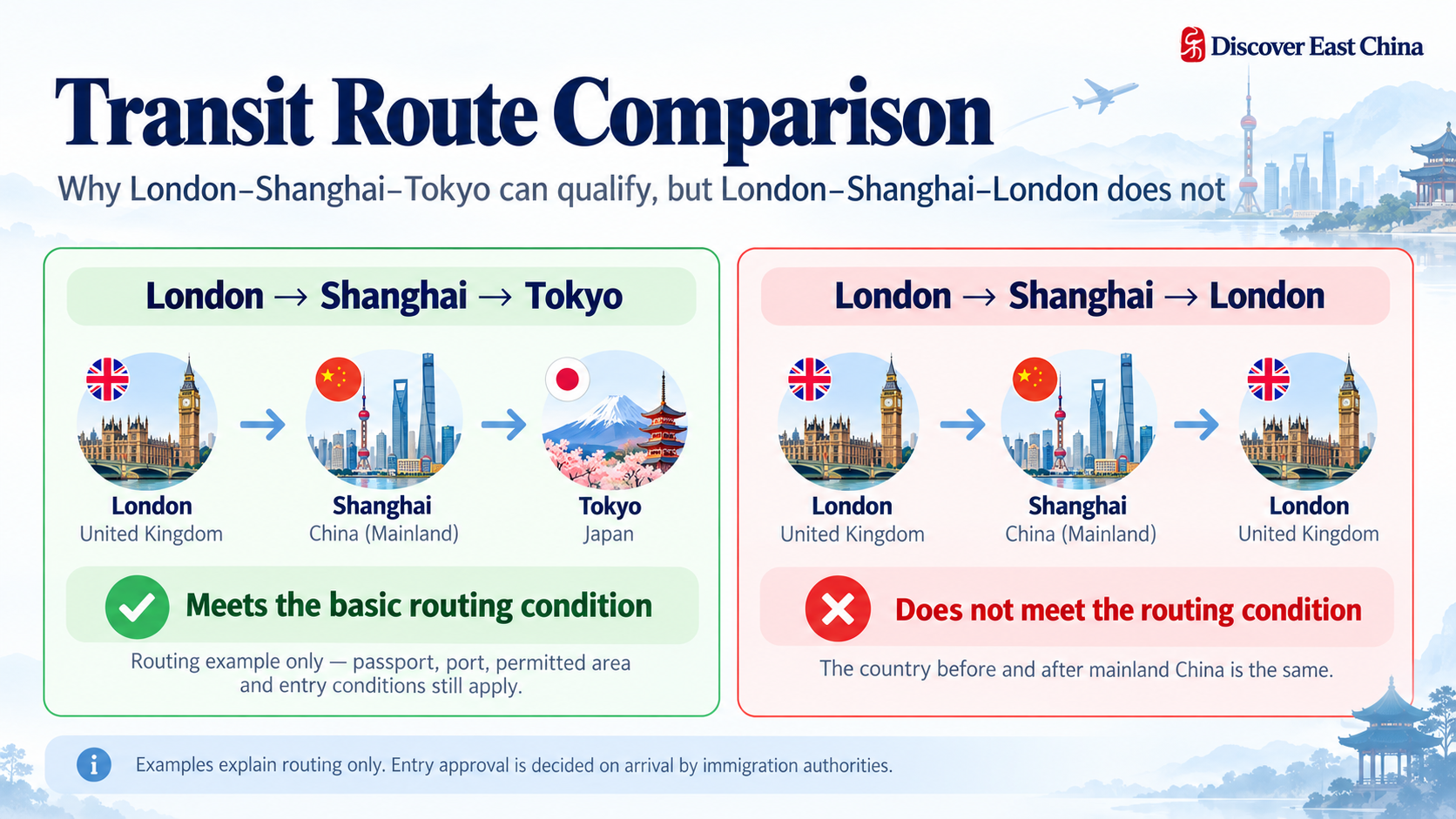
A qualifying transit requires a different country or region on the other side of mainland China; passport and entry conditions still apply.
Which Shanghai and East China Ports Can You Use?
For Shanghai arrivals, Shanghai Pudong International Airport (PVG) and Shanghai Hongqiao International Airport (SHA) are designated ports under the current 240-hour policy. Shanghai Port is also included for qualifying passenger travel.
The airports are different places. Hongqiao Airport is not interchangeable with Pudong Airport, and neither should be confused with Shanghai Hongqiao Railway Station. A domestic train station is not an international entry port simply because its name resembles an airport’s name.
The following selection covers Shanghai and several destinations commonly combined with it. It is not a replacement for the complete official table.
| Provincial-level region | Designated ports in the current table relevant to this guide |
|---|---|
| Shanghai | Pudong International Airport; Hongqiao International Airport; Shanghai Port for passenger travel. |
| Jiangsu | Nanjing Lukou International Airport; Sunan Shuofang International Airport; Yangzhou Taizhou International Airport; Lianyungang Port for passenger travel. |
| Zhejiang | Hangzhou Xiaoshan International Airport; Ningbo Lishe International Airport; Wenzhou Longwan International Airport; Yiwu Airport; Wenzhou Port and Zhoushan Port for passenger travel. |
| Anhui | Hefei Xinqiao International Airport; Huangshan Tunxi International Airport. |
| Jiangxi | Nanchang Changbei International Airport. |
A designated airport does not necessarily have a suitable international flight for your dates. Policy eligibility and practical flight availability are separate checks.
Entry through Shanghai does not inherently require departure from the same Shanghai airport. A different qualifying exit can be possible under the policy, but check the exact exit port and any applicable conditions before building an open-jaw itinerary. Do not assume that every international airport, railway crossing or cruise terminal is available under the 240-hour arrangement.
Cruise passengers should verify the actual passenger port, ship itinerary and entry arrangement with both the carrier and authorities. Different cruise-related visa exemptions exist; do not apply the rules of one to another simply because both involve a ship.
Where Can You Travel After Entering Through Shanghai?
The policy permits travel across provincial boundaries within the designated areas. It is no longer adequately described as a Shanghai-only stop or simply the former Shanghai–Jiangsu–Zhejiang arrangement. However, “24 provincial-level regions” does not mean unrestricted access to the whole country or the full territory of every listed province.
For a Shanghai-based East China journey, these distinctions matter:
| Destination area | Published permitted area under the current 240-hour policy | Practical implication |
|---|---|---|
| Shanghai | The municipality. | City sightseeing and a visit to Zhujiajiao are within the Shanghai area. |
| Jiangsu | The whole province. | Suzhou and Nanjing can be considered within an otherwise compliant journey. |
| Zhejiang | The whole province. | Hangzhou and Wuzhen can be considered within an otherwise compliant journey. |
| Anhui | The whole province. | Huangshan and villages such as Hongcun can be considered, with adequate travel time. |
| Jiangxi | The municipal administrative areas of Nanchang and Jingdezhen. | Other parts of Jiangxi are not included merely because the province appears in the national policy. |
The Jiangxi distinction is particularly important
Wangxian Valley is in Shangrao, outside the published Nanchang and Jingdezhen permitted areas. Check the official port and permitted-area table alongside the current policy page. A tour advertised as “Shanghai and Jiangxi” therefore needs a closer review. Permission to visit Jingdezhen under the transit policy does not authorise a side trip to every scenic area in Jiangxi.

Similarly, a permitted destination is not automatically a designated entry airport. Jingdezhen’s inclusion as a travel area does not mean you can use any flight into Jingdezhen as a qualifying 240-hour international entry.
Check the journey between destinations as well
Review accommodation locations and the actual route taken by road, rail or air. If transport passes through an area outside the published permitted boundaries, seek route-specific guidance rather than assuming that passing through is exempt from the restrictions.
A domestic train ticket is not proof that your entry permission covers every part of the route. A tour operator’s ability to sell a transfer is not immigration permission either. Give anyone arranging your journey the entry basis and the geographical conditions so the proposed route can be checked properly.
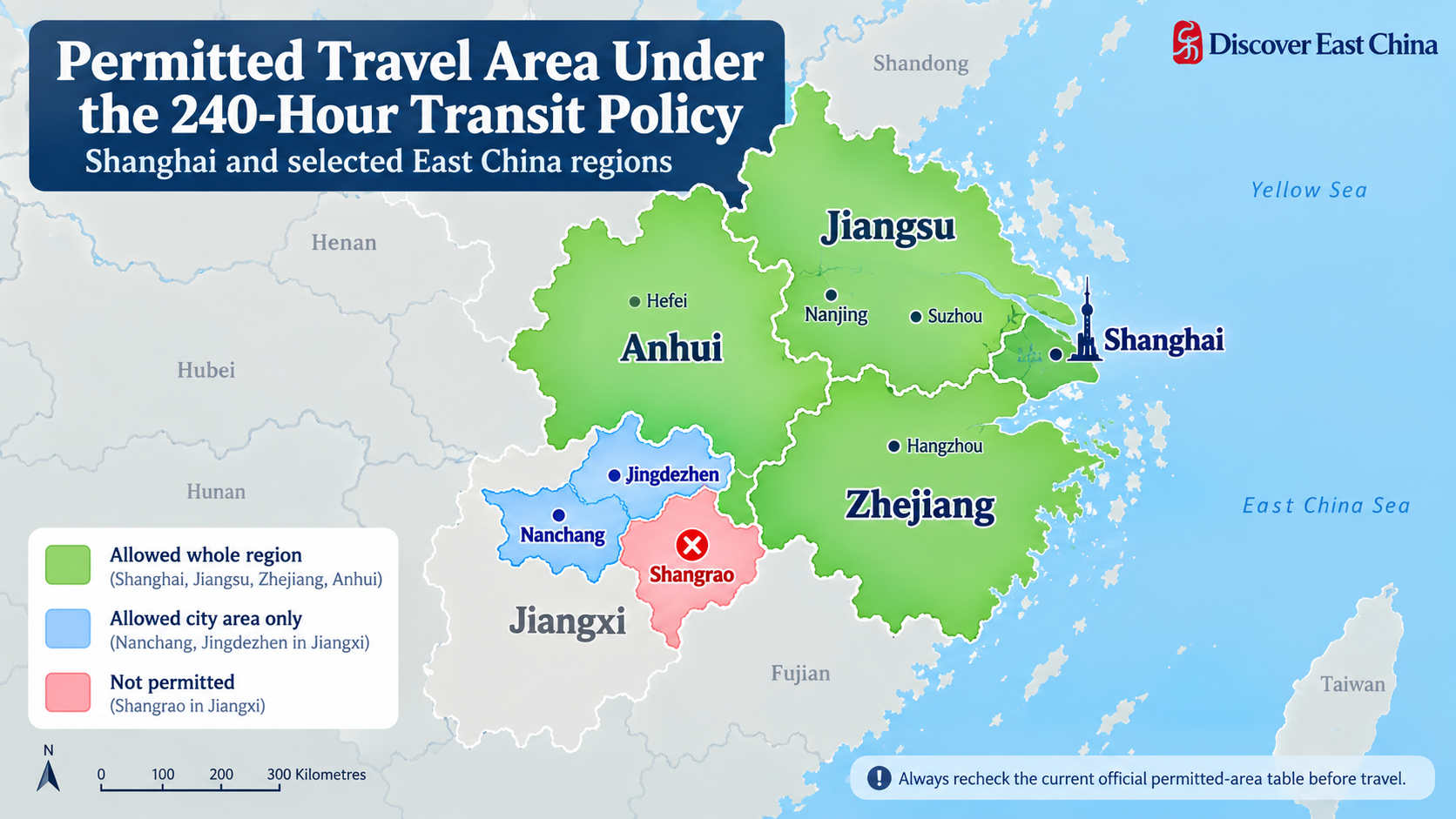
Check administrative boundaries, not just province names: the current Jiangxi allowance covers Nanchang and Jingdezhen, not all of Jiangxi.
How Is the 240-Hour Stay Counted?
The NIA’s published conditions state that the visa-free stay period is calculated from 00:00 on the day following the day of entry. For example, if you enter on 9 October, the published counting method starts at 00:00 on 10 October.
Use this to understand the policy, but plan your departure around the permission actually issued. Check the authorised last date and time before leaving the immigration area, and ask an officer if anything is unclear. Do not rely on an online calculator, an older local FAQ or a tour itinerary to override your temporary entry conditions.
Leave a practical margin before expiry. A departure scheduled at the edge of the allowance can become difficult if weather, a missed connection or an airline cancellation changes the journey. Completing check-in is not the same as completing departure formalities.
Travel to Suzhou, Hangzhou or another mainland destination does not start a fresh 240-hour period. Moving hotels does not reset it either. The 24-hour transit policy has its own conditions: do not transfer the 240-hour counting method to a short connection.
Preparing for Airline Check-In and Shanghai Arrival
The airline’s document check takes place before you reach China. Border inspection takes place on arrival. Passing one does not replace the other, so allow time at the departure airport and carry clear evidence of your complete journey.
Documents and information to keep available
- Your qualifying ordinary passport, with sufficient validity for China and the onward journey.
- Confirmed onward travel showing the required departure date, seat and destination.
- The complete international itinerary, including connecting flights and any separate bookings.
- Evidence of permission to enter the onward country or region, where required.
- Your first accommodation booking, address and contact details, plus later accommodation if already arranged.
- A concise itinerary showing destinations and how you will travel within the permitted areas.
- Any arrival information required by the current official procedure.
Download copies before travelling and keep essential details accessible without mobile data. Names and passport details should match across the documents. A useful preparation sheet is one page with your entry port, international exit, onward destination, hotel address and travel dates.
What happens on arrival?
- Follow the airport’s current signs and ask staff where to apply for 240-hour visa-free transit temporary entry. Queue arrangements can change.
- Complete the required arrival information. Official online arrival-card channels are available, but an online submission is not an entry approval and does not replace the temporary entry assessment.
- Present your passport, confirmed onward itinerary and supporting information to the immigration inspection authority.
- Answer questions about your visit, accommodation and onward travel accurately.
- If entry is granted, check the temporary permission and the authorised stay before proceeding into the city.
Do not book a tightly timed museum visit immediately after an international arrival. Immigration processing, baggage collection and the airport-to-hotel journey can take longer than expected. A light first afternoon is a better choice than a prepaid activity that depends on fast entry.
If your connection is too short for a comfortable city visit, staying at the airport may be the sensible decision even when a longer transit exemption could otherwise apply.
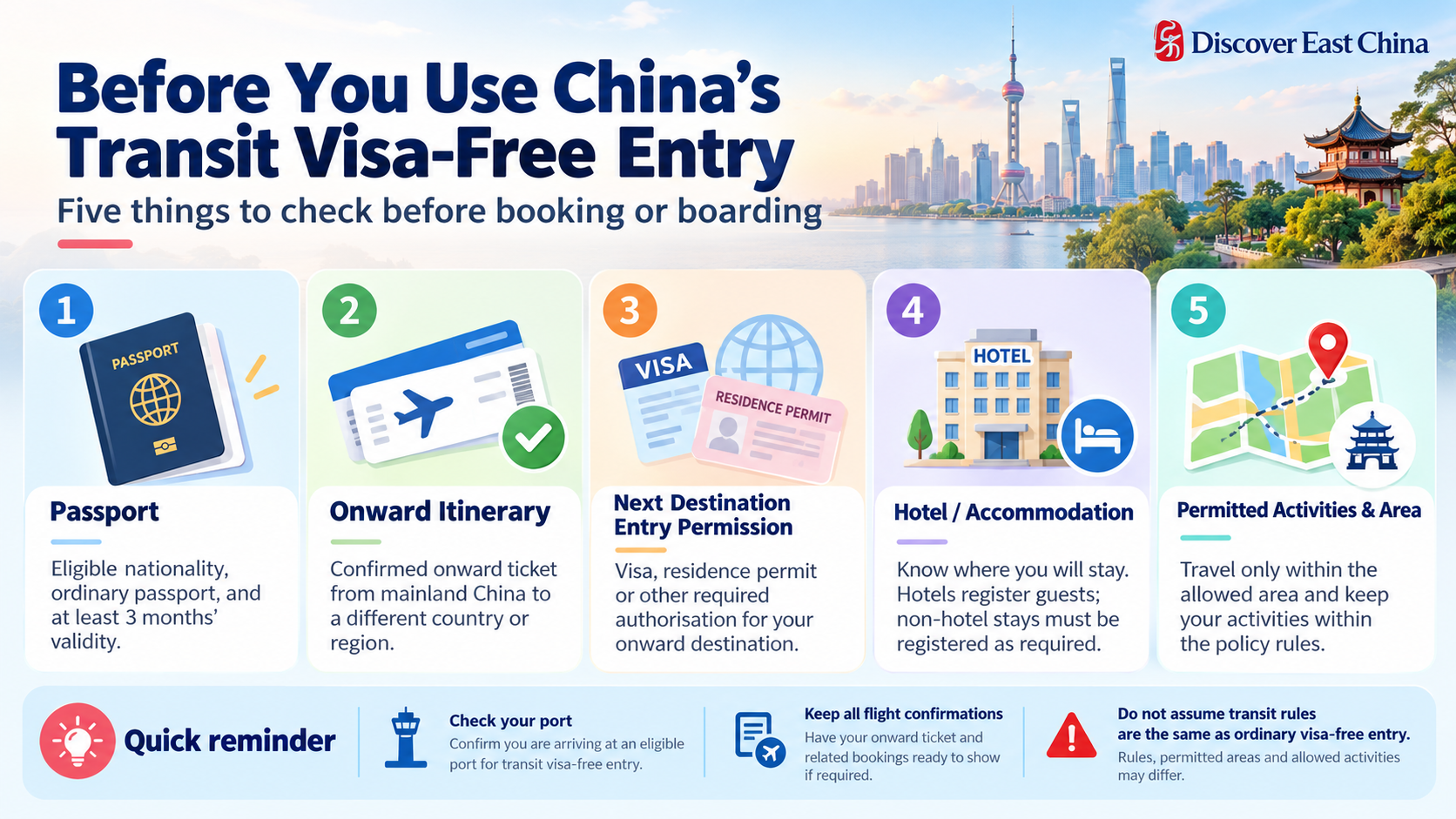
Keep the complete itinerary and accommodation details accessible for airline and immigration checks.
How Ordinary Visa-Free Entry Differs
Ordinary visa-free entry is based on a unilateral policy or mutual exemption agreement, rather than the requirement to transit to a different country or region. Its permitted purposes, passport types, duration and effective dates depend on the specific scheme.
This difference can change your entire trip. A traveller who qualifies for ordinary visa-free tourism may be able to fly to Shanghai and return to the same country without constructing a third-destination itinerary. A traveller relying on 240-hour transit must satisfy the transit-routing condition as well as the other rules.
A current example: UK and Canadian ordinary passports
The Chinese Embassy’s published notice covers eligible UK and Canadian ordinary-passport holders for visits of up to 30 days for specified purposes, from 17 February to 31 December 2026. That is a separate arrangement from 240-hour transit.
For an eligible British or Canadian traveller visiting Shanghai during the effective period, ordinary visa-free entry may therefore be the more straightforward basis for a standard return holiday. Check your exact passport status, purpose and travel dates against the notice.
Do not assume the policy continues into 2027. A future extension needs an official announcement. Other nationalities may have different effective dates or bilateral conditions; “30-day visa-free” is not a universal rule for every passport.
Likewise, the United States appearing on the 240-hour transit list does not establish a general 30-day tourism exemption for US ordinary-passport holders. Use the entry arrangement that actually applies to your document and journey.
Ordinary visa-free entry also does not remove other legal restrictions or special permit requirements. If your journey involves restricted areas or activities requiring prior approval, check those separately.
Planning a Practical Shanghai Transit Trip
A permitted ten-day maximum is not a target to fill. Choose a route you can enjoy comfortably, then check every destination, transport leg and departure against the entry conditions.
Two or three nights: concentrate on Shanghai
For a short stop, one Shanghai hotel is usually enough. Allow a gentle arrival day, one full day for the Bund and nearby neighbourhoods, and another for a museum, a garden or a district that fits your interests. Add Zhujiajiao only if you have a proper spare day rather than squeezing it between airport transfers.
For families or travellers arriving after a long flight, prioritise sleep and easy meals. Crossing the city several times on the first day does little to improve the visit.
Four or five nights: add one nearby contrast
Choose Suzhou for classical gardens and a different urban atmosphere, Hangzhou for West Lake and a more relaxed landscape, or one water town for canals and walking. The geographical allowances for Jiangsu and Zhejiang make these possibilities worth considering, subject to your complete compliant itinerary.
Avoid adding several water towns simply because they are available. A single well-chosen canal experience often gives more variety than repeating a similar setting on consecutive days. An overnight stay can be worthwhile when it avoids a rushed return to Shanghai, but it also creates another hotel change and another transport leg.
Seven to nine days: keep the route coherent
A longer permitted visit could combine Shanghai with one or two other bases. Shanghai, Suzhou and Hangzhou offer a manageable city-and-landscape mix. Shanghai and Huangshan can provide a stronger contrast, but Anhui requires more travel time and weather flexibility.
Do not turn a policy allowance into a race across all the regions it covers. Huangshan mountain weather, luggage transfers and recovery time matter as much as the train timetable. Jingdezhen requires particular attention to the permitted municipal area and the route used to reach it.
Choose the international exit before finalising the hotels
An exit from Hangzhou or another designated port may reduce backtracking if a suitable international service and qualifying routing are available. Compare the entire journey: hotel transfers, domestic transport, airport access and onward flights. A cheaper ticket can be poor value if it adds a difficult final-day transfer.
If departing internationally from Shanghai, consider returning to Shanghai the previous day after a distant stay. This is especially useful when bad weather or a disrupted train could jeopardise the international departure and the authorised stay limit.
Keep sightseeing bookings flexible where possible until your itinerary has been checked. A reservation for Shanghai Disneyland or a museum establishes a visit time, not permission to enter China.
Accommodation, Luggage and Everyday Arrangements
Accommodation registration still applies
Visa-free entry does not remove accommodation registration requirements. Hotels register foreign guests and submit their information to the local public security authorities. Bring the passport used for entry and make sure everyone in the party is properly registered.
For a stay outside a hotel, the traveller or host must complete registration with the local public security authorities within 24 hours of arrival at the accommodation. Since 21 September 2026, the NIA’s nationwide online registration announcement provides online registration, with offline channels remaining available.
If staying in a private home or rented apartment, ask the host how registration will be completed and keep confirmation. The official online registration guidance says the host should assist with the initial registration to ensure accurate accommodation information. A booking confirmation from an accommodation platform is not the registration itself. Follow the current official process rather than an old guide to a local pilot service.
Keep airport and hotel plans realistic
Check which Shanghai airport your flights use, whether checked luggage is through-checked, and whether you need to collect and recheck it. Ask the airline about luggage rather than assuming that immigration eligibility determines baggage handling.
A landside airport hotel normally requires leaving the restricted airport area. Describing a property as an “airport hotel” does not mean you can reach it without entry permission. For a short connection, verify whether a room is genuinely airside and accessible with your itinerary.
For city stays, choose a hotel that makes the route easy: manageable access to your planned neighbourhoods and a clear departure transfer. Keep heavy luggage at one base when making a nearby day trip, if the hotel offers suitable storage. Verify storage hours and arrangements before relying on them.
If Your Plans Change
Check the entry conditions again whenever a flight, destination or transport leg changes. A replacement ticket can affect the third-country routing condition, the exit port or the authorised departure time. Moving from an international onward flight to a mainland domestic flight does not preserve the same transit arrangement by itself.
An airline cancellation or delay does not automatically extend your permission. If there is a risk that you cannot leave on time, contact the local public security exit-entry authority promptly, before expiry where possible, and seek advice through the NIA’s 12367 service hotline. Keep the airline’s disruption evidence and follow the authority’s instructions about any necessary formalities.
For illness or another emergency, seek help early. Do not assume that an online booking change, a doctor’s note or the airline’s promise of a later flight independently authorises a longer stay.
If the new itinerary no longer fits transit rules, ask which lawful arrangement is required. A domestic excursion does not reset the clock, and a quick exit and re-entry should not be treated as a guaranteed way to obtain a fresh allowance.
Verify the Policy Before You Commit
Use a two-stage check: once while choosing flights, and again shortly before departure. Repeat it after any material itinerary change.
- Nationality and document: Is the passport you will actually use eligible under the scheme in force on your travel dates?
- International routing: Does the full itinerary meet the third-country or third-region requirement, including connections?
- Ports: Are the entry and proposed exit appropriate under the current policy?
- Travel area: Are the attractions, hotels and transport route within the permitted boundaries?
- Onward evidence: Are departure date and seat confirmed, and can you enter the next destination?
- Duration: Is the departure comfortably within the allowance, and will you verify the permission on arrival?
- Purpose: Does the visit fall within the permitted activities?
For authoritative checks, start with the NIA transit policy, the published 240-hour application conditions, and the Chinese embassy or consulate responsible for your location. The conditions page may retain an older nationality count, so read it alongside the newer nationality announcement rather than using that count as the current list.
For the UK and Canada example, see the Chinese Embassy’s dated visa-waiver notice. Other travellers should look up their own applicable notice or agreement.
Ask the airline to check the complete itinerary for boarding requirements. For a complex route, contact the NIA through its official channels or the 12367 service hotline with precise passport, flight, port and date information. Avoid asking only whether “Shanghai is visa-free”: that leaves out the facts needed to assess the trip.
Frequently Asked Questions
1. Is Shanghai visa-free for everyone for ten days?
No. The 240-hour transit policy applies to eligible ordinary-passport nationals with qualifying international transit, designated ports and travel within the permitted areas. Other travellers may qualify under a different exemption or need a visa.
2. How many nationalities are currently eligible?
The NIA lists 57 as checked on 14 October 2026. Kyrgyzstan and Vietnam were added on 20 August 2026. Recheck the current official list before booking rather than relying on an older 54- or 55-country summary.
3. Can I use transit visa-free entry for a London–Shanghai–London trip?
That direct return route does not meet the different-country-or-region requirement for 240-hour transit. Ordinary visa-free entry may separately cover an eligible UK ordinary-passport holder during the applicable policy period; check that scheme instead.
4. Does Hong Kong count as an onward region?
Yes, Hong Kong can serve as a different onward region for the transit-routing condition. You must still meet the passport, ticket, port, duration and other requirements, including any requirements for entry into Hong Kong.
5. Do separate tickets qualify?
Have the complete ticketed arrangement checked with the airline and immigration authority. You need confirmed onward evidence, not an intention to buy a ticket later. Do not assume that separate bookings either automatically qualify or are universally prohibited.
6. Do connecting flights affect eligibility?
They can. Show every international and domestic sector, because the relevant countries or regions around the mainland China visit, the first entry port and the exit may differ from the headline endpoints of your booking.
7. Can I enter through Pudong and leave through Hongqiao?
Both airports appear in the current designated-port table, so using different Shanghai airports can be possible with a qualifying international itinerary. Verify the actual flights and routing. A domestic departure from Hongqiao alone is not an international exit from China.
8. Can I enter Shanghai and leave from Hangzhou?
Hangzhou Xiaoshan International Airport is included in the current table. An itinerary entering Shanghai and departing internationally from Hangzhou can be possible if all conditions are met. Check the exact route, onward destination and authorised stay before booking.
9. Can I visit Suzhou, Hangzhou, Wuzhen or Huangshan?
The current permitted areas include all of Jiangsu, Zhejiang and Anhui, so these destinations can be considered within a compliant visit. Check transport routing, accommodation, the stay limit and the international departure as well as the destination itself.
10. Can I visit anywhere in Jiangxi?
No. The published Jiangxi allowance covers the municipal administrative areas of Nanchang and Jingdezhen. Wangxian Valley in Shangrao is outside those areas. Do not assume that a province appearing in the policy is wholly open under transit permission.
11. When does the 240-hour period start?
The NIA conditions state that counting begins at 00:00 on the day following entry. Check and follow the expiry and conditions of the permission issued to you, and leave a margin for disruption rather than departing at the limit.
12. Can a 24-hour connection include a trip into Shanghai?
Only if you obtain the required temporary entry permission to leave the port’s restricted area and have enough practical time. The 24-hour transit exemption itself does not automatically provide city access. A hotel outside the restricted area also requires the appropriate permission.
13. Do I apply for the 240-hour permission before travelling?
The temporary entry assessment is made by the immigration inspection authority on arrival at a qualifying port. Prepare and verify the itinerary beforehand, and complete current arrival information as required. An online arrival card is not advance entry approval.
14. Must I register my accommodation during a visa-free visit?
Yes. Hotels handle registration for their guests. For accommodation outside a hotel, the traveller or host must complete the required registration within 24 hours of arrival there. Current official online and offline channels are available.
15. What if my onward flight is cancelled?
Contact the local public security exit-entry authority promptly and retain evidence of the cancellation. Ask about the formalities needed if departure before expiry is at risk. The airline’s cancellation does not automatically extend your authorised stay.
16. Is 240-hour transit the best option if I qualify for ordinary visa-free entry?
Not necessarily. Ordinary visa-free entry may allow a simpler return itinerary and a different stay allowance. Compare the scheme that applies to your exact passport, purpose and dates before adding a third-country flight or accepting transit-area restrictions.
Build the Route Around Verified Entry Conditions
A successful Shanghai stop begins with a lawful, workable itinerary: the right passport and entry arrangement, confirmed onward transport, permitted destinations and time to travel comfortably. Once those foundations are clear, you can choose the experiences that make the visit worthwhile.
For help shaping a Shanghai and East China itinerary around your confirmed flights, interests and pace, contact Discover East China Tours. Share your arrival and departure details and the entry arrangement you intend to use so that proposed destinations and transfers can be reviewed against the current published rules. Final immigration decisions remain with the relevant authorities.
Prepared for Discover East China Tours. Updated 14 October 2026.