
Explore Hongcun’s water channels, South Lake, Moon Pond and historic interiors, with walking routes, overnight advice and Huangshan Mountain connections.
Hongcun is a village best explored on foot, with time to look beyond its famous reflections. Water channels run beside the lanes, whitewashed houses gather around Moon Pond, and carved interiors reveal a more elaborate world behind the plain outer walls. The appeal lies in seeing how these elements belong together.
For a first visit, allow around three to four hours inside the village for a selected walking route and a break. Add lunch, a guided architectural visit or photography time if you want a fuller day. Staying overnight is worthwhile when you want another chance to walk in changing light, but it brings different accommodation and luggage considerations from a modern hotel outside the heritage area.
Hongcun combines well with Huangshan Mountain because it offers a different experience: village scale, water, courtyards and cultural history after the mountain’s ridges and steps. It deserves its own time, rather than being treated as a quick photograph on the way to a train.
Hongcun at a Glance
| Planning question | Practical answer |
|---|---|
| Where is Hongcun? | In Yi County, within the wider Huangshan area of southern Anhui. It is separate from Huangshan Mountain, Tangkou and Tunxi. |
| Why visit? | A distinctive water system, Huizhou architecture, historic interiors and atmospheric village walking. |
| Main first-visit sights | South Lake, Nanhu Academy, the water channels, Moon Pond and selected historic buildings such as Chengzhi Hall. |
| How long inside the village? | Around 3–4 hours for a selected visit; 5–6 hours with lunch, more interiors and unhurried photography. |
| Is an overnight essential? | No. A day visit covers the main sights; a night gives more flexibility for evening and morning walks. |
| Is it a quiet, untouched village? | It is an inhabited heritage village and a popular visitor destination, with accommodation, shops and busy periods. |
| Best way to combine it with the mountain | Give Hongcun a separate half day or more, with the road transfer and mountain descent allowed for. |
| Biggest planning mistake | Counting only time at South Lake and Moon Pond, while overlooking interiors, transport and the return journey. |
The time allowances in this guide are editorial planning estimates, not published timetables. Your route, crowd levels, pace and transport arrangements will change the total.
What Makes Hongcun Different?
Hongcun and Xidi form the UNESCO World Heritage property called Ancient Villages in Southern Anhui, inscribed in 2000. Their value includes village layout, architecture, decoration and the relationship between settlement and landscape.
At Hongcun, water is particularly important to that relationship. South Lake and Moon Pond are not isolated ornamental scenes. They belong to a planned village system connected by channels and embedded in the street pattern.
The village also reflects the history of Huizhou, a cultural region associated with merchants, clan organisation, education and distinctive building traditions. “Huizhou” here is the historical region of southern Anhui and neighbouring areas, not Huizhou city in Guangdong.
A good visit connects the open water, lanes and buildings. You do not need to see every historic hall to understand the village, but entering at least one substantial interior adds depth to the exterior views.
Understand the Water System Before You Walk
The Village's Ox-Shaped Interpretation
Hongcun is often described as an ox-shaped village. In this traditional interpretation, the hill, old trees, houses, bridges, channels and ponds correspond to parts of an ox.
The image is a useful introduction to the overall layout, rather than something you will clearly recognise from every lane. Ask a guide to explain it using a map, then follow the actual water and street connections on foot.
Water Beside the Lanes
The narrow channels, known as shuizhen, are an important part of the visit. Notice how water runs beside homes and how small crossings accommodate movement through the lanes.
These channels help make the water system tangible. They are easy to miss when following a group directly between headline sights, so pause at a safe point where you are not blocking residents or other walkers.
The historical system served practical village needs as well as shaping the landscape. It is not an invitation to drink untreated channel water or let children play in it. Respect the waterways and avoid putting anything into them.

Moon Pond and South Lake
Moon Pond, or Yuezhao, lies within the village, enclosed by houses and civic buildings. South Lake, or Nanhu, opens the landscape at the southern edge. Their contrasting scale is part of Hongcun’s character: an intimate central space and a broader foreground for the village and hills.
See both, but give yourself time between them. Following the channels through the lanes explains more than taking two photographs and leaving.
What to See in Hongcun
South Lake: Begin With the Village's Wider Setting
South Lake provides one of the clearest introductions to Hongcun’s setting. The water, village buildings and surrounding hills form a composition that changes with the light, weather and movement on the lake surface.
Start by walking a selected section of the lakeside rather than rushing straight to the most photographed spot. Look at the relationship between the open shore and the denser houses beyond it.
The well-known bridge and waterside viewpoints can become crowded. Take your photographs from permitted positions without blocking crossings. Reflections depend on wind and other conditions; they are not guaranteed by choosing a particular hour.
For an overnight visit, South Lake is worth revisiting when convenient. You may find a different atmosphere in the morning or late afternoon without needing to repeat the whole itinerary.
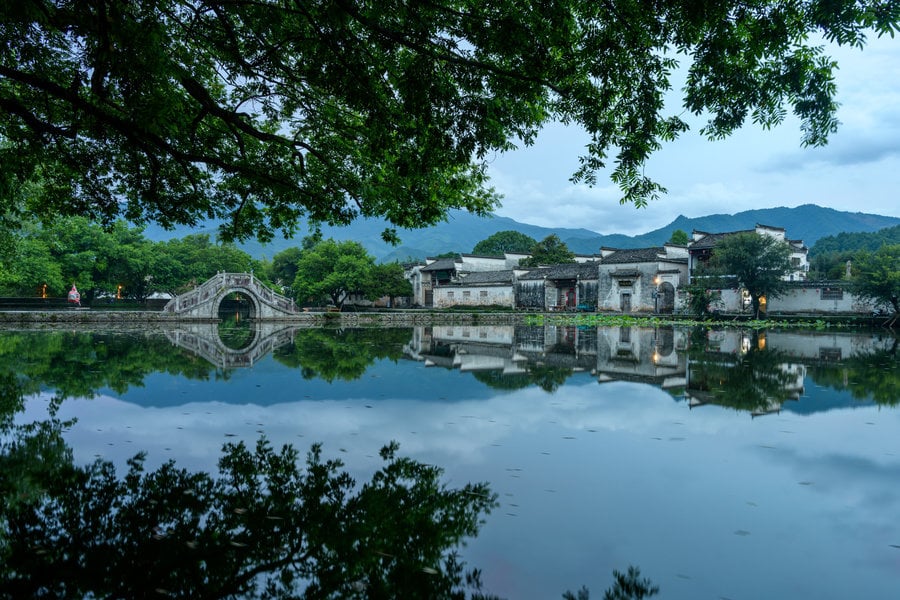
South Lake introduces the village’s wider setting; reflections depend on the conditions.
Nanhu Academy: Education Beside the Lake
Nanhu Academy, or Nanhu Shuyuan, sits beside South Lake and helps explain the place of education in village life. Its historic development brought earlier teaching spaces together into an academy.
Visit it early in your route if open, then compare its shared educational role with the domestic spaces you see later. A guide can help interpret room functions and inscriptions that might otherwise be difficult to understand.
Interior opening times may differ from access to the surrounding lanes. Check the day’s arrangements rather than leaving every building until the evening.
Moon Pond: The Village's Central Water Space
Moon Pond is one of Hongcun’s most recognisable places. Walk slowly around the permitted edges and look at how the surrounding buildings define the space.
It is a good point to pause and understand the village layout, but not necessarily a quiet place to linger at peak times. Step away from the narrowest passage if stopping for photographs or a guide’s explanation.
Ask about the nearby ancestral hall and its role in clan life. The relationship between communal buildings, homes and water is more interesting than the pond’s shape alone.
Chengzhi Hall: Look Inside a Merchant Residence
Chengzhi Hall is a prominent historic residence known for its elaborate carved decoration. It gives a useful contrast to the restrained walls and rooflines seen from outside.
Look for the arrangement of halls, light wells and domestic spaces, as well as decorative details. Rather than trying to interpret every carved scene independently, ask a guide to explain a few examples and how they relate to the household.
The interior can be busy and darker than the outdoor lanes. Allow time to move through without pushing, follow photography instructions and avoid touching historic surfaces.
Selected Halls, Courtyards and the Old Trees
Other historic buildings may be included according to current access and your interests. Names such as Shuren Hall and Taoyuan Residence appear on village routes, but visiting every listed building is not necessary for a rewarding first walk.
Choose one or two additional interiors if architecture is your priority. If photography or a slower family pace matters more, use that time for the lanes and a seated break.
The old trees around the village-edge area provide another way to connect the layout with its traditional ox-shaped interpretation. Their surroundings can be a useful final stop, depending on the exit or hotel you need to reach.
How to Read Huizhou Architecture
The first impression is often the contrast between white walls and dark roof tiles. Spend a little longer looking and you will see differences in gables, entrances, light wells and ornament.
Raised, stepped gable walls are commonly called horse-head walls. In a village walk, notice how their varying heights give rhythm to the roofscape. Historic interiors reveal how buildings admitted light and organised life behind relatively enclosed street fronts.
Wood, brick and stone carving are important elements of Huizhou craftsmanship. Their locations and motifs can carry meanings related to prosperity, family values, learning and status. Ask for a few specific examples rather than assuming every motif has the same significance.
A useful architectural visit asks three questions: how does the building work, who used its spaces, and what does its decoration communicate? Those questions turn a series of beautiful rooms into a more coherent understanding of village life.
A Practical First-Visit Walking Route
A good starting sequence is:
South Lake → Nanhu Academy → water-channel lanes → Moon Pond and nearby communal buildings → Chengzhi Hall → selected quieter lanes or an additional interior → old-tree area or your chosen exit.
This is a sightseeing sequence, not a turn-by-turn navigation instruction. Entrance arrangements, temporary restrictions and building access may change the exact path. Use the current visitor map and follow local signage.
| Stage | What to focus on | Approximate visit allowance |
|---|---|---|
| South Lake | Landscape, village frontage and selected photographs | 30–45 minutes |
| Nanhu Academy | Education, architecture and interior interpretation | 20–35 minutes |
| Water channels and Moon Pond | How water connects the lanes and central village | 40–60 minutes |
| Chengzhi Hall and one selected interior | Layout, household history and carving | 40–60 minutes |
| Lanes, old trees and a break | A slower finish suited to your exit | 30–45 minutes |
These are flexible allowances, not entry slots. They overlap with the three-to-four-hour recommendation depending on how many interiors you choose and how long you stop. Add lunch and extended photography separately.
A Shorter Visit of Around Two Hours
If time is genuinely limited, prioritise South Lake, a connecting water-channel walk, Moon Pond and one open interior. Reduce shopping and additional buildings, and keep the exit arrangement simple.
This is a compact introduction, not an in-depth architectural visit. With crowds or a slower group, it may still take longer than expected. Do not attach it to a tight train connection without allowing for the road journey.
A Fuller Half Day
For most first-time visitors, three to four hours is a comfortable starting point. It lets you connect the main spaces, enter selected buildings and stop briefly without turning the visit into a checklist.
A guide can help during the central part of the walk, followed by independent time for photography, a café or quieter lanes. Confirm the meeting point and language support before arrival.
A Slow Day With Lunch
Allow five to six hours inside and around the village when you want lunch, more architectural explanation or time to sketch and photograph. Keep some of this time unassigned.
A slow day does not require adding another distant attraction. Revisit one place in different light, sit down for a meal and take a less direct route between the main sights where public access permits.
Day Trip or Overnight Stay?
Choose a Day Trip When the Main Sights Are Your Priority
A day visit is enough to see Hongcun’s principal spaces and selected interiors. It suits travellers who prefer a modern hotel elsewhere, have a limited itinerary or want the village as one cultural component of a wider Huangshan trip.
Its success depends on allowing for transport. A “half-day Hongcun visit” usually refers to time in the village, not necessarily the entire excursion from Tunxi, Tangkou or a railway station.
Plan the return before setting off. Public transport timetables, boarding locations and last departures require checking for the actual date. A private vehicle simplifies timing, but road traffic and parking still affect the total.
Stay Overnight When Atmosphere and Flexibility Matter
An overnight lets you divide the visit between afternoon, evening and the following morning. You can take your main interior tour while buildings are open, then return to waterside places at another time.
It may provide quieter moments outside the busiest day-visitor periods, but does not guarantee empty lanes. Hongcun has residents, overnight guests and businesses, and popular dates remain busy.
Do not confuse access to the lanes with round-the-clock access to every heritage interior. Check the current admission and re-entry procedure for your stay, including early or late arrival and passport verification.
| Choice | Main benefit | Practical trade-off |
|---|---|---|
| Day trip | Main sights without changing hotels | Transport takes part of the day, and light conditions are less flexible. |
| One night inside the heritage village | Easy return to lanes and waterside spaces | Luggage approach, older buildings and room facilities need checking. |
| One night near the entrance | Simpler vehicle access and potentially easier luggage handling | Entry and re-entry still need planning; the walk into the village is additional. |
| Rural accommodation farther away | More space or a countryside setting, depending on the property | You may need transport for every village visit and evening return. |
Staying Inside the Village: Questions to Ask
A converted historic house can be memorable, but “traditional” is not a specification of comfort. Ask about the actual room rather than relying on exterior photographs.
Check bathroom arrangements, heating or air conditioning, dampness concerns, stairs, bed configuration and permitted occupancy. Sound insulation can vary, and a room near a busy lane, restaurant or courtyard may not suit light sleepers.
Ask where the vehicle can stop and how far you must carry bags. Confirm whether staff will meet you, which entrance to use and whether any luggage assistance is included. A suitcase may need carrying over uneven paving or thresholds.
For families or visitors with mobility needs, request precise information about the entrance, room floor and bathroom access. A ground-floor room alone does not establish a fully accessible property.
Clarify whether village admission is included and what identity checks apply. Accommodation inside the ticketed area does not automatically eliminate the ticket requirement.
Photography: Make Time Without Blocking the Village
South Lake and Moon Pond
These are useful starting points, but they need patience. Wind can disturb reflections, groups can fill a bridge, and changing cloud can alter the contrast within minutes.
Choose a safe position and allow space for people to pass. If a favourite composition is crowded, move to another permitted view rather than waiting in the middle of a narrow route.
An overnight gives a second opportunity for these scenes, but it does not guarantee ideal conditions. Keep the visit worthwhile even if you do not get the classic reflection photograph.
Lanes, Doorways and Interior Details
Look for smaller subjects: a channel beside a doorway, a curve in a lane, rooflines seen between walls or light falling into a courtyard. These photographs can convey the village more personally than repeating only the headline views.
Ask permission before photographing residents closely or entering a doorway. Some houses remain private, and an open door does not establish visitor access.
Respect interior photography restrictions. Avoid flash where prohibited, and do not touch, move or lean on historic objects for a better image.
Tripods, Drones and Evening Photography
Use a tripod only where it is permitted and leaves the route clear. Heritage-area drone rules and local permissions need verification before any flight; do not assume that a scenic view makes drone use acceptable.
For evening photography, check the return path to your hotel or vehicle. Carry a light for uneven surfaces and be considerate of residents. Do not assume a fixed lighting programme or performance schedule from an old video.
Food and Where to Pause
Build lunch into the visit rather than grazing continuously between doorways. Choose a restaurant where you can confirm the menu, price and order size before sitting down, especially for fish and dishes charged by weight.
Regional dishes may include Huizhou-style fermented mandarin fish, chou gui yu, and fermented “hairy tofu”, mao doufu. They have distinctive flavours; you do not need to order them simply because they are famous. Ask what the restaurant actually serves and whether a smaller portion is possible.
Simple alternatives may include rice, noodles, vegetables and egg dishes, depending on the menu. For a family meal, choose a few familiar dishes alongside one regional speciality and ask for chilli on the side where feasible.
| Useful English request | Chinese note to show staff |
|---|---|
| Please make it without chilli. | 请不要放辣椒。 |
| Is this dish cooked with pork or meat stock? | 这道菜有猪肉或肉汤吗? |
| Please confirm the total price before cooking. | 请在制作前确认总价。 |
| Can we order a smaller portion? | 可以做小份吗? |
For a strict vegetarian diet or an allergy, explain the actual ingredient restriction. “No chilli” does not mean vegetarian, and a vegetable dish may use meat stock. Ingredient substitution and separate preparation are not guaranteed by showing a translated sentence.
A café or tea stop can provide a useful rest, but it should fit your interests and budget. Check prices and avoid feeling obliged to shop after a demonstration or tasting. Carry drinking water, particularly on a warm day.
Culture Beyond the Main Walking Route
A Guided Water-System and Architecture Walk
This is the most straightforward way to deepen a first visit. Ask for an explanation of the water channels, village organisation and selected building interiors, rather than only a sequence of photo stops.
English-language support should be arranged in advance. A general group commentary in Chinese may not meet your needs, and availability of an English-speaking guide should not be assumed at the entrance.
Sketching and Slow Observation
Bring a small sketchbook or use a quiet permitted place to study rooflines and reflections. Independent sketching can fit naturally into a slow visit without needing a booked workshop.
Keep entrances and paths clear, and ask before occupying private space. A long drawing session should not block a bridge or the route around Moon Pond.
Craft, Tea or Food Experiences
A hosted activity can add depth when it is genuinely available and well matched to the visit. Ask exactly where it takes place, who teaches it, what you make or taste, how long it lasts and whether language support is included.
Do not assume that woodcarving, lantern-making, a tea session or cooking is a daily walk-in service inside Hongcun. Some regional programmes take place elsewhere, and events may operate only on specific dates or for pre-booked groups.
Distinguish a short shop demonstration from a hands-on lesson. If an experience is part of a tour, confirm its fee, materials, participant limits and suitability for children before describing it as included.
Getting to Hongcun and Planning the Full Journey
Hongcun can be reached from the wider Huangshan area’s towns and railway stations by road. Regional services have included connections with Tangkou, Tunxi, Huangshan North and Yixian East, but timetables and boarding points need checking for your date.
The station that best suits Hongcun depends on the train you can actually take and the rest of your itinerary. Yixian East and Huangshan North are different stations; do not choose solely from a map without checking rail services and the onward transfer.
The following allowances are rough road-planning estimates for private vehicle travel in ordinary conditions. They are not bus schedules, and holiday traffic can add substantially more time.
| Starting point | Rough one-way road allowance | What it means for the visit |
|---|---|---|
| Tangkou/South Gate area | Around 1–1.5 hours | A village half day can work, but not as a negligible stop after a long mountain descent. |
| Tunxi | Around 1.5–2 hours | Keep roughly 7–9 hours for a relaxed excursion with 3–4 hours in the village and lunch. |
| Huangshan North station | Around 1–1.5 hours | Add station procedures and a generous return buffer when combining with a train. |
| Yixian East station | Around 30–60 minutes | A potentially useful village approach if the actual train and transfer fit. |
| Xidi | Around 30–45 minutes | Combining both villages is possible, but each needs meaningful time. |
Check the current map journey from the exact pickup point. Public transport adds waiting, boarding and any connections; an advertised travel time may not include them.
For a Tangkou return excursion, a three-to-four-hour village visit plus road travel already uses around five to seven hours before a substantial lunch or delays. For Tunxi, the longer road journey makes a full-day allowance more appropriate.
If transferring rather than returning to the same place, confirm baggage handling and vehicle service hours. A driver waiting for a few hours and a vehicle booked only for a one-way transfer are different arrangements.
Combine Hongcun With Huangshan Mountain
Option 1: Hongcun Before the Mountain
Visit Hongcun on a separate arrival or sightseeing day, then continue towards Tangkou for the night before your mountain ascent. This can give you a cultural introduction without reducing the mountain’s available walking time.
It works best when your arrival is early enough for the village. A late train, a long transfer and a full Hongcun tour should not all be compressed into the same afternoon.
Confirm the luggage plan while you walk and the onward transfer after the visit. Leave enough time for dinner and preparation in Tangkou.
Option 2: Hongcun After a Mountain Overnight
Complete the two-day mountain route, descend and continue to Hongcun for an overnight. If arrival is late, use the evening for check-in, dinner and a short local walk, then do the main village visit the next morning.
This arrangement lets you recover from the mountain instead of expecting tired legs to finish every interior before closing. It also gives more flexibility if the descent takes longer than planned.
Do not reserve a late-afternoon heritage tour that depends on reaching the first available cableway without queues. Allow for the shuttle, luggage collection and road journey after descent.
Option 3: Separate Mountain and Village Days From One Base
You can visit both from a wider-area base, but the road travel differs. Tangkou is convenient for the South Gate; Tunxi offers more urban services and has longer journeys to both the mountain and Hongcun.
Choose a base around the priority of the trip rather than assuming one location is equally convenient for everything. Moving hotels once may save repeated road travel, provided the luggage arrangements are straightforward.
Is a Mountain Day Trip Plus Hongcun on the Same Day Sensible?
Usually not for a balanced first visit. A meaningful mountain route already needs most of the day, and the descent is followed by a separate road journey to Hongcun.
A very restricted mountain visit and brief village stop may be possible with suitable transport, but both experiences become reduced. If time is short, choose the priority rather than promising a complete visit to each.
Should You Add Xidi or Another Village?
Xidi offers another perspective on Huizhou village architecture and is part of the same UNESCO property. Hongcun’s water spaces are a particular attraction; Xidi can complement it when you want a more sustained architectural day.
Allow separate walking time, tickets and the transfer. Visiting both in one day is feasible with a realistic start and suitable transport, but a slow Hongcun visit, long lunch, workshop and full Xidi visit will compete for the same hours.
Nearby countryside or another village can be an alternative to a second major heritage stop. Check what interests you most: more buildings, rural walking or time to sit and observe. Avoid adding places solely because their names appear close together in a tour brochure.
Seasons, Rain and Crowds
Spring and autumn can appeal to walkers and photographers, but conditions change. Rural seasonal scenery is not visible everywhere in the village, and blossoms or autumn colours depend on the year and exact location.
In summer, schedule breaks, carry water and avoid making the whole afternoon a continuous walk. Interiors provide some respite, but they may be busy and do not replace rest in a comfortable seated space.
Rain can suit Hongcun’s atmosphere while making paving slippery. Wear shoes with grip, protect electronics and keep the itinerary flexible. An umbrella is easier to manage here than on an exposed mountain ridge, but still needs care in narrow lanes and crowded interiors.
During severe weather, follow local warnings and restrictions. A rain plan should not depend on access to every building continuing unchanged.
Public holidays and popular weekends can bring heavy foot traffic. Start with a simple route, allow extra time at key interiors and respect any temporary one-way or crowd-management instructions. An early start or overnight may help, but neither guarantees solitude.
Practical Advice for Families and Slower Walkers
Hongcun is usually easier to pace than a mountain crossing because you can shorten the walking and stop for meals. It still has uneven paving, thresholds, steps inside buildings and open water beside some routes.
With children, make the water system a simple observation game: follow a channel, identify the two main water spaces and look for differences between public and domestic buildings. Keep close supervision near ponds and channels.
Use a few main sights and one good interior rather than asking children to visit every hall. Choose a seated break before they become tired, and confirm restaurant and bathroom options along the route.
A stroller may work on some outdoor sections but need lifting at thresholds or stairs. Visitors with mobility limitations should confirm the exact path and property access; a compact village is not automatically step-free.
Tickets, Entry and Overnight Access
Hongcun is a ticketed heritage visitor area. Use a legitimate booking channel and check the current adult price, concession eligibility, document requirements and included sites before payment.
Overseas visitors should carry the original passport and confirm how their booking is verified. Do not assume a domestic identity-card-only online workflow applies unchanged to every passport holder.
If staying overnight, ask the accommodation provider which entrance to use, how late arrival is handled and what re-entry arrangements apply. Check the ticket’s current validity instead of assuming an old multi-day rule is still sufficient for your plans.
Building interiors and visitor services have their own hours. Access to village lanes at a particular time does not mean every academy, hall, ticket desk or café is operating then.
Frequently Asked Questions
What Is Hongcun Best Known For?
Its water-linked village layout, South Lake and Moon Pond, Huizhou architecture and historic interiors. It is most rewarding when you connect these elements on foot.
Is Hongcun a UNESCO World Heritage Site?
Yes. It forms part of Ancient Villages in Southern Anhui – Xidi and Hongcun, inscribed in 2000.
How Long Should I Spend in the Village?
Allow around three to four hours for a selected first visit. Add time for lunch, more interiors, photography or a hosted activity.
Can I See Hongcun in Two Hours?
You can make a compact visit to the main water spaces and one interior, depending on crowds. It leaves less time for architectural explanation and a relaxed walk.
What Is a Good First Walking Route?
Start with South Lake and Nanhu Academy, follow the channels towards Moon Pond, then visit Chengzhi Hall and selected lanes. Adjust to the actual entrance and open buildings.
Is Hongcun the Same Place as Huangshan Mountain?
No. It is a separate village in the wider Huangshan area and requires a road journey from the mountain gateway.
Should I Stay Overnight?
Stay if you value another morning or evening walk and flexible photography. A day visit is enough for the main sights when transport and timing are planned well.
Is Staying Inside the Village Always Better?
No. It offers atmosphere and convenient walking, while entrance-area accommodation may simplify luggage and vehicle access. Compare the actual room and approach.
Does a Village Hotel Include Admission?
Not automatically. Confirm the ticket requirement, included benefits and entry or re-entry procedure before arrival.
Can I Visit After Descending From the Mountain?
Yes, with enough time for the complete descent and road transfer. An overnight followed by the main village tour next morning is often less pressured than a late-afternoon full visit.
Can I Combine a Full Mountain Day and Hongcun in One Day?
It is usually too rushed for meaningful visits to both. Choose a priority or give the village a separate half day or more.
Is an English-Speaking Guide Necessary?
You can walk independently, but a guide adds value for the water system, inscriptions and interiors. Arrange English-language support in advance if it matters to you.
What Food Should I Try?
Consider a regional dish such as fermented mandarin fish or hairy tofu if the flavours appeal, alongside simpler dishes. Confirm the menu, portion and price before ordering.
Are Cultural Workshops Available Every Day?
Do not assume so. Verify the host, location, activity, language support and booking requirements; some regional experiences take place outside Hongcun.
Is Hongcun Suitable for Children?
Yes, with a shorter route, breaks and close supervision near water. Uneven paving and interior steps require planning, especially with a stroller.
Can I Visit in Rain?
Often, with grippy shoes and a flexible route. Protect your equipment and follow weather warnings or temporary restrictions during severe conditions.
Plan Your Hongcun Visit With Our Local Team
Share your travel dates, arrival and departure points, walking pace and main interests with our local team. Tell us whether you prefer a guided architecture walk, photography time, a village overnight or a cultural visit alongside Huangshan Mountain.
We can help build a realistic route with suitable transfers, accommodation and meal breaks, and clarify any cultural activity that needs arranging in advance.
Prepared for: Discover East China Tours
Last updated: 8 October 2026