
Assess entry, airports, baggage and the complete return journey before choosing a short Shanghai city outing, an airport hotel or rest between flights.
A Shanghai layover can mean a short riverfront visit, a comfortable meal outside the airport or simply a useful period of rest. What makes sense depends on your actual time, the airport and terminal, whether you can enter mainland China and what happens to your luggage.
Do not plan from the hours between the two flight times alone. Immigration, baggage, transport and the next departure’s procedures can use much of that interval. Pudong and Hongqiao are different airports, and a quick train segment is not the complete journey from your arrival gate to a city attraction.
This guide helps you decide whether to leave the airport, choose a manageable outing and protect the return. Its time bands and buffers are conservative planning suggestions, not airline connection requirements or guarantees of entry. Check your flights and travel documents before booking any landside activity.
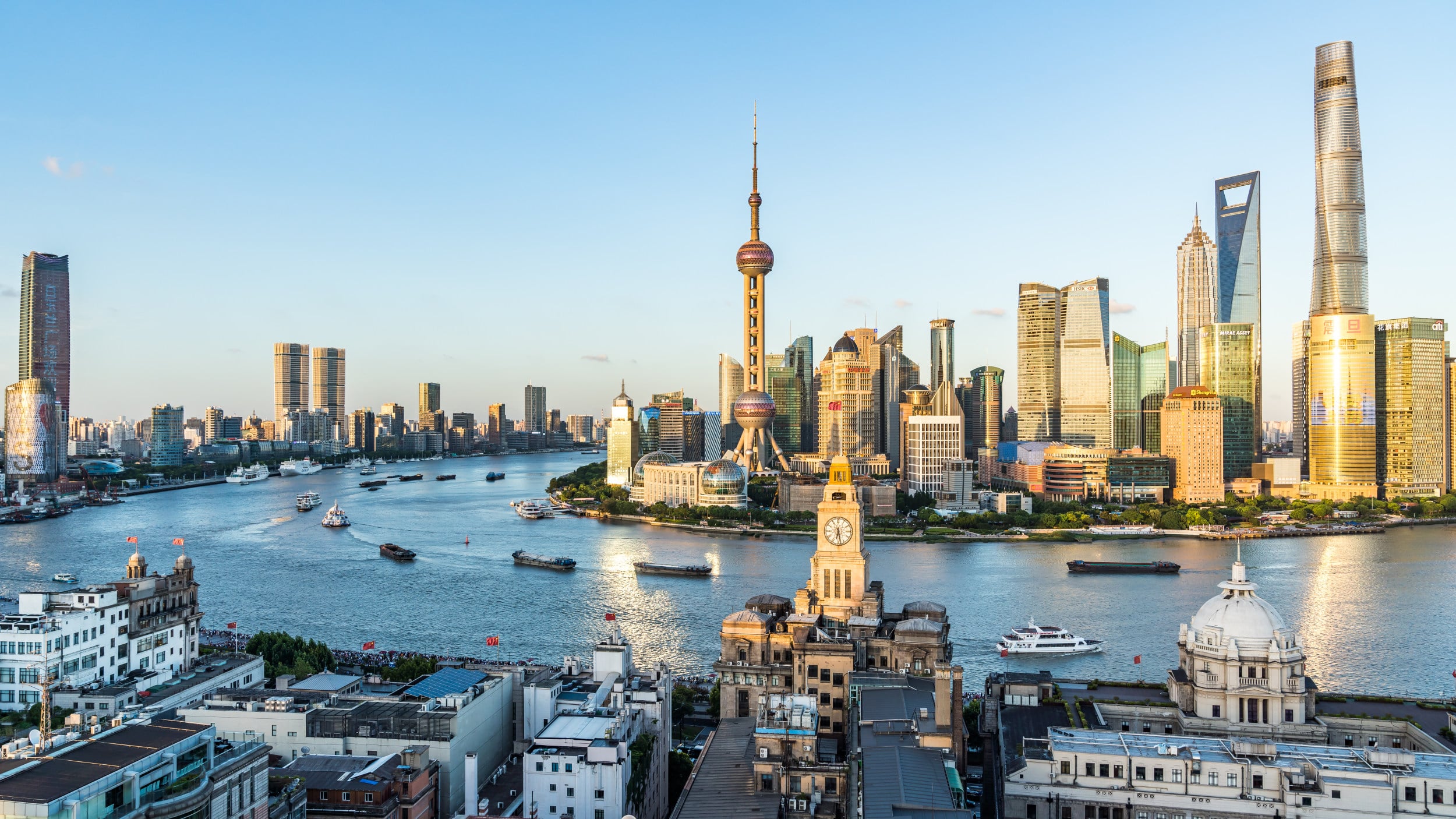
A short skyline visit can work on a long layover, but only after allowing for the complete return journey.
First Check These Five Things
Before choosing attractions, confirm:
- Arrival and departure airports. Pudong is PVG; Hongqiao is SHA. Check both codes on the actual itinerary.
- Terminals and flight types. Domestic, international and regional connections can involve different procedures. A satellite gate is also not the same as the landside terminal entrance.
- Entry eligibility. An airside transfer and permission to enter mainland China are separate matters.
- Baggage and tickets. Ask whether bags are checked through, whether collection is required and whether the flights are on separate tickets.
- The next departure’s requirements. Confirm check-in, bag-drop and boarding deadlines, and any document checks at the airline counter.
If these are unclear, resolve them before making a sightseeing reservation. A short uncertainty at the airport can remove the time that made an outing seem possible.
A same-airport, through-ticket connection with confirmed through-checked bags is usually simpler to assess than separate tickets, collected luggage or an airport change. It still requires checking the airline’s actual transfer instructions.
Pudong and Hongqiao: Different Starting Points
Pudong International Airport: Allow for the Longer City Journey
Pudong handles international and domestic services and is farther from the central sightseeing areas than Hongqiao. Metro Line 2 links the airport with central Shanghai; the Maglev connects the airport with Longyang Road, where you still need onward transport for most visitor destinations.
Your first usable moment is not the scheduled landing time. You need to leave the aircraft, reach the appropriate processing area, complete any entry and customs formalities and resolve luggage before starting a landside journey.
Pudong’s terminal and satellite arrangements can add walking or internal transport. Check the next flight’s actual terminal and gate instructions. Do not assume that being near an airport railway station means you are near your departure gate.
For a limited layover, staying at the airport or using a suitable airport hotel may be more valuable than spending several hours travelling to a very short city stop.
Hongqiao International Airport: Often a Shorter Urban Journey
Hongqiao is in western Shanghai. Its terminal matters: Terminal 1 is served by Metro Line 10; Terminal 2 has Lines 2 and 10 and access to the Airport Link Line connection towards Pudong.
A shorter city journey can make a modest outing more practical, but you still need to assess entry, bags, the next flight and the correct return terminal. Hongqiao Railway Station is part of the wider transport hub; it is not a substitute name for every airport entrance.
Do not use a general Hongqiao journey estimate for an arrival at one terminal and a departure from another. Check the terminal transfer as a separate stage.
| Situation | Main time issue | First planning priority |
|---|---|---|
| PVG arrival and PVG departure | City travel plus airport processing | Calculate the complete outward and return journey |
| SHA arrival and SHA departure | Terminal-specific access and procedures | Confirm the terminal and final return route |
| PVG arrival and SHA departure, or the reverse | Two airports and a landside transfer | Complete the airport change before adding sightseeing |
| Different terminals at one airport | Internal or landside transfer procedures | Follow the airline’s connection instructions |
| Separate tickets | Bags, check-in and protection if delayed | Treat the onward flight as a fresh departure |
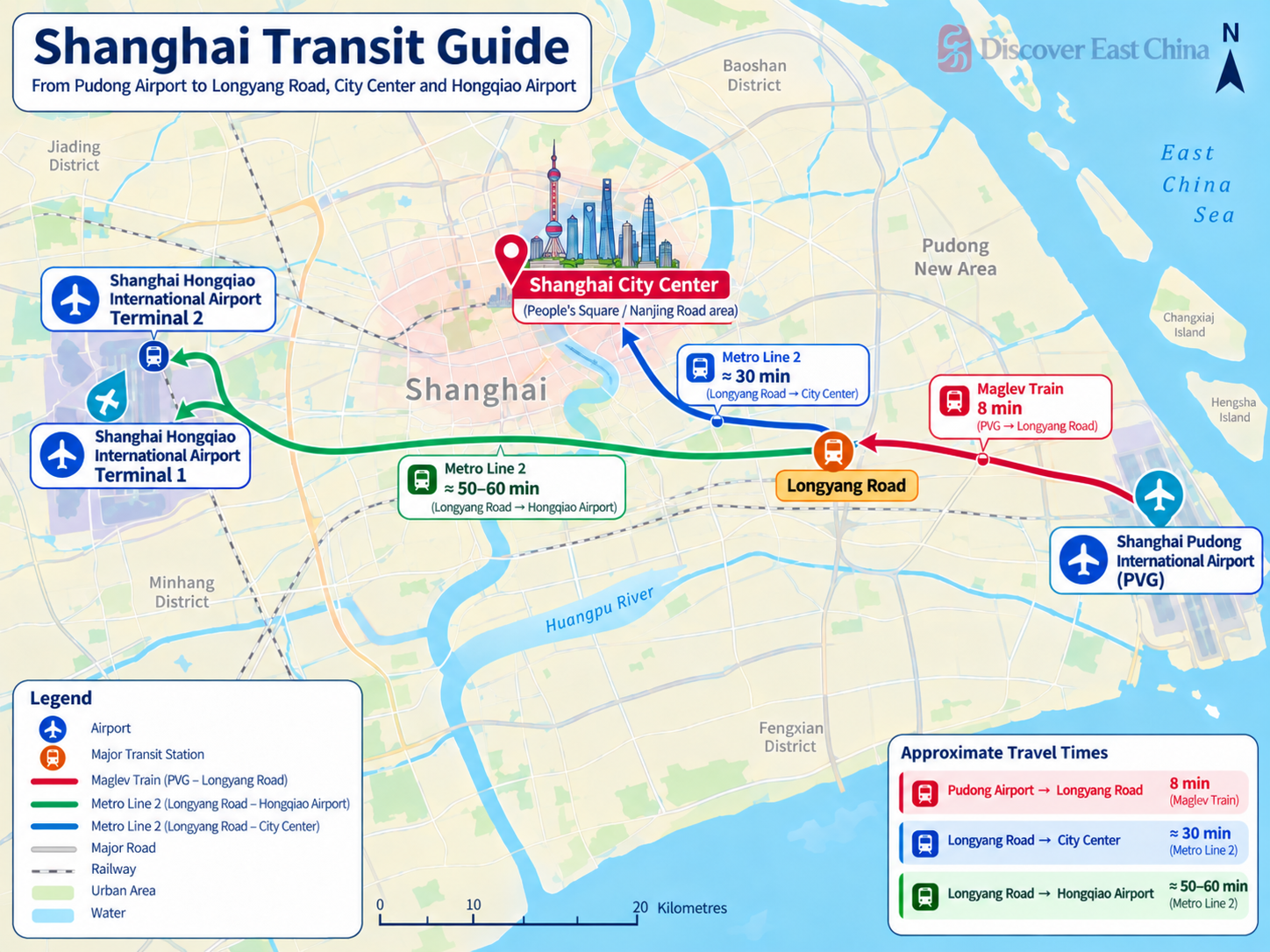
Check both airport codes and the terminal before deciding how far you can travel.
Can You Leave the Airport?
Transit Permission Is Not the Same as Entry Permission
For an international arrival, leaving the restricted transit area requires an appropriate basis for entry and completion of border formalities. This may involve a valid visa, a nationality-specific visa-free entry policy or an eligible transit arrangement. The applicable route depends on your passport and full itinerary.
China’s 24-hour visa-free transit policy allows qualifying transit within the restricted port area. Under the National Immigration Administration’s guidance, travellers who need to leave that area must first obtain a temporary entry permit. Do not read the phrase visa-free transit as automatic permission to go sightseeing.
The 240-hour transit policy is another arrangement for eligible passport holders travelling through China to a third country or region, using qualifying ports and staying within permitted areas. It is subject to its own conditions. A route that returns directly to the same country or region you arrived from does not satisfy the third-country-or-region condition for that policy merely because it has a stop in Shanghai.
Nationality-specific visa-free entry may be a separate option. Do not assume that a rule applying to a companion’s passport applies to yours. Check the current National Immigration Administration guidance and confirm boarding requirements with the airline before departure. The transit-policy distinctions here were rechecked against official guidance on 13 October 2026; eligibility still needs to be assessed for each traveller and routing.
Keep the onward itinerary, valid travel document and accommodation information available where required. An airline’s boarding decision and the border authority’s entry decision are different stages; a planned excursion does not guarantee admission.
Domestic Arrivals Need a Different Assessment
If you are arriving on a domestic flight and are already lawfully in mainland China, the first arrival does not normally involve a new international entry process. However, baggage, security and check-in procedures for the next flight still matter.
Do not copy an international-to-international timing example into a domestic connection without adjusting it. Likewise, a domestic-to-international departure needs the outbound airline’s document and airport procedures, even if the arrival was straightforward.
Calculate Real Sightseeing Time
Use the next flight’s scheduled departure as a fixed anchor, then work backwards. Allow for the airport’s correct terminal, any bag collection or storage retrieval, airline check-in, outbound immigration where applicable, security and reaching the gate.
For an international departure after a city outing, a useful initial target is to be back at the correct landside departure terminal about three hours before departure. For a domestic departure, about two hours can be a starting planning allowance. These are editorial buffers, not universal airline rules. Use a longer allowance when the airline, airport, bags or your circumstances require it.
Check-in closing time is a deadline, not a sensible airport-arrival target. Reaching the counter shortly before closure leaves little room for queues, document problems or onward gate travel.
Subtract the following from the scheduled layover:
- Arrival formalities and becoming ready to leave landside.
- Outward travel to the selected area.
- Return travel to the correct departure terminal.
- The departure processing allowance.
- An extra margin for delay or uncertainty.
What remains must cover the visit, meals and any local movement. If the result is small, uncertain or depends on everything going perfectly, stay at the airport or choose rest instead.
A Hypothetical 12-Hour Pudong Connection
Imagine a 12-hour international connection at the same airport. For illustration, reserve two hours for arrival and luggage, two and a half hours for outward and return city transport combined, three hours at the airport before departure and one hour of additional contingency. That leaves about three and a half hours for the outing, including lunch.
This is a calculation example, not a promise about immigration queues or journey times. If arrival processing takes longer, remove sightseeing time. Do not recover it by reducing the return buffer.
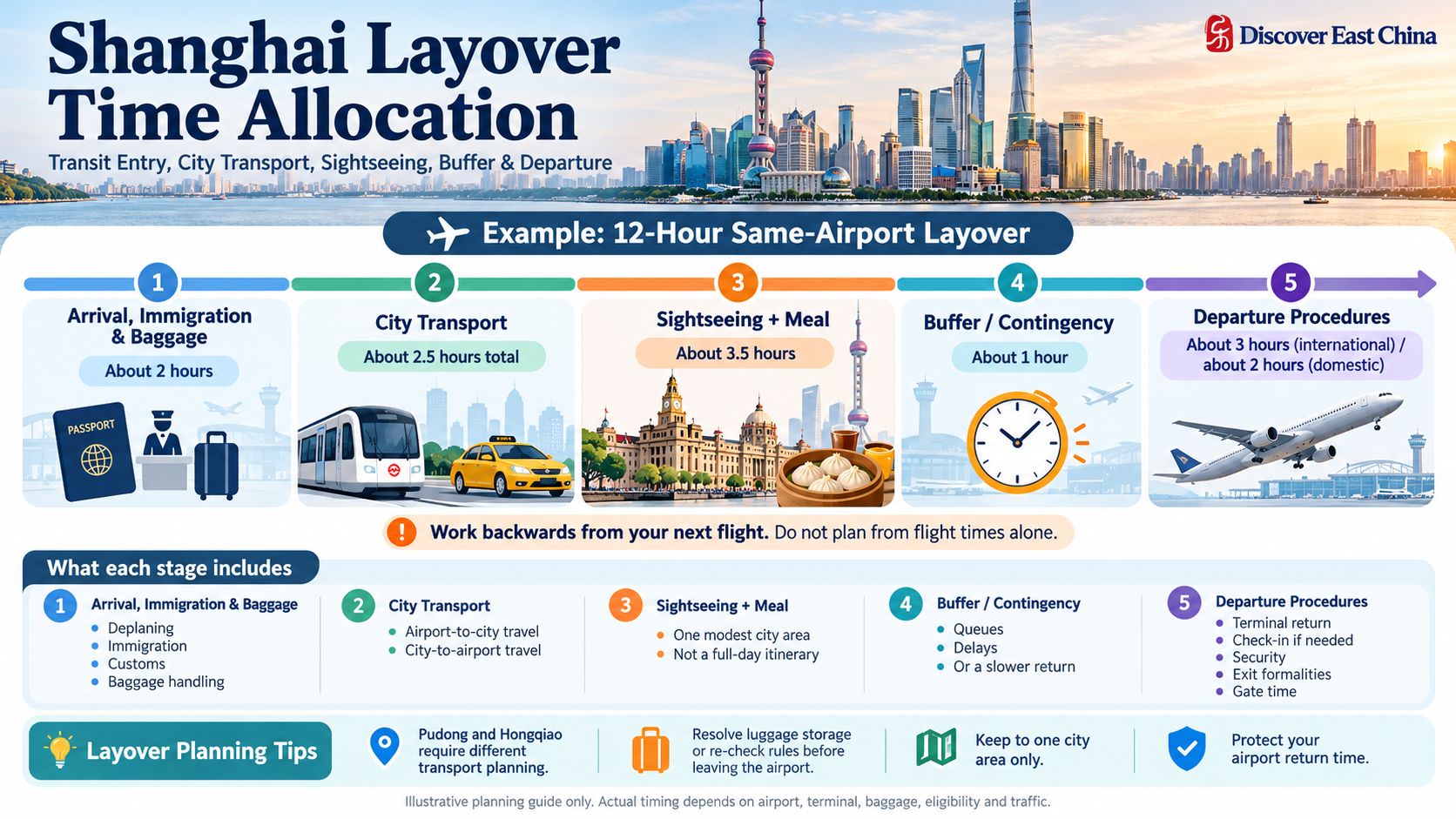
The hours between flights are not all available for sightseeing.
What Is Realistic at Different Layover Lengths?
These bands describe the scheduled interval between flights. They assume that entry, bags and the connection type have already been checked. Actual arrival delays can change the decision, and an airport change needs a separate calculation.
| Scheduled interval | Sensible starting plan | What could change the decision |
|---|---|---|
| Under 6 hours | Remain at the airport and focus on the connection | Required luggage or terminal procedures may already use much of the interval |
| 6–8 hours | Rest, eat or consider a landside airport facility if entry and timing allow | A city trip is usually too sensitive to queues and transport delays |
| 8–10 hours | Assess a short local outing carefully; central sightseeing may still be marginal, especially from PVG | A simple SHA connection may leave more usable time than PVG, but calculate it |
| 10–12 hours | One modest city area can be possible under favourable, confirmed conditions | Late arrival, luggage collection, rush-hour travel or a scarce booking can remove the window |
| 12–18 hours in daytime | A focused city visit with a meal and protected return | Keep to one area rather than treating this as a full tourist day |
| Long overnight connection | Compare airport rest, a landside airport hotel and a city hotel | Entry eligibility, sleep time, transport hours and next-morning departure |
These are not approvals to leave. Reassess after arrival, when you know the actual time, entry result and baggage situation. A 12-hour connection overnight can offer less practical sightseeing than a shorter interval in daylight.
Baggage Can Change the Whole Plan
Through-Checked Bags
Ask the airline whether checked bags will travel to the final destination and whether the particular transfer requires collection in Shanghai. Being on one booking does not justify guessing the baggage process.
If collection is unnecessary, you may only need to manage cabin baggage during a landside outing. Keep passport, medication, flight information and essentials with you. Confirm that leaving the airport does not alter any connection procedure the airline expects you to follow.
Bags That Must Be Collected
Allow time for the reclaim belt, customs and either storage or re-checking. The next airline may not accept bags until its check-in period opens, so early bag drop is not a guaranteed solution.
Pudong publishes luggage-storage services in its terminals. Hongqiao has also introduced a Terminal 1 storage offer for eligible transit visa-free travellers. Verify the current location, hours, eligibility, charges and retrieval process before relying on either service. Do not assume free storage applies to every passenger or terminal.
Choose the storage location around the departure, not only the arrival. If bags are in another terminal, the collection journey must be included before the airport return target. Keep the receipt and allow time for queues at retrieval.
Separate Tickets and Self-Transfers
With separate tickets, confirm baggage collection and the onward check-in as a fresh process. Ask the airlines about protection if the first flight is delayed; do not assume the onward carrier will move you to a later flight without cost.
If the connection already requires a difficult self-transfer, sightseeing should be the first item removed. A generous-looking interval may be doing important work as a connection buffer.
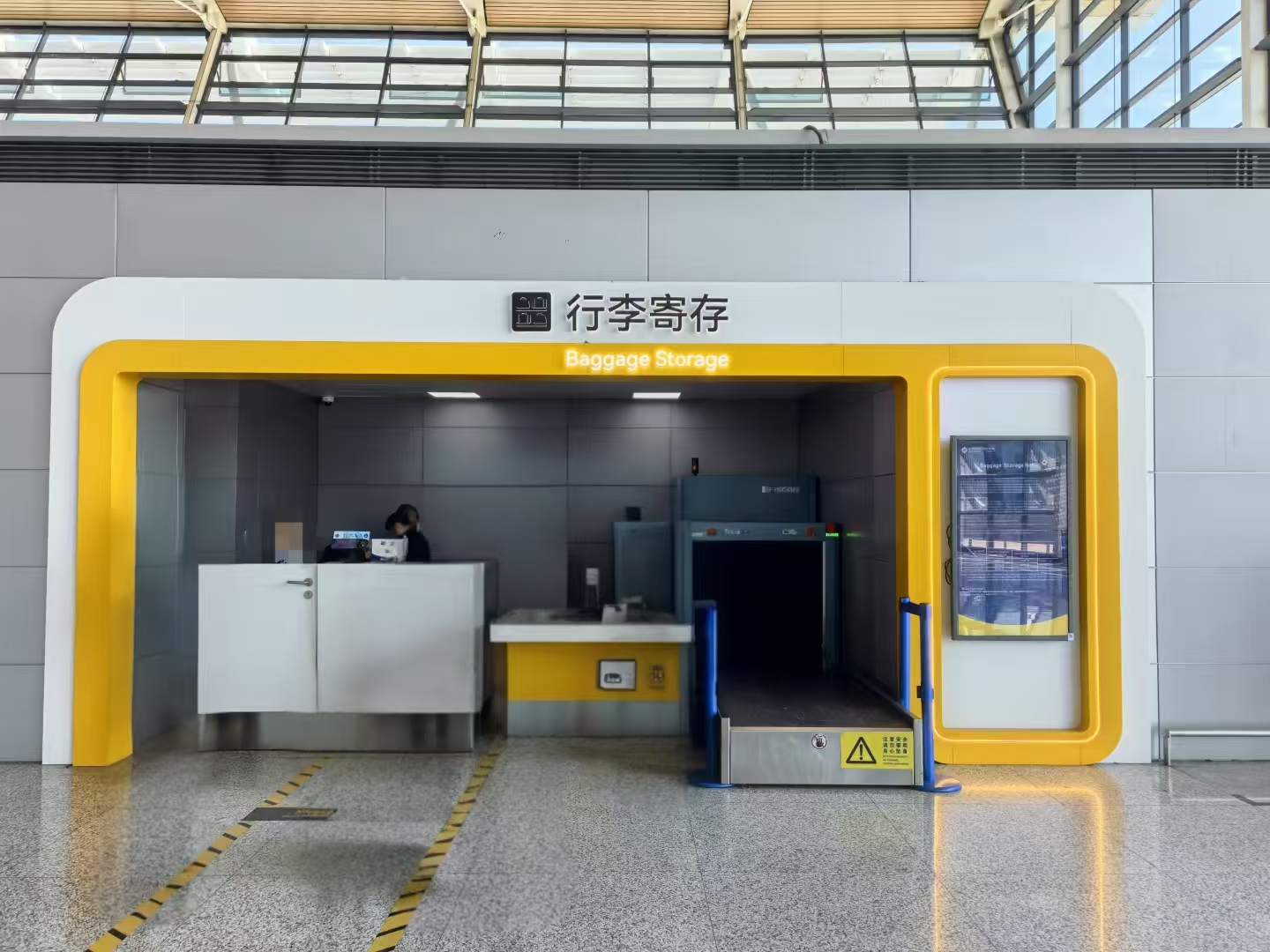
Confirm the counter, service hours and retrieval time before leaving your bags.
Transport: Compare the Complete Route
Pudong Metro Line 2
Line 2 provides a connection between Pudong Airport and central Shanghai. Official visitor guidance gives an approximate one-hour station-to-station journey to People’s Square, but your total trip also includes walking, waiting and reaching the chosen destination after leaving the station.
It can be practical when the selected outing fits the route. Confirm the current service and last return before leaving, especially for an evening connection. Do not assume rail runs throughout the night.
Pudong Maglev and Onward Transport
The Maglev runs between Pudong Airport and Longyang Road, with an approximately eight-minute train journey described by the operator’s line information. Longyang Road is not the Bund or People’s Square. Add the transfer and onward journey before deciding whether it saves useful time.
Use it if the whole route is convenient or the train itself interests you. Do not choose it only because the eight-minute figure sounds like an eight-minute airport-to-city transfer. Waiting, terminal walks and connections can matter more than the fast segment.
Hongqiao Metro
Choose the route for the actual terminal: Line 10 serves Terminal 1, while Terminal 2 also has Line 2. Check where you will emerge in the city and how long the return to the correct terminal requires.
A direct Metro journey can be useful, but a route with several changes is a poor use of a short sightseeing window. Keep the final walk and luggage in mind when comparing it with a taxi.
Taxi or Prearranged Car
A direct vehicle reduces transfers and can simplify a short outing. It still depends on traffic, queues and legal pick-up or drop-off points. Check a current traffic estimate before departure and leave room for deterioration on the return.
For a booked car, confirm the airport, terminal, meeting point, arrival waiting policy and return time. A flight number helps the provider monitor arrival, but monitoring is not a guarantee that a delayed flight leaves time for the original tour. Confirm how shortening or cancelling the outing is handled.
Airport Link Line: Useful for an Airport Change
The Airport Link Line connects Pudong Airport T1 & T2 station with Hongqiao Airport Terminal 2 station in around 40 minutes of train travel. Add station access, waiting, terminal movement and any required Terminal 1 connection. It is a landside journey, not a protected airside transfer between flight gates.
If changing airports, make that transfer the core task. Only consider an extra stop after you have calculated all entry, baggage and departure requirements. The published rail time does not establish a safe total connection time for your flights.
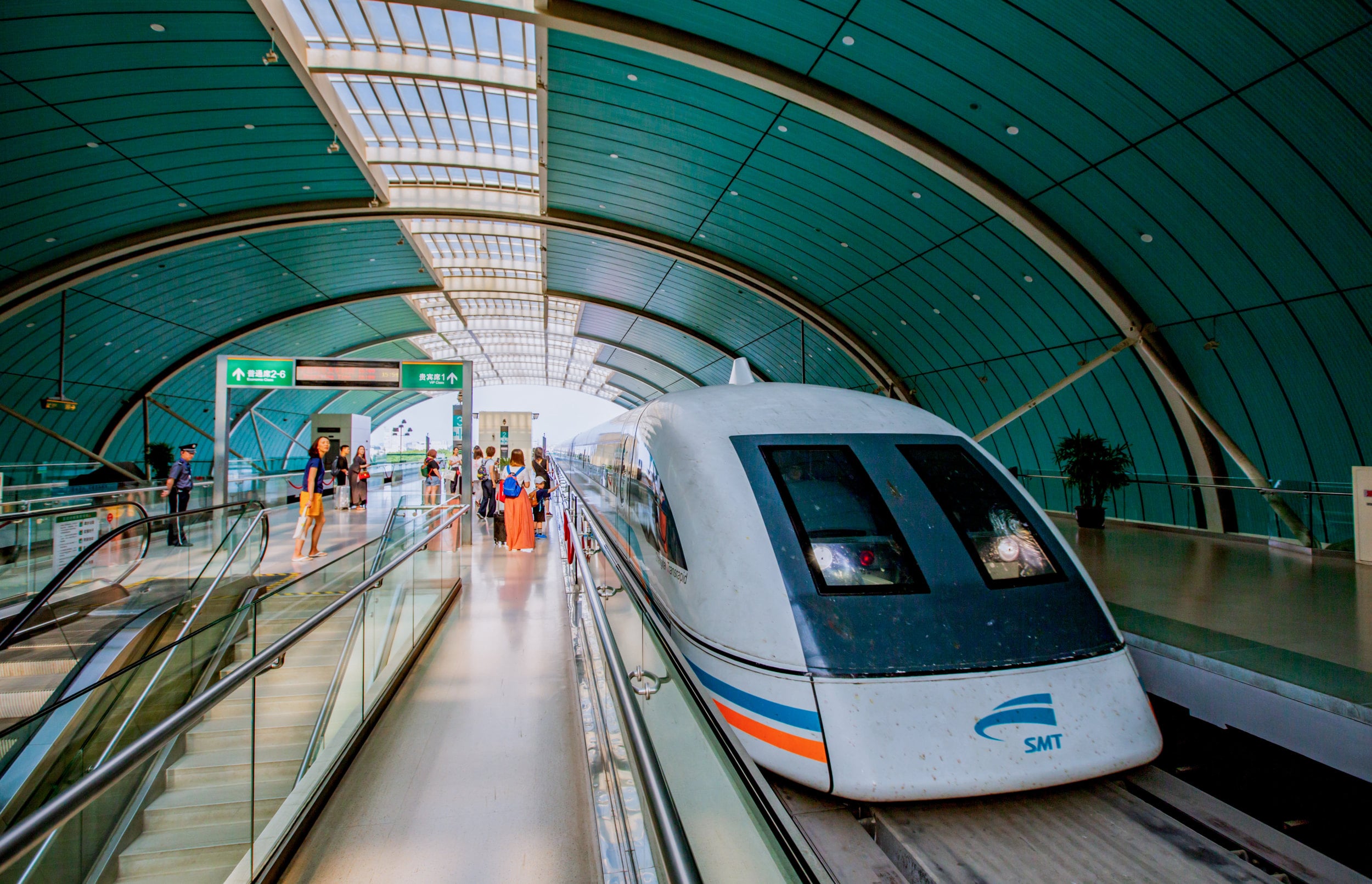
The Maglev's short ride ends at Longyang Road; most city visits still need onward transport.
Three Sensible Ways to Use the Layover
Option 1: Stay at the Airport
This is the most practical choice when time is short, entry is unavailable, bags or flight procedures are complicated, or you need rest more than sightseeing.
Find the facilities within the area you can actually access. A lounge listed at the airport may be in another terminal or restricted to passengers with particular flights, tickets or memberships. Confirm lounge entry, operating hours, showers, food and whether there is a quiet place to rest.
Rest areas and sleep pods are not necessarily private hotel rooms. Ask about location, booking, charges and access from your transfer route. Do not leave a permitted airside connection simply because a landside facility looks attractive online.
Minimum flight-connection times describe transfer arrangements under specific conditions. They are not time available for sightseeing and should not be used as a reason to leave the airport.
Option 2: Rest or Eat Landside Near the Airport
If you have permission to enter and enough time to return comfortably, a landside hotel, meal or shower can be a useful compromise. It provides a break from the transfer area without committing to central Shanghai.
At Pudong, Aerotel’s official property information identifies it as a landside hotel in Terminal 2, on Floors 6–7, with its entrance on the fourth floor. International arriving passengers need to complete entry formalities to reach it. Being inside the airport building does not make it an airside transit hotel.
Check day-use or short-stay terms, room availability and the full route to your next departure. An airport-area hotel outside the terminal needs its own shuttle or taxi plan. Verify shuttle hours, frequency, whether it serves your terminal and how early you need to request it.
Around Hongqiao, a meal or hotel break in the airport or connected transport-hub area may be useful. Check whether the venue is truly reachable on foot from your terminal or needs another transfer. A hotel branded Hongqiao can be in the wider district, not beside the terminal.
Nearby does not mean effortless. Do not add Disney Resort from Pudong just because it is in the same broad part of Shanghai: park admission, queues, walking and the return make it a different kind of visit.
Option 3: One Focused City Outing
Choose one area that gives a clear Shanghai experience. The outing should still make sense if you need to shorten it after arrival.
For a first visit, a selected Bund section with lunch or a drink nearby is often enough. Enjoy the skyline and historic riverfront, then start the return at the agreed time. You do not need to add a tower, cruise and shopping street.
Another option is a short old-city visit around the Yu Garden area. The garden, bazaar and temple are separate visiting components, and tickets or opening hours may differ. Historic paths, bridge steps and crowds can slow the route. Choose the part you care about rather than promising the whole district.
From Hongqiao, a short neighbourhood-and-meal outing or Qibao can be worth comparing with a central riverfront journey. Qibao is in Minhang and offers old streets and waterways, but it is not next to every Hongqiao terminal. Check the actual outward and return route.
A museum can work on a longer daytime layover if admission is available and the location fits the journey. Do not make a short connection depend on a scarce timed reservation or an all-gallery visit.
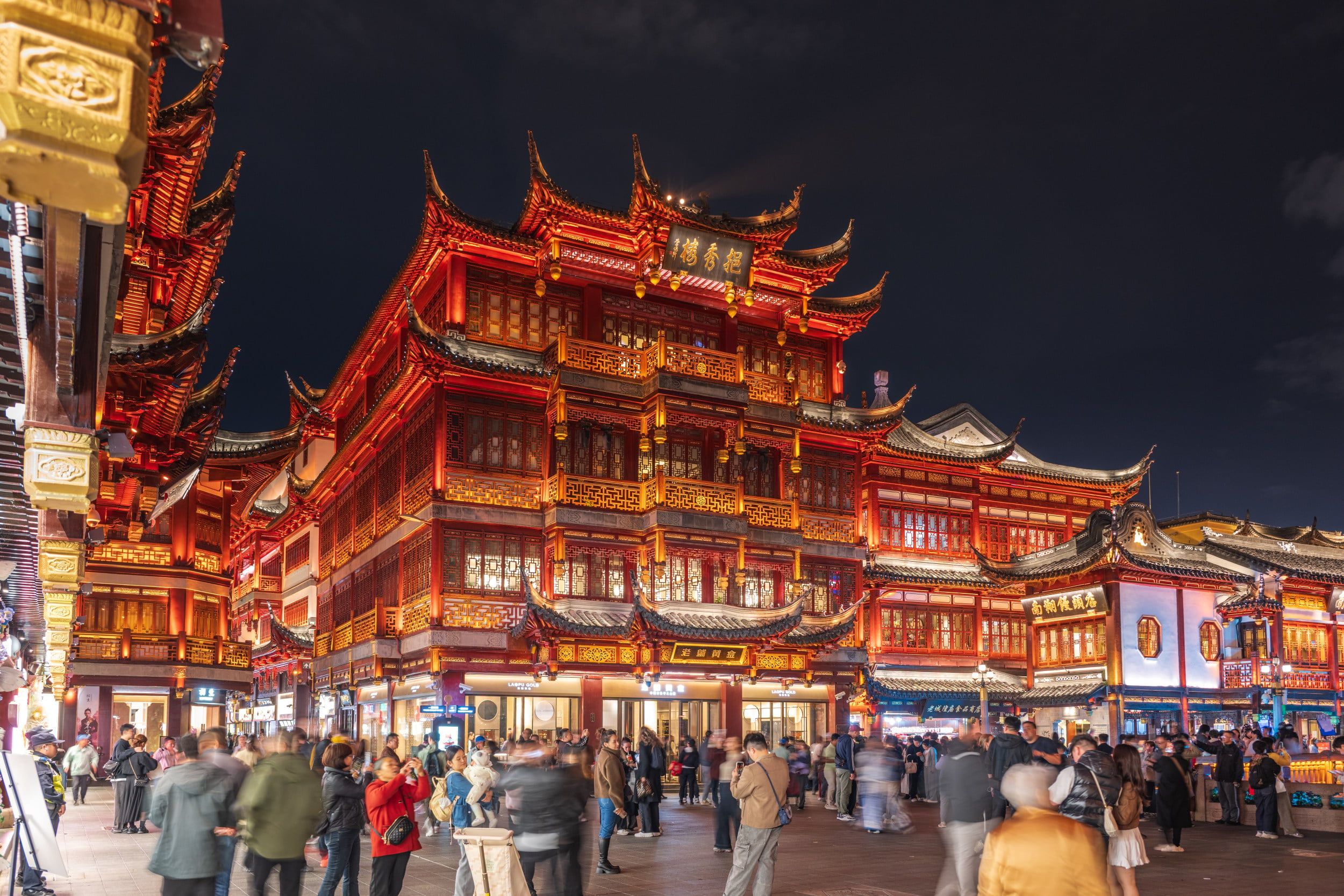
Choose a limited old-city route rather than assuming the garden, bazaar and temple all fit the same stop.
A Practical Long Daytime Layover Plan
This outline is for a sufficiently long same-airport connection with entry confirmed and luggage resolved. It is not a fixed flight timetable.
Before leaving the arrival area: confirm the next flight, departure terminal and required procedures. Check the actual time left, store bags if needed, obtain the receipt and save the return route. Choose a latest departure time from the city and an earlier trigger if transport conditions worsen.
Outward journey: use the simplest route to one area. If arrival was delayed, shorten the plan before travelling. Do not reach the city and then discover that your sightseeing allowance has disappeared.
City visit: take a short walk and a seated meal or drink. Keep additional stops optional. Avoid an activity that locks you into a long queue, a fixed boat departure or a lengthy performance close to the return time.
Return: leave at the protected time even if you have not completed every idea. Retrieve bags before the required check-in process and go to the correct terminal. Continue to the gate with time for any document check or internal airport journey.
If the remaining time after arrival no longer supports the outing, switch to airport rest. That is a good use of the new information, not a failed travel plan.
Overnight Layovers: Plan for Sleep First
An overnight connection can look long while offering few useful city hours. A late arrival and early departure leave time for immigration, transport, a short sleep and the return, rather than a normal sightseeing day.
Landside Airport or Nearby Hotel
This is often the simplest option when you can enter and want sleep before a morning flight. Check the airport and terminal carefully, particularly if the next flight leaves from the other airport.
Confirm that the hotel accepts the planned arrival time, how it handles flight delays and whether late-night transport is available. A short-stay rate may have a fixed duration or checkout condition. A hotel booking does not provide entry permission.
City Hotel
A city hotel can make sense when the overnight interval includes substantial usable daytime and you want a brief city experience. It makes less sense when the additional outward and return transfers consume the hours you hoped to sleep.
Choose the hotel for the departure route, not only a famous location. Check reception hours, luggage arrangements and early transport. Do not plan around a Metro service that has stopped or has not yet started.
Remaining Airside
If you cannot or prefer not to enter mainland China, confirm which facilities you can reach from the permitted transfer area and whether they operate overnight. Official September 2026 information for Pudong described sleep pods in international departure areas and distinguished them from landside hotel accommodation.
Ask the airline about the overnight transfer process, boarding-pass access and any terminal restrictions. An international departure lounge is not necessarily accessible immediately after every arriving flight. Do not book a facility before checking that your transfer route allows you to reach it.
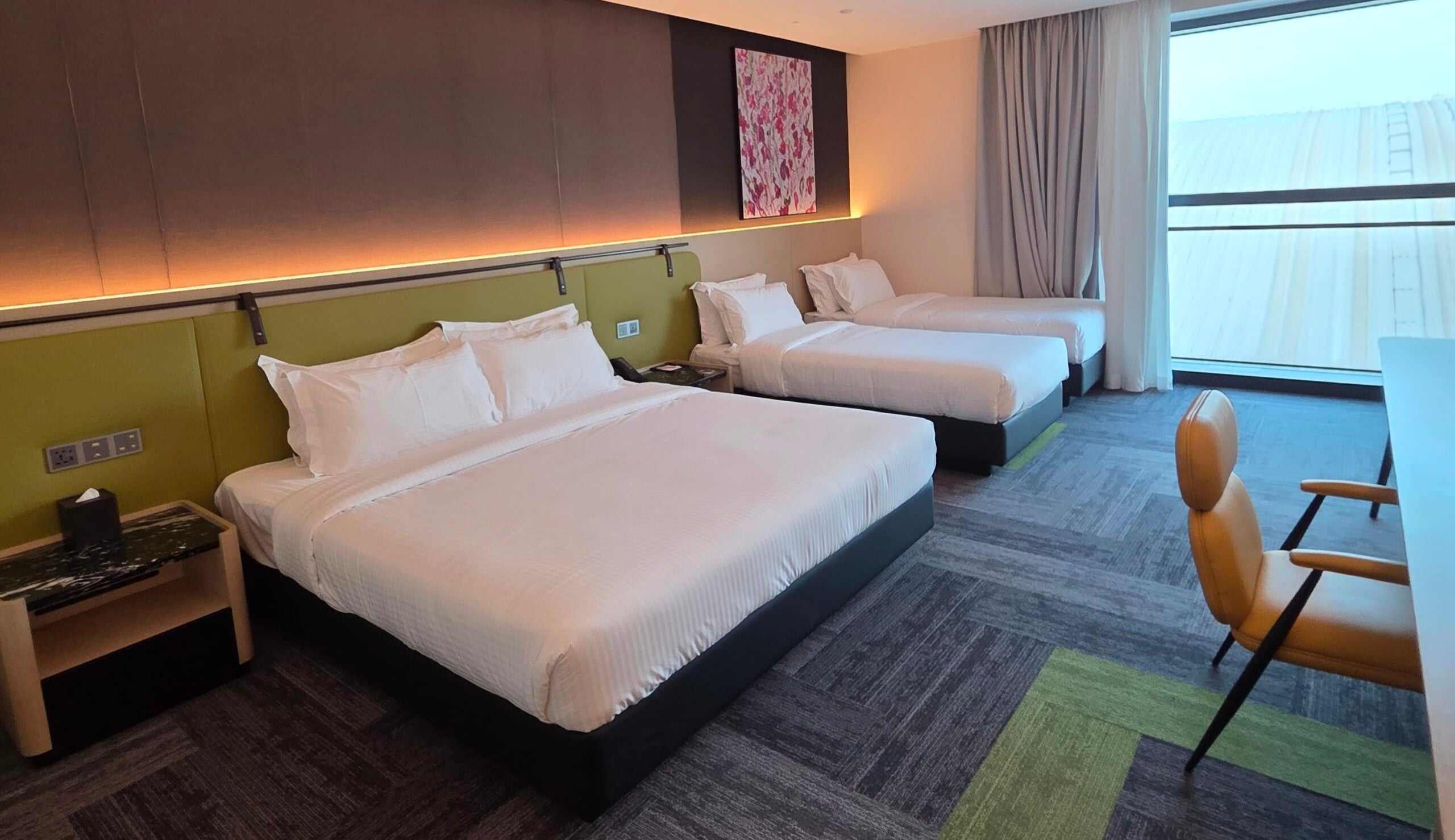
Aerotel is inside Pudong Terminal 2 but landside; arriving international travellers must complete entry formalities to reach it.
What to Avoid on a Short Connection
Avoid regional day trips to Suzhou, Hangzhou or Wuzhen between flights unless your stop is effectively a longer entered stay with a separately planned itinerary. Intercity stations, local transfers and return uncertainty make them unsuitable default layover suggestions.
Avoid a packed city loop. The Bund, Yu Garden, a tower, a cruise and a museum are not adjacent pieces that can be combined just because each sounds like a short stop.
Avoid planning to arrive at the airport at check-in closing time. Airport entry, queues and gate travel still take time, and some airlines require earlier document checks.
Avoid relying on through-checked baggage, 24-hour transport, automatic temporary entry or a guaranteed hotel room without confirmation. These assumptions often matter more than the attraction choice.
Finally, avoid placing a non-refundable timed activity at the centre of a plan that depends on an on-time arrival and uncertain immigration duration. Keep the outing flexible enough to shorten or cancel.
A Final Decision Before You Leave
Ask yourself: am I permitted to enter, are my bags resolved, do I know the next flight’s procedures, and is there still a worthwhile outing after protecting the return? If all four answers are clear, choose the smallest useful plan.
If one remains uncertain, resolve it or stay at the airport. The value of a layover outing is the experience you can enjoy comfortably, not the number of hours printed between flights.
Frequently Asked Questions
1. Can I leave Shanghai Airport during a layover?
Only if you meet the applicable entry conditions, complete the required formalities and have enough time for the connection. Permission to remain in a restricted transit area is not the same as permission to enter the city.
2. Is a six-hour layover enough for central Shanghai?
This guide recommends staying at the airport for such a short interval. Arrival, transport and departure procedures can use most of the time. Even a straightforward connection should not depend on every stage being unusually fast.
3. Is a ten-hour layover enough to visit the Bund?
It may be possible under favourable conditions, but calculate it from the actual arrival and baggage situation. Pudong’s longer city journey can leave a small window. Choose one short outing and preserve the return allowance.
4. Which airport is more convenient for a city visit?
Hongqiao often offers a shorter urban journey, while Pudong requires more transport time. The actual terminal, destination, flight procedures and bags can change the comparison.
5. Does the Maglev go directly to the Bund?
No. It connects Pudong Airport and Longyang Road. Add the onward transport, waiting and terminal walks before deciding whether the route suits the layover.
6. Can I transfer between Pudong and Hongqiao in 40 minutes?
That is an approximate Airport Link Line train time between its airport stations, not a flight-to-flight transfer. Terminal access, waiting, entry, bags and the next departure’s procedures need additional time.
7. Does 24-hour visa-free transit automatically let me go sightseeing?
No. Under the published policy, leaving the restricted area requires a temporary entry permit. Check the arrangement applicable to your passport and itinerary rather than assuming city access.
8. Can I use 240-hour transit for a return to the country I arrived from?
The policy requires onward travel to a third country or region and has additional eligibility conditions. Do not assume a simple return itinerary qualifies. Check current official guidance for the complete routing.
9. Must I collect my checked luggage?
Ask the airline for the specific connection. Through-checking and collection requirements vary. If collection is necessary, include reclaim, customs, storage or re-checking in the time budget.
10. Is luggage storage available?
Published services exist at Shanghai airports, but counter location, hours, eligibility and charges need confirmation. Include retrieval and any terminal transfer before your departure procedures.
11. Is an airport hotel always airside?
No. Aerotel at Pudong Terminal 2 is landside. International arriving travellers must complete entry formalities to reach it. Confirm the location of any other property before booking.
12. Can I stay in the airport overnight without entering China?
Follow the airline’s transfer instructions and confirm facilities within the area you can access. Rest areas, pods and lounges have their own location and operating conditions; they are not guaranteed overnight hotel rooms.
13. What if my first flight arrives late?
Recalculate after arrival and shorten or cancel the outing. Preserve the departure and return buffers rather than trying to complete the original city plan in less time.
14. Can I visit Shanghai Disneyland during a layover?
It is not a suitable default short-connection plan. Transport, admission, walking and queues require substantial time. Consider it only as part of a longer entered stay with a separate full-day plan.
15. Are overnight layovers good for sightseeing?
Only when they include enough usable hours beyond the sleep and transport requirements. A late arrival and early departure usually favour rest near the airport. Check late-night and early-morning transport separately.
16. What should I provide when requesting a layover transfer or tour?
Provide both flights, airport codes, terminals where known, dates, passport-related entry status, baggage arrangements and walking or transport needs. Agree what happens if entry is delayed or the outing must be shortened.
Plan a Layover Around the Flights You Actually Have
A useful layover plan starts with your flight details, not a list of sights. Once entry, baggage and the return are clear, a small city outing or a good rest can make the time more enjoyable.
Discover East China Tours can help assess a landside transfer or focused Shanghai outing around those details. Share the complete flight itinerary and any special requirements. Confirm the vehicle, waiting policy, return time and cancellation arrangements in the actual proposal; a sightseeing booking does not guarantee entry or protect an onward flight.
Prepared for Discover East China Tours. Updated: 13 October 2026.