
Plan a rewarding Xidi visit with selected historic houses, Huizhou carving, village walks and practical advice on guides, overnight stays and onward journeys.
Xidi rewards a visit that looks beyond the first photograph of white walls and dark roof tiles. Walk through its lanes, enter a few historic buildings and take time to examine a doorway, a light well or a carved panel. The village becomes more interesting when you begin to understand how its spaces worked and what they meant to the people who built them.
For a first visit, allow around three to four hours inside the village for selected interiors, a guided explanation and a break. You can make a shorter introduction, but an unhurried half day is a better starting point for visitors interested in architecture. Add lunch or a confirmed cultural activity if you want a fuller day.
Xidi combines naturally with Hongcun or Tunxi, though each combination has a different purpose. Hongcun offers a useful comparison through its water-linked layout and open scenery; Tunxi adds an urban setting, restaurants and a different evening pace. Choose the pairing around your interests and actual travel time, rather than trying to fit every place into one day.
Xidi at a Glance
| Planning question | Practical answer |
|---|---|
| Where is Xidi? | In Yi County, within the wider Huangshan area of southern Anhui. It is separate from Huangshan Mountain and Tunxi. |
| Why visit? | Historic houses, ancestral halls, carved decoration and a village street pattern that rewards walking. |
| Main first-visit focus | Hu Wenguang memorial archway, a communal hall, selected residences and connecting lanes. |
| How long inside the village? | Around 3–4 hours for an unhurried selected visit; more for lunch, photography or a booked activity. |
| Is a guide useful? | Particularly for inscriptions, building functions and the meaning of decorative details. |
| Is an overnight necessary? | No. A day visit covers the main architectural introduction; a night supports a slower pace. |
| Can I combine it with Hongcun? | Yes, with a full village day and distinct themes for each stop. |
| Can I combine it with Tunxi? | Yes. A village half day followed by a transfer and a relaxed city evening is a practical option. |
| Is it step-free? | Do not assume so. Uneven paving, thresholds and interior steps require route-specific checking. |
The time allowances throughout this guide are editorial planning estimates. They are not published schedules or promises of completion, and road travel is additional unless stated otherwise.
What Makes Xidi Worth Visiting?
Xidi and Hongcun form the UNESCO World Heritage property Ancient Villages in Southern Anhui – Xidi and Hongcun, inscribed in 2000. Its value includes traditional village layout, architecture, decoration and the relationship between buildings, water and landscape.
At Xidi, a particularly rewarding way to explore is through the built fabric of the village: an archway, shared halls, residences and the lanes between them. Historic Huizhou culture connects these places with commerce, education, family organisation and public life.
Huizhou here refers to the historical region associated with southern Anhui and neighbouring areas. It is not the city of Huizhou in Guangdong. Understanding this distinction helps when researching museums, crafts and regional architecture.
Xidi is also a lived-in village and a visitor destination. Businesses, accommodation and contemporary residents are part of the experience. Treat the public heritage spaces as places to explore carefully, while recognising that some doorways lead into private homes.
How to Look at Xidi's Architecture
Start With the Exterior, Then Look for the Interior Contrast
The familiar white walls and dark roof tiles give the village a shared visual character. Raised, stepped gable walls, often called horse-head walls, create variation in the roofline. Entrances and street-facing walls are useful places to begin observing differences between buildings.
Inside, spaces may be more elaborate than the exterior suggests. Halls, light wells, timber structures and decorative surfaces reveal how the house was arranged. Compare the street frontage with the spaces behind it rather than treating the façade as the whole building.
Understand the Tianjing, or Light Well
A tianjing is an open light well within the building arrangement. It helps you see how a relatively enclosed house brings daylight into its interior and relates different rooms to one another.
At a suitable open residence, look from the entrance towards the light well and hall. Ask how the different spaces were used and how the building’s arrangement changed as it extended farther inward.
A light well is not necessarily a courtyard intended for visitors to sit in. Follow the building’s access instructions, and do not step into restricted areas to find a better photograph.

Notice Wood, Brick and Stone Carving
Huizhou carving appears in different architectural materials and locations. Woodwork may be found in structural and interior decorative elements; brick and stone details can enrich entrances, walls and other features.
Look at the relationship between the carving and the building. Is it placed where a visitor first arrives, in a shared hall or in a more domestic setting? Does it use plants, animals, figures or a narrative scene?
Motifs can communicate ideas about good fortune, family values, learning or status. Ask a guide to interpret a few actual examples. A specific explanation is more useful than assuming that every decorative animal or flower carries the same meaning.
Read Inscriptions Through Their Context
Couplets, plaques and other inscriptions may be difficult to understand without Chinese-language support. Instead of asking for a literal translation of every line, request an explanation of its central idea and why it appears there.
A short discussion about education, conduct or family expectations can bring a room to life. It also gives the building a different role from the previous interior, which helps avoid a repetitive tour.
Compare a Communal Hall With a Residence
These are different kinds of spaces. A communal hall helps explain shared village or clan life; a residence shows domestic organisation, household resources and private display.
Include both in a first visit if access allows. After seeing one of each, you will have a better basis for choosing another building or deciding that a lane walk and break would be more enjoyable.
What to See in Xidi
Hu Wenguang Memorial Archway
The Hu Wenguang archway, also known as the Xidi archway, is a prominent introduction near the village entrance area. Built in 1578, it commemorates an official and provides a useful starting point for discussing status, achievement and stone craftsmanship.
Walk around the permitted viewing area and look at its proportions before studying individual details. A guide can explain the inscriptions and selected carved elements without turning the introduction into a long list of names.
The archway also gives you a recognisable meeting point. Confirm where your guide or vehicle will meet you, as the visitor facilities and vehicle stopping point may be elsewhere nearby.
Jing'ai Hall
Jing’ai Hall is associated with the Hu clan and communal life. When open for visitors, it provides a useful contrast with the domestic buildings on the route.
Ask what kinds of activities the hall historically supported and how its scale and organisation differ from a house. This is an opportunity to understand the village as a community, rather than only as a collection of attractive interiors.
If an event or activity is taking place, follow the current access instructions. A publicised cultural programme does not mean the same ceremony is performed daily for every visitor.
Dafu Residence
Dafu Residence, commonly labelled Dafu Di, is a useful stop for connecting architecture with a specific local story. Its association with making room for passers-by offers a way to discuss consideration for neighbours through the building’s street edge and inscriptions.
Ask your guide to show the relevant detail where access permits and explain its context. The interest lies in how the story relates to an actual space, not simply in repeating an English slogan.
West Garden, East Garden and Other Selected Residences
Names such as West Garden, East Garden and Lufu Hall appear in Xidi’s architectural visitor routes. Their availability and the exact spaces open to the public should be checked for the day.
Select a building that adds something different: a contrasting plan, an interesting carved feature or a story that connects to what you have already seen. You do not need to enter every named house to understand the village.
Historic building names may appear in different English translations or spellings. Keep the Chinese name or the current visitor-map label available to avoid confusion when arranging a meeting or asking for directions.
The Lanes, Streams and Village Edges
Xidi’s public lanes are part of its heritage experience. Look at how doors, walls, crossings and streams relate to everyday movement, and notice the changing width and perspective as you walk.
Water is present in Xidi’s settlement layout, even though a first visit is usually less dominated by large reflection scenes than at Hongcun. Use the current map to understand the connections rather than assuming that every water feature has the same historical role.
A walk towards the village edge can provide a broader view, but optional elevated viewpoints may add steps or climbing. Check access and effort separately if your route is intended to be gentle.
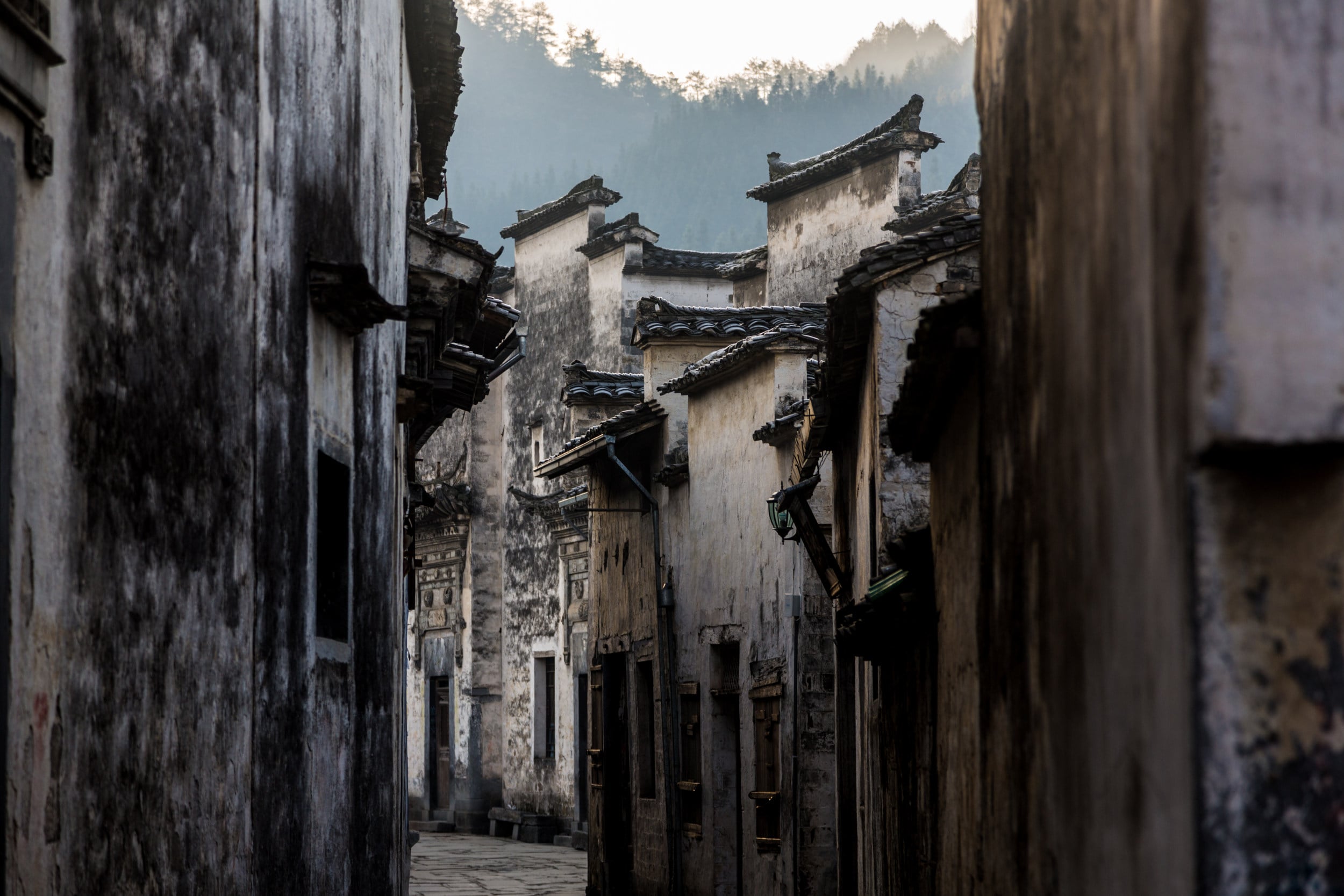
Public village lanes, streams and Huizhou-style houses in Xidi
A Practical First-Visit Walking Route
A useful starting sequence is:
Entrance and Hu Wenguang archway → main public lanes → Jing’ai Hall or another open communal building → Dafu Residence and one contrasting residence → a quieter public lane or stream-side section → a seated break and return to your chosen exit.
This is an editorial sightseeing sequence, not a turn-by-turn route. Use the current visitor map, open-building information and local instructions to connect the stops. The order may change to suit the entrance, crowds and the buildings selected.
| Part of the visit | What to focus on | Flexible allowance |
|---|---|---|
| Entrance and archway | Orientation, stonework and the village’s wider setting | 20–30 minutes |
| Communal hall | Shared life and the difference from a domestic building | 25–40 minutes |
| Selected residences | Light wells, room organisation, inscriptions and carving | 60–90 minutes |
| Public lanes and streams | How the buildings work together as a settlement | 30–45 minutes |
| Rest and independent time | Photography, a café or a slower return | 30–45 minutes |
Choose the stops to fit the time available. These allowances are not timed-entry slots and may overlap with the three-to-four-hour recommendation. Busy interiors, detailed explanations or mobility needs can extend the visit.
A Compact Visit of Around Two Hours
Begin at the archway, follow a selected lane route and enter one communal or domestic building that interests you. Add a short independent walk before returning to the exit.
This gives an introduction, but little room for several interiors and a meal. If you want architectural interpretation, reduce the number of stops rather than rushing through every room.
A Balanced Half Day
Allow three to four hours for an initial guided section, selected contrasting interiors and some independent time. This is a useful arrangement for first-time visitors with an interest in history or buildings.
Agree what you want from the guide before starting. An explanation of how spaces were used will produce a different tour from one focused chiefly on photography.
A Slow Visit With Lunch or a Cultural Activity
Keep around five to six hours when you want a meal, a longer architectural discussion, sketching or a confirmed hands-on activity. Avoid filling every extra hour with more houses.
A slower day can include revisiting a lane, sitting down for tea or comparing a detail you noticed in two different buildings. It does not require another attraction beyond the village.
Visiting Independently or With a Guide
Independent walking works if you mainly want to observe the streets, photograph buildings and enter a few open spaces. Use the current map and remain aware of private areas.
A guide adds particular value for inscriptions, the functions of rooms and the relationship between architecture and village life. Choose a duration and route that leave some free time after the main explanation.
Arrange English-language support in advance. A Chinese-language group commentary may not suit an overseas visitor who wants detailed interpretation. Confirm whether the service is an English-speaking guide, a guide with an interpreter or another arrangement.
Transport and guidance are separate services. A driver taking you to the entrance does not automatically provide an architectural tour, assist throughout the ticket process or remain available for an unlimited visit.
Cultural Experiences: What to Arrange in Advance
A Focused Architecture Walk
This is the most direct cultural extension of a first visit. Ask for a theme such as domestic space, carving, inscriptions or the relationship between family and community buildings.
An explanation of two or three real examples is often more memorable than a rapid survey of every architectural term. For a family, ask the guide to adapt the discussion into observations children can make themselves.
Craft Activities
Xidi has hosted heritage activities, including examples involving sachets and lantern crafts. The actual programme available to independent visitors varies by date and provider.
If you want a session, confirm the venue, instructor, duration, materials, language support and minimum group size before travelling. Ask what you will actually make, whether tools are suitable for the participants and whether the finished item can be taken away.
Do not assume that carving a historic-style object, making ink or participating in a lantern activity is a daily walk-in service. A festival demonstration or organised group programme may require separate arrangements or may not be available during your visit.
Performances and Seasonal Events
Xidi has staged performances and evening programmes on particular schedules. Check the actual dates, venue, price and weather arrangements before making one the reason for an overnight.
A ceremony, performance and participatory cultural activity are different experiences. Confirm whether you will watch or take part, and whether explanation in English is provided.
Sketching and Independent Observation
A small sketchbook can turn a rest stop into a more attentive visit. Choose a permitted place that does not block an entrance or lane, and ask before using private space.
You can also set yourself a simple observation exercise: compare two doorways, identify how a light well changes the interior, or look for the same carving material in different locations. This requires no booked workshop and can fit into a short visit.
Photography and Respectful Village Walking
Xidi offers both wider lane scenes and close architectural details. Start with the archway and rooflines, then look for doorways, the fall of light inside permitted interiors and small views between walls.
Ask before photographing residents closely. An open doorway does not establish permission to enter or photograph inside, and a property operating as a guesthouse may still have private areas.
Follow restrictions on interior photography and flash. Do not touch carved surfaces, move objects or lean equipment against historic structures. Keep tripods out of narrow passages and verify local rules before any drone flight.
A more patient visit often helps photography. If a group occupies a room, use another open part of the route rather than pushing through for a photograph. Weather and the time of day influence results; neither an early arrival nor an overnight guarantees empty lanes.
Meals, Rest Stops and Dietary Needs
Allow a proper seated break, particularly if the guided walk includes several interiors and long periods standing. Confirm the restaurant menu, price and portion size before ordering.
Regional dishes may include Huizhou-style fermented mandarin fish and hairy tofu, alongside simpler rice, noodle, vegetable or egg dishes where available. Choose flavours that suit your group rather than feeling obliged to try every speciality.
For a family meal, a few familiar dishes and one regional option can work better than ordering only unfamiliar food. Ask for chilli separately where possible and check fish prices carefully if charged by weight.
Vegetarian requirements, allergies and other restrictions need precise communication. A vegetable dish may use meat stock, and a request for mild food does not remove meat or allergens. Carry a clear translated note and confirm what the restaurant can prepare.
Keep a café or tea stop optional and check prices. A tasting or craft demonstration should not create an obligation to buy. Carry drinking water and use available toilets when you reach a suitable service area, rather than assuming every heritage interior has visitor facilities.
Day Visit or Overnight Stay?
A day visit is sufficient for an architectural introduction and selected walks. It suits travellers using a city or mountain-gateway hotel and those who want Xidi as one part of a wider itinerary.
An overnight can be worthwhile if you want to slow down, revisit the lanes or divide the interiors across an afternoon and the following morning. It also gives flexibility for a confirmed evening activity, though village access and building hours still need checking.
Do not choose a Xidi stay only because it is described as quieter than another village. Noise varies by room, business location, events and date.
| Accommodation choice | Main benefit | What to check |
|---|---|---|
| Inside the heritage village | Easy return to the lanes and a traditional setting | Luggage approach, room facilities, stairs, admission and re-entry. |
| Near the entrance | Potentially simpler vehicle access and baggage handling | Actual walking distance and whether entry is needed for each visit. |
| Farther into the surrounding area | A different rural setting or more space, depending on the property | Transfers to the village and the evening return. |
| Tunxi city hotel | Urban dining and services after the village | The longer road journey and station transfer requirements. |
For a historic-house stay, confirm the actual room: private or shared bathroom, heating or air conditioning, bed configuration, permitted occupancy and sound insulation. Ask where the vehicle stops and how far you must carry luggage.
A village room booking does not automatically include admission or a guided visit. Confirm late arrival and the morning departure route, especially if you have a train to catch.
Getting to Xidi
Xidi requires a road connection from the wider area’s towns or railway stations. Yixian East can be a practical rail approach for a village-focused visit, while Huangshan North may fit a broader itinerary or the train services you need.
Use the actual station name on your ticket. Do not book a station solely because it contains “Huangshan” or appears convenient in a general travel article.
Regional public services have connected Xidi with Yixian East and Tunxi. Check the current timetable, boarding point, last return and any onward connection for your date. Holiday transport notices should not be reused as a universal daily schedule.
For private transport, confirm whether you have a one-way transfer, a vehicle waiting during the visit or a full-day service. Ask how luggage is handled and where the pickup will be. Road traffic, entry procedures and walking from the drop-off are part of the journey.
| Journey decision | Practical planning approach |
|---|---|
| Arriving at Yixian East | Check the actual onward road journey and bus departure; a nearby station still requires a transfer. |
| Arriving at Huangshan North | Allow a separate road leg and choose around the wider itinerary. |
| Day trip from Tunxi | Treat the village visit and both road journeys as an excursion, not just three hours of sightseeing. |
| Continuing to Hongcun | Allow an initial road estimate of around 30–45 minutes, plus pickup, entry and any bus waiting. |
| Continuing to Tangkou | Confirm the direct journey and arrival needs for the following mountain day. |
| Returning for a train | Work backwards from station security and boarding, with a generous road buffer. |
The Hongcun transfer allowance is approximate advice for ordinary private-road conditions. Verify the actual route and date; public transport takes additional waiting and stops into account.
Combine Xidi With Hongcun
A full day comparing the villages can be rewarding if each has a different focus. Use Xidi for a selected architectural tour and Hongcun for its water system and wider scenery, adding only a limited number of afternoon interiors.
One workable arrangement is Xidi in the morning, lunch and transfer, then Hongcun in the afternoon. Reverse the order if it fits your arrival point, accommodation or departure better.
Allow around two and a half to three hours for a selected Xidi visit and around three hours for a selected Hongcun route. Lunch, the inter-village journey and entry processes make this a full day before long outer transfers are added.
If you prefer detailed architecture, shorten the Hongcun interior selection. If photography in Hongcun matters more, avoid spending the entire morning in a long sequence of Xidi residences.
A half day is better spent in one village. Splitting it between two entrances and a road journey can leave little time for interpretation. Visiting both is optional, even though they share a World Heritage listing.
For a slower pace, sleep in one village and visit the other on the following day. Changing hotels solely to sleep in both usually adds work without improving the sightseeing.
Combine Xidi With Tunxi
Tunxi provides a useful change of setting after a village walk. It offers an urban base, restaurants and an evening around Old Street or the river, rather than another rural heritage tour.
A practical plan is a morning Xidi visit, lunch and the road transfer, followed by hotel check-in and a relaxed Tunxi evening. Leave the transfer time realistic and avoid attaching a tightly scheduled performance to an uncertain arrival.
Tunxi Old Street and Liyang’s historic-commercial area can support a short evening walk, but you do not need to cover both in full. Choose the area that fits your hotel, dinner and energy.
If you want a museum, plan it during its actual opening hours. Tunxi District Museum on Old Street is a different institution from the larger Anhui China Huizhou Culture Museum elsewhere in Tunxi. Check the exact location, current admission and hours before choosing one; neither should be assumed to be an evening attraction.
For a cultural trip, a museum can help interpret what you have seen in Xidi. Avoid turning the city afternoon into another rushed checklist if the village visit has already been substantial.
Fit Xidi Into a Huangshan Mountain Itinerary
Xidi is a separate cultural destination, not a short detour inside the mountain scenic area. Give it its own time and road journey.
Before the mountain, a village visit followed by a transfer to Tangkou can work if you arrive early enough. Leave time to eat, store luggage and prepare for the next morning’s ascent.
After a mountain overnight, allow for the complete descent: upper walking, cableway queue, scenic transport, luggage collection and road travel. If that process runs late, use the evening for check-in and rest, and visit Xidi the following morning.
Do not expect tired walkers to complete a full Xidi architectural route and another village after a long mountain descent. On a short trip, choose the cultural stop that interests you most and protect the mountain’s available time.
Weather, Seasons and Crowd Planning
Spring and autumn can appeal to village walkers, but pleasant weather is not guaranteed. Carry a light layer and check the forecast for the actual date rather than choosing from seasonal photographs alone.
In summer, build in water and a seated break. Moving between interiors does not eliminate heat or the effort of standing through explanations. A slower morning tour may suit families better than continuous afternoon walking.
Rain can add atmosphere to the lanes while making paving slippery. Wear shoes with grip, protect your phone or camera and allow time at thresholds. Narrow interiors and umbrellas can be awkward together, so close and store wet umbrellas as instructed.
During severe weather, follow warnings and any restricted access. Do not assume that every interior remains open or that a rural transfer will take its usual time.
Popular weekends, holidays and organised groups can make key buildings busy. Keep the route flexible and respect any one-way instructions. If a hall is congested, a guide may be able to change the sequence rather than waiting in a narrow doorway.
Xidi With Children or Limited Walking Energy
A good family visit selects a few things to notice: a carved animal, a light well, a difference between two entrances or the route of a stream. Short explanations with visible examples work better than a long series of building names.
Choose one communal space and one residence, then reassess. Add another interior only if the group remains interested, and place a seated break before everyone becomes tired.
Keep children close near streams and uneven edges. Strollers may need lifting over thresholds, and some interiors are unsuitable for easy wheeled access.
For significant mobility limitations, ask about the exact entrance, public path, toilets and selected buildings. A compact map or a ground-floor room does not establish a step-free visit. The most comfortable route may include exterior observation and fewer interiors.
Tickets, Entry and Practical Preparation
Xidi is a ticketed visitor area. Check the current ticket price, included sites, concessions, identity requirements and cancellation conditions through a legitimate booking channel.
Overseas visitors should carry the original passport and confirm the verification process. Do not assume a domestic identity-card-only booking workflow covers every document type.
If staying overnight or leaving and returning, check the current ticket validity and re-entry conditions. Hotel staff can help explain the relevant entrance, but the room reservation should not be treated as automatic admission.
Interior hours can differ from access to public lanes. Make your essential building visits while they are open, and leave an independent walk or meal for later.
Carry comfortable shoes, weather protection, drinking water, a charged phone and accessible booking details. If travelling onward, arrange luggage storage or vehicle handling before the walk rather than carrying a suitcase through the village.
Frequently Asked Questions
What Is Xidi Best Known For?
Its historic houses, communal halls, carved decoration and village lanes. A visit is most rewarding when you enter selected buildings and understand how their spaces worked.
Is Xidi a UNESCO World Heritage Site?
Yes. It forms part of Ancient Villages in Southern Anhui – Xidi and Hongcun, inscribed in 2000.
How Long Should I Spend in Xidi?
Allow around three to four hours for a selected first visit with explanation and a break. Add time for lunch, photography or a confirmed cultural activity.
Can I Make a Short Two-Hour Visit?
Yes, by choosing the archway, a short lane walk and one meaningful interior. It will be an introduction rather than a detailed architectural tour.
Which Buildings Should I Prioritise?
Start with the Hu Wenguang archway, a communal hall such as Jing’ai Hall when open, and one or two contrasting residences. Check the actual access on the day.
What Should I Look for Inside a House?
Notice the relationship between the entrance, light well and hall, then examine selected carving and inscriptions. Ask how the spaces were used rather than focusing only on decoration.
Do I Need a Guide?
Independent walking is possible. A guide is particularly useful for inscriptions, room functions and cultural context; arrange the language support you need in advance.
Is Xidi Quieter Than Hongcun?
Not always. Crowds vary by date, groups, events and individual routes. Choose Xidi for the experience you want, rather than a promise of empty lanes.
Can I Visit Xidi and Hongcun in One Day?
Yes, with suitable transport and selected routes. Give them different themes and allow time for lunch, entry and the transfer.
Should I Visit Both With Only Half a Day?
Usually choose one. Splitting a short period between two villages leaves less time for meaningful walking and interpretation.
Can I Combine Xidi With Tunxi?
Yes. A village visit followed by a transfer, hotel check-in and a relaxed city evening is a practical combination. Museums need their own daytime planning.
Is an Overnight in Xidi Worthwhile?
It can suit a slower architectural visit or another morning walk. A day visit is enough for the main introduction if you prefer to stay elsewhere.
Does Accommodation Include the Village Ticket?
Not automatically. Confirm admission, re-entry, late-arrival arrangements and the exact room location before booking.
Are Craft Experiences Available Every Day?
Do not assume so. Confirm the actual host, activity, language support, materials and date before adding a session to the itinerary.
Is Xidi Suitable for Families?
Yes, with a short route, visible stories and breaks. Uneven paving, water edges and interior thresholds require supervision and realistic stroller planning.
Can I Visit After Descending From Huangshan Mountain?
Potentially, if the descent and road journey leave enough time. A stay followed by the main visit next morning is often more comfortable than a rushed late-afternoon tour.
Plan Your Xidi Visit With Our Local Team
Share your dates, arrival and departure points, walking pace and main interests with our local team. Tell us whether you want architectural interpretation, a slower village stay, a confirmed craft activity or a route combining Xidi with Hongcun or Tunxi.
We can help select meaningful stops, clarify language support and transport, and leave enough time for meals, breaks and the onward journey.
Prepared for: Discover East China Tours
Last updated: 8 October 2026