
Hangzhou is a useful base for exploring nearby water towns, historic cities and countryside. The challenge is choosing an outing that adds something to your trip without spending most of the day in transit.
For a first visit, Wuzhen is a strong choice for a dedicated water-town experience, Shaoxing for canals and literary history, and Liangzhu for archaeology. Nanxun is worth considering if historic houses and merchant heritage interest you. Qiandao Lake, Tonglu and Moganshan suit more specific landscape or outdoor interests, but require closer attention to the route and the time available.
The right choice depends on what you have already planned. If you are visiting a water town from Suzhou, another canal-town outing from Hangzhou may add less than a day in the tea hills or a visit to Liangzhu. If you only have two days in Hangzhou, the city itself usually deserves that time.
This guide compares the most useful options, explains the transport decisions that matter, and identifies places better enjoyed with an overnight stay.
The Short Answer: What Should You Choose?
| Your main interest | Best place to investigate | Why it may be worth your time |
|---|---|---|
| A first Jiangnan water-town visit | Wuzhen | Canal scenery, bridges and a substantial visitor experience in one destination |
| Historic neighborhoods and literary culture | Shaoxing | A city-based day combining canals, Lu Xun’s heritage and selected cultural stops |
| Archaeology and early Chinese civilization | Liangzhu | A World Heritage archaeological landscape with a museum that helps explain it |
| Historic homes and merchant architecture | Nanxun | Canal streets and substantial heritage buildings |
| Covered canal-side walks and another water-town setting | Xitang | A worthwhile alternative when its particular atmosphere fits your interests |
| A lake-focused excursion | Qiandao Lake | Broad lake scenery and a selected boat or waterfront experience |
| River landscapes and a tailored countryside outing | Tonglu | Fuchun River scenery and an outing built around one chosen area |
| Bamboo hills and a rural retreat | Moganshan | A landscape-focused visit, often more satisfying with a night in the area |
These are editorial recommendations by interest, not a ranking of every attraction near Hangzhou. Choose one destination for the day and keep the plan focused.
How Much Time Do These Trips Really Need?
The train ride is only one part of a day trip. Add the journey from your hotel, station procedures, the transfer after arrival, your visit and the return.
| Destination | Approximate total day to allow | Useful visiting time to protect | Overall planning effort |
|---|---|---|---|
| Liangzhu | 6–8 hours for museum and park | Around 4–5 hours across the two venues | Moderate: two separate destinations and a large outdoor site |
| Shaoxing | 7–9 hours | Around 4–5 hours in a selected central area | Moderate: rail or road plus local transfers |
| Wuzhen | 8–10 hours for a daytime visit; longer if staying for evening views | Around 4–6 hours in a selected scenic zone | Moderate: zone choice and return transport matter |
| Nanxun | 8–10 hours | Around 4–5 hours in the old town | Moderate: heritage interiors and the transport route need coordination |
| Xitang | 8–10 hours; longer for an evening visit | Around 4–5 hours | Moderate: allow the transfer between the railway station and town |
| Tonglu | 8–10 hours for a focused outing | Around 4–5 hours at chosen stops | Higher: attractions are spread out |
| Qiandao Lake | 9–11 hours for a focused day | Enough time for the specific cruise or waterfront plan | Higher: station transfer and boat timings can shape the entire day |
| Moganshan | 9–11 hours for a selective visit | Several hours at the chosen mountain or village destination | Higher: hillside access and local transport matter |
These ranges are suggested planning allowances from a central Hangzhou hotel, not live journey times or guaranteed tour durations. They assume a selective itinerary and workable connections. Traffic, holiday queues, walking pace and your actual departure station can extend the day.
If your available time is shorter, reduce the number of stops or choose an outing closer to your hotel. Do not force a full-day route into the hours left after a late start.
1. Wuzhen: A Strong First Water-Town Choice
Wuzhen — 乌镇
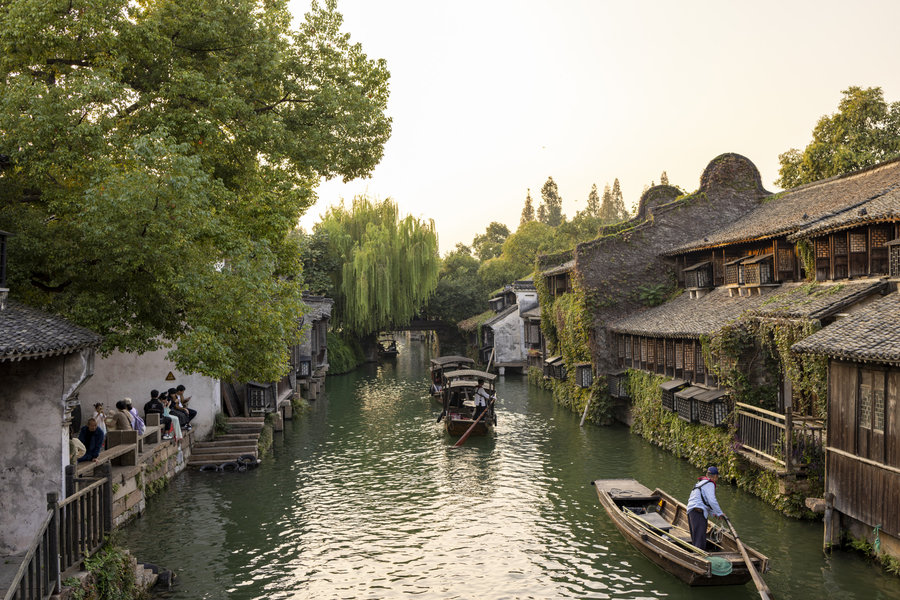
Wuzhen is a useful choice when you want a dedicated Jiangnan water-town outing. Canals, bridges, lane walks and cultural displays provide enough to fill a substantial visit.
The experience is organized around scenic zones with visitor infrastructure. Expect a popular tourism destination with shops, restaurants and managed attractions, rather than an untouched village without modern commercial activity.
East Zone or West Zone?
The two main zones are Dongzha, the East Scenic Zone — 东栅, and Xizha, the West Scenic Zone — 西栅. They are separate visitor areas, with different tickets and arrangements.
For many first-time day visitors, choosing one zone gives a more comfortable pace. Xizha is a useful default if you want a longer walk and are interested in evening waterfront views. Dongzha can suit a more compact daytime visit focused on its selected streets and exhibits.
If you want both, allow time for the transfer and check the combined ticket’s rules. A two-zone ticket is not a reason to rush through both if you would enjoy one more slowly.
How to Get There
You can investigate a direct road transfer or a train to Tongxiang Station — 桐乡站, followed by local transport to Wuzhen.
Tongxiang Station is not the scenic-zone entrance. Include the onward journey and the same transfer on the way back. Check the actual direct-coach or local-bus service for your date rather than relying on an old route number.
A Sensible Day Plan
Travel to your chosen zone, spend time walking, have lunch and choose a few exhibits or a boat ride if the service appeals. Keep the final part of the visit flexible.
If staying for evening views, arrange the return first. Make sure the journey back to a railway station leaves enough time for your train; a late scenic-zone closing time does not imply late onward transport.
Verdict: Worth a day for a first water-town visit. Consider staying overnight if evening views, a relaxed dinner and a quieter start the following morning are central to what you want.
2. Shaoxing: Canals, Literature and a City Beyond the Scenic Gates
Shaoxing — 绍兴
Shaoxing is a good choice if you enjoy historic neighborhoods with cultural context. Its literary associations, waterways and traditional buildings support a day that combines walking with one or two meaningful visits.
What to Focus On
Lu Xun’s Native Place — 鲁迅故里 introduces the writer’s family and educational setting through associated buildings and exhibitions. It is useful even if you have not read his work, though some background or a guide can help make the visit more engaging.
Shen Garden — 沈园 provides a different literary connection, associated with the poet Lu You and Tang Wan. Choose it if the garden and its story interest you rather than simply adding every famous name to the day.
A selected canal walk and lunch can complete the outing. If you want a traditional boat ride, confirm the actual boarding point, route and operation on the day.
How to Get There
Rail is worth investigating, but choose the arrival station carefully. Shaoxing North — 绍兴北 is a major high-speed station outside the central historic area; arriving there still leaves a local transfer.
Other rail or road options may fit your hotel and selected sights better. Compare the complete journey rather than choosing the shortest train ride in isolation.
A Sensible Day Plan
Start with Lu Xun’s Native Place or the cultural stop you care about most. Add lunch and a manageable canal-area walk, then choose one additional visit if time remains.
Do not combine a central-city literary itinerary, an outlying water town and several distant sights unless you are deliberately arranging a longer, transport-heavy day.
Verdict: One of the most rewarding choices for a culture-focused day. It works well with a selected central itinerary and a clear return plan.
3. Liangzhu: The Best Choice for Archaeology
Archaeological Ruins of Liangzhu City — 良渚古城遗址公园 Liangzhu Museum — 良渚博物院
Liangzhu lies within the wider Hangzhou municipality, but a museum-and-park outing can take most of a day from the central city. It belongs in this guide because it requires the same deliberate planning as a trip farther away.
The Archaeological Ruins of Liangzhu City were inscribed on the UNESCO World Heritage List in 2019. The site helps explain a late-Neolithic society with rice agriculture, social differentiation and a shared belief system.
Museum First or Park First?
For many visitors, the museum is a helpful starting point. Objects and interpretation give context to the landscape you encounter afterward.
The park is an archaeological landscape, with earthworks, site interpretation and open spaces. Do not expect streets lined with complete ancient buildings or a palace reconstructed as a conventional sightseeing complex.
Liangzhu Museum and the ruins park are separate destinations. Plan transport between them and check each venue’s opening and entry rules.
How to Get There
Investigate a road transfer or a metro journey with an onward local connection. A station named Liangzhu does not put you at every museum or park entrance associated with the name.
For the park, confirm the entrance and whether an internal shuttle would suit your route. Its size matters, especially in hot weather or for anyone who prefers less walking.
A Sensible Day Plan
Visit the museum, have a break, then explore a selected park route. Give the exhibits and landscape enough time rather than adding several nearby attractions simply because they share the Liangzhu name.
Verdict: Worth the day if early history and archaeology interest you. For someone mainly seeking canal streets, shopping or dramatic standing architecture, another destination may be a better fit.
4. Nanxun: Water-Town Streets and Merchant Heritage
Nanxun Ancient Town — 南浔古镇
Nanxun is a good alternative to Wuzhen if you are especially interested in historic residences and the relationship between wealth, trade and architecture.
Canal walks provide the setting, while selected gardens, houses and other heritage interiors give the visit depth. Choose a few buildings according to your interests rather than treating every interior as compulsory.
What Makes It Different?
Nanxun can support a more building-focused water-town day. You can combine a canal-side walk with a closer look at domestic and merchant spaces.
Do not choose it solely on a promise that it is always quiet. Visitor numbers depend on the date and the particular part of town, and holidays can be busy here too.
How to Get There
Compare a road transfer with the rail options serving Huzhou Nanxun Station — 湖州南浔站. Check the departure station and available services for your travel date, then allow for the final local transfer.
Older guides may describe travel only through Huzhou Station. Compare those routes with current options rather than assuming the older station remains the most convenient choice for every trip.
A Sensible Day Plan
Choose two or three heritage interiors, leave time for lunch and walk the canal areas at a comfortable pace. Check the current distinction between public street access and tickets for individual buildings, boats or combined attraction products.
Verdict: Worth considering for architecture and water-town heritage. Choose it over a second similar town if its particular buildings appeal to you.
5. Xitang: Another Water-Town Option, with a Clear Reason to Go
Xitang Ancient Town — 西塘古镇
Xitang is associated with old bridges, narrow lanes and covered canal-side corridors. It is worth investigating if those features are what you want from a water-town outing.
The town is in Jiashan, and the scenic area requires an onward transfer after arriving at a railway station. A train to the wider county is not the end of the journey.
Compare a road transfer with rail through the station that best suits your service and route. Jiashan South — 嘉善南 is one high-speed station to investigate; verify the local connection to the town.
Spend the visit walking a selected canal route, taking a break and entering attractions that interest you. Check current admission and boat arrangements rather than assuming streets, interiors and rides share one ticket.
If you want to stay into the evening, confirm the return journey before committing. You may prefer an overnight stay if dinner and night views are the main purpose.
Verdict: A worthwhile alternative, especially for its covered walkways and canal setting. For a short East China trip, choose it deliberately rather than adding it after several other water towns.
6. Qiandao Lake: Worth It for a Lake Day, with the Boat Plan Settled First
Qiandao Lake / Thousand-Island Lake — 千岛湖
Qiandao Lake is an extensive reservoir landscape in Chun’an, within the wider Hangzhou municipality. It suits visitors who want a lake-focused excursion rather than a historic-city walk.
The key is deciding which lake experience you want. A scheduled sightseeing cruise, a shorter boat product and a waterfront visit have different time requirements.
Why the Transfer Matters
Qiandaohu Railway Station — 千岛湖站 is not the main lakefront or your cruise pier. An onward road journey is part of the trip.
A fast train therefore does not guarantee an easy morning sailing. Work backward from the boat’s boarding time, including the station transfer and the operator’s arrival instructions.
A Sensible Day Plan
Choose one boat product or one defined waterfront area. Confirm duration, boarding location, landing arrangements and any walking on islands before booking.
Do not assume all cruises visit the same islands or return at the same time. A full sightseeing circuit can occupy much of the visiting window, while a shore-based outing leaves more flexibility.
Weather and visibility influence the experience, and boat operations may change. Keep a workable alternative rather than organizing the entire day around an unconfirmed sailing.
Verdict: Worth a focused day if lake scenery is a priority. An overnight stay often works better if you want cycling, several activities or a resort-style break.
7. Tonglu and the Fuchun River: Choose a Specific Landscape Outing
Tonglu — 桐庐 Fuchun River — 富春江
Tonglu is useful for travelers who want river landscapes and countryside rather than another urban heritage district. The Fuchun River setting gives the outing a different character from the lake and canal scenery of central Hangzhou.
However, Tonglu is a broad area. “A day in Tonglu” needs a defined plan: a selected river-side visit, a hill walk, a village outing or another attraction you have checked.
How to Get There
Rail can bring you to the wider area, but the attraction you choose determines the onward journey. Check whether Tonglu Station — 桐庐站 or another station better fits the service and destination; Tonglu and Tonglu East are different stations.
A planned car transfer may be useful if you are connecting rural stops. Confirm each location and the return rather than assuming taxis will be equally easy to arrange everywhere.
A Sensible Day Plan
Choose one main attraction or river area, add lunch and leave room for a smaller nearby stop. Tongjun Mountain is one place to investigate for a town-side hill and river setting; other countryside activities need their own route planning.
If booking a cruise or seasonal outdoor activity, check the actual operation for your date. A news article about a past service is not a current timetable.
Verdict: Worth it for a clearly chosen river or countryside experience. It is less useful as a vague excursion with several distant stops added on arrival.
8. Moganshan: Possible in a Day, Often Better as a Retreat
Moganshan / Mogan Mountain — 莫干山
Moganshan, in Deqing, is associated with wooded hills, bamboo landscapes and rural stays. It can make an appealing change of pace if you want time outdoors.
The mountain scenic area, surrounding villages and accommodation properties are different destinations. Choose the specific place you want to visit before arranging transport.
How to Get There
A train to Deqing Station — 德清站 can be one part of the journey, but you still need local transport to your destination. Deqing Station and Deqing West are separate stations, so check the ticket carefully.
Investigate the scenic area’s current approach, access and transfer arrangements if you are visiting the mountain itself. A vehicle dropping you at one point does not mean it can follow the entire route or collect you anywhere you finish.
A Sensible Day Plan
Choose a defined walk or scenic-area route with a lunch stop. Keep the day’s physical demands appropriate to your group and arrange the return pickup in advance.
If your interest is mainly a rural hotel, a long meal, quiet village time and a slower pace, give the area a night rather than fitting a retreat into a tightly scheduled return trip.
Verdict: A day trip can work for a specific outdoor plan. An overnight stay is usually the stronger choice for the relaxed experience many travelers associate with Moganshan.
Should You Choose More Than One Water Town?
Wuzhen, Nanxun and Xitang each have their own appeal, but a short trip rarely needs all three. Adding Tongli or Zhouzhuang from Suzhou increases the chance of repeating similar experiences.
Choose according to the features you care about:
- Wuzhen: A substantial, organized visitor experience, with Xizha worth considering for evening views.
- Nanxun: Canal scenery combined with a focused interest in historic buildings.
- Xitang: Covered canal-side corridors and its particular walking environment.
Avoid combining two towns just because a road route makes it technically possible. Transfers, entrance procedures and lunch can leave too little time to appreciate either place.
If you have already chosen one water town, consider whether Shaoxing, Liangzhu or a landscape outing would add more variety to the rest of your journey.
Shanghai, Suzhou and Huangshan: Should They Be Day Trips?
Shanghai
A focused Shanghai day from Hangzhou is possible by rail, but the arrival station is only the beginning of a large-city visit. Allow time to reach the neighborhood you want to explore.
Choose one compact route rather than trying to fit the Bund, museums, shopping and several distant districts into a single day.
If Shanghai is already part of your onward itinerary, it usually makes more sense to move there and stay than to return to Hangzhou after a brief introduction.
Suzhou
Suzhou can also be visited selectively, but one garden and one nearby historic area are a more realistic aim than the entire city plus a water town.
Check the arrival station carefully. Suzhou Station, Suzhou North and Suzhou South serve different locations; a fast service to a station farther from your intended sights may not give the quickest overall visit.
If gardens and historic neighborhoods are a major interest, give Suzhou its own stay on a multi-city route.
Huangshan
For most first-time visitors, Huangshan’s mountain scenic area is a poor choice for a relaxed day trip from Hangzhou.
Reaching Huangshan North Station is not the same as reaching the mountain entrance. You must also account for the road transfer, scenic-area transport, cable cars if used, walking, queues and the return.
Huangshan city, the mountain and villages such as Hongcun are separate destinations. Do not assume a train to the region makes all of them accessible within the same short visit.
If the mountain is important to you, plan an overnight or multi-day extension that gives you room for weather, physical effort and the scenery. A brief city visit should not be sold as the equivalent of seeing the mountain.
How Many Day Trips Should You Add?
With Two Days in Hangzhou
Stay focused on Hangzhou unless there is a nearby destination you specifically came to see. West Lake, the tea area, temples, the canal and the old town already offer more than two days of possibilities.
If you add a full-day outing, acknowledge the trade-off: you will have less time for Hangzhou itself.
With Three or Four Days
One carefully chosen outing can work well. Use your main interest to decide: water town, literary city, archaeology or landscape.
Keep another day flexible for weather or an experience you discover after arrival.
With Five Days or More
Two varied outings may be worthwhile, but consider turning the farther one into an overnight stop. Moving onward can be more efficient than repeatedly returning to the same hotel.
A water-town day and an archaeological visit provide more variety than several similar towns. A city visit and a countryside stay can also balance each other well.
How to Plan the Transport Properly
Compare the Whole Journey
For rail-based trips, calculate:
Hotel to departure station + station buffer + train ride + onward transfer + return journey.
Hangzhou, Hangzhou East and Hangzhou West are different stations. Choose according to the actual service and your hotel location. Do not head to a station simply because its name seems to match the city.
For road travel, compare the convenience of a direct journey with possible traffic and the cost of an arranged return. A private vehicle may simplify rural stops, but it does not remove queues or attraction access restrictions.
Book the Return Before Committing to Late Activities
Check the return train or coach as part of the initial plan. Leave enough time to reach the station, clear the necessary procedures and board.
This matters especially for Wuzhen or Xitang after dark, and for lake or countryside activities with fixed end times. Do not rely on finding a suitable final service after dinner.
Use the Correct Identification
Book rail travel using the passenger information required by the booking platform and carry the original document used for the ticket. Save your train number, station names, date and departure time.
If a passport does not work at an automated checkpoint, ask staff for the appropriate assisted channel. A booking confirmation does not replace the identification required for travel.
Decide Whether to Arrange Local Transport
For a central Shaoxing visit, local taxis or urban transport may be enough. For a rural route, a lake pier or a mountain outing, a prearranged transfer can make the itinerary easier to control.
Confirm the pickup point, waiting arrangements, included stops and return destination. A one-way ride does not automatically provide a car waiting for your afternoon departure.
Tickets and Reservations: What to Check
Day-trip destinations use different systems. A town ticket, museum registration, boat booking and mountain entry should be treated as separate arrangements unless a product explicitly combines them.
Before booking, check:
- The exact attraction, zone or entrance covered.
- Date validity and any time slot.
- Whether re-entry or movement between areas is permitted.
- Which transport, boats or interiors cost extra.
- Identification requirements and the passport booking option.
- Cancellation terms and weather-related changes.
Free admission can still involve registration or a capacity limit. A discount advertised for local residents or a temporary festival does not necessarily apply to an overseas day visitor.
If an online flow does not accept your document or phone number, contact the venue or ask your hotel or travel provider for the correct alternative. Do not enter a substitute Chinese identity number.
Weather, Seasons and Crowds
Choose the outing with the forecast in mind. A museum-led Liangzhu visit or a selective Shaoxing cultural day can be easier to adapt than an outing depending on lake visibility or a long hill walk.
Water towns still involve walking outdoors. Covered sections do not make the whole visit sheltered, and bridge steps or old paving can be slippery in rain.
Qiandao Lake and Moganshan can be appealing landscape choices, but conditions influence views and activities. Confirm any boat or outdoor operation close to the visit date.
Weekends and major holidays can affect roads, train availability, entrances and restaurants. Leave room for delays and resist adding extra stops to a day already dependent on several connections.
Traveling with Children or Older Family Members
Choose according to the full day’s demands, not just the headline attraction. Station walking, transfers, bridge steps and a long return can be tiring even when the main visit sounds easy.
For a mixed-age group, protect time for lunch, toilets and seated breaks. A vehicle that simplifies transfers can help, but accessibility within the attraction still needs checking.
At water towns, ask about routes that reduce bridge steps where necessary. At Liangzhu, investigate internal transport and the amount of outdoor walking. For Qiandao Lake, check boarding and island access. For Moganshan, confirm the actual elevation and path demands of your selected route.
A shorter visit to one area is often more comfortable than a tour with several included attractions that the group has little time to enjoy.
Sample One-Day Outlines
These examples show a sensible sequence rather than fixed departure times.
Water-Town Day
Morning transfer to Wuzhen or Nanxun → focused walk and selected cultural stops → lunch → further exploration or an optional boat ride → return with a protected transport buffer.
If evening views are essential, arrange a later return or stay overnight. Do not add another water town just to fill a midday gap.
Shaoxing Cultural Day
Morning rail or road journey → Lu Xun’s Native Place or your selected cultural anchor → lunch → canal walk and one additional stop → return to Hangzhou.
Liangzhu Archaeology Day
Museum visit → lunch or a break → transfer to the ruins park → selected landscape route → return to the central city.
Reverse the order if reservations or weather make that more practical. Confirm both venues’ opening arrangements before choosing the day.
Lake or Countryside Day
Travel to the exact pier, village or attraction → one main booked experience → meal and a nearby stop if time allows → return.
Work backward from any cruise or class time. Leave out the extra stop if it threatens the return connection.
Common Mistakes That Make a Day Trip Disappointing
- Judging the journey only by the shortest advertised train ride.
- Confusing the railway station with the attraction entrance.
- Booking two similar water towns without enough time at either.
- Planning a late night in a town before checking return transport.
- Expecting Liangzhu to look like a complete standing ancient city.
- Arriving at Qiandao Lake without choosing a pier or boat product.
- Treating a broad region such as Tonglu or Moganshan as one compact attraction.
- Adding Huangshan mountain to a short Hangzhou stay because the region has a high-speed station.
- Ignoring which station is convenient for the hotel and the sights.
Frequently Asked Questions
What is the best day trip from Hangzhou for a first visit?
Wuzhen is a strong choice if you want a first water-town experience. Shaoxing is useful for cultural neighborhoods, while Liangzhu is the better fit for archaeology. Choose according to the experience missing from your itinerary.
Is Wuzhen possible in one day?
Yes, with a focused plan and return transport arranged. One zone can give a comfortable visit. Staying overnight is worth considering if evening views and a slower pace are priorities.
Should I visit Wuzhen and Xitang on the same day?
Usually not for a relaxed first visit. Choose one and allow time to explore it properly, eat and return comfortably.
Is Shaoxing easy to visit by train?
Rail can be practical, but station choice and the transfer into the historic area matter. Check the complete route and book a suitable return service.
Is Liangzhu inside Hangzhou?
Yes, it is in the wider Hangzhou municipality. A museum-and-park visit can still take most of a day from the central city.
Is Qiandao Lake worth a day trip?
It can be if lake scenery is a priority and you choose a specific cruise or waterfront plan. For several activities or a resort break, an overnight stay is more comfortable.
Is Moganshan better for a day or overnight?
A defined outdoor day can work. An overnight stay gives more room for the village, accommodation and slower pace often associated with the area.
Can I visit Huangshan mountain in a day from Hangzhou?
The full sequence of rail travel, road transfers, mountain access and walking makes it a rushed option for most visitors. Plan a separate overnight or multi-day extension if the mountain matters to you.
Do I need a guide or driver?
You can arrange many trips independently. A guide adds interpretation, while a driver can simplify local transfers, especially for rural stops. Decide according to the route and the assistance you need.
Should I add a day trip if I only have two days in Hangzhou?
Usually, give Hangzhou those two days. Add an outing only if it is a clear priority and you accept having less time for the city.
Which trip works best in uncertain weather?
A cultural day with indoor options is easier to adapt than a route relying mainly on views or outdoor activity. Check venue opening days and the actual forecast before deciding.
Choose the Trip That Adds the Most to Your Journey
A worthwhile day trip has a clear purpose. Choose a water town for canal streets, Shaoxing for literary and urban heritage, Liangzhu for archaeology, or a lake and countryside outing for a change of landscape. Keep travel and activities in proportion so you have time to enjoy the place.
If you would like help comparing options, arranging local transport or turning a farther destination into an overnight extension, Discover East China Tours can help plan around your interests, travel dates and preferred pace.