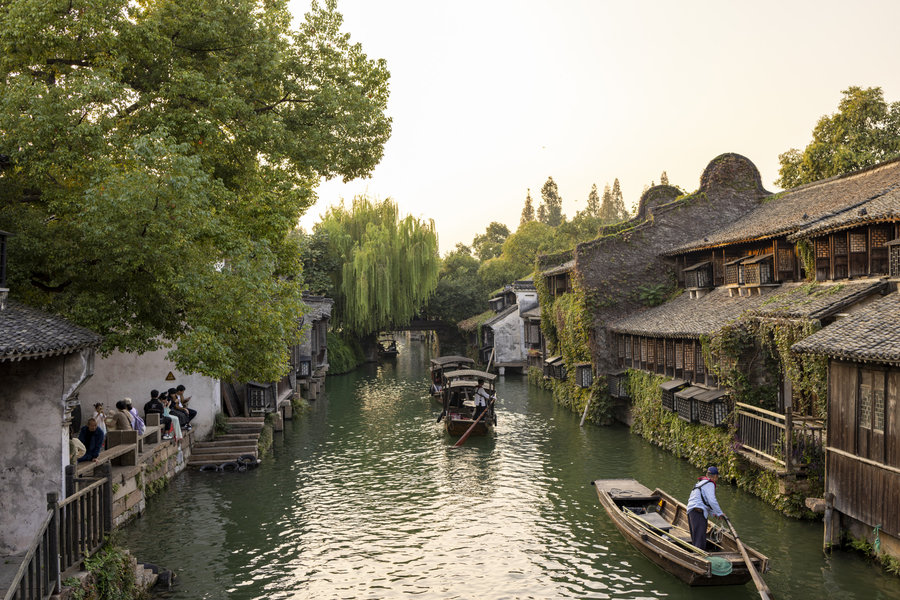
Wuzhen is a place to slow down between the larger cities of eastern China. Walk beside narrow canals, cross stone bridges, step into a courtyard to look at traditional textiles, and finish the day with dinner near the water. After dark, the reflections and illuminated streets give the town a different atmosphere.
Located in Tongxiang, within Jiaxing in Zhejiang Province, Wuzhen fits into a journey through Shanghai, Hangzhou and Suzhou. Its setting is part of Jiangnan, the region south of the Yangtze associated with waterways, trading towns and closely spaced historic settlements.
For a first visit, the most useful decision is how you want to spend your time. Dongzha, the East Scenic Area, suits a compact visit with heritage displays and traditional streets. Xizha, the West Scenic Area, provides more room for canal walks, dining and an overnight stay. You can visit both, but a relaxed afternoon and evening in Xizha can be more rewarding than trying to cover every attraction.
Wuzhen is a carefully managed tourism destination. Historic buildings, restoration, shops, exhibitions and modern visitor facilities sit together here. Expect a comfortable, organized water-town visit, with busy stretches around popular bridges and viewpoints.
This guide explains how to choose your area, plan transport, decide whether to stay overnight, and make time for the experiences that interest you.
Wuzhen at a Glance
| Planning question | Recommended starting point |
|---|---|
| Which area should first-time visitors prioritize? | Xizha for an extended canal walk, evening scenery and a choice of places to eat and stay |
| When is Dongzha worth adding? | When you enjoy heritage displays, traditional crafts or literary history and have enough time for a separate visit |
| Is a day trip possible? | Yes, with an early enough arrival and a reliable return journey |
| Is one night worthwhile? | Yes, if you want the evening atmosphere and another walk the following morning |
| How long should you allow? | A full day for a day trip, or an afternoon through the following morning for an overnight visit |
| Which railway station should you investigate first? | Tongxiang, followed by a road transfer to Wuzhen |
| Do you need a boat trip? | No. It is an optional way to see the canals from a different level |
| What needs advance checking? | Admission products, hotel package benefits, onward transport and any workshop or performance you especially want to attend |
Walking time, transport time and time spent waiting are separate parts of the day. A short train journey does not mean you will reach the canal streets immediately after leaving your hotel.
Understanding Dongzha and Xizha
Dongzha and Xizha are separate scenic areas with their own entrances. They are not two sections of one continuous ticketed walking route. Allow for travel between them and check exactly which area your admission covers.
The canal boats within the scenic areas are sightseeing services. Do not plan to use them as a connection between Dongzha and Xizha.
Dongzha: A Compact Heritage Visit
Dongzha works well when you want a shorter walk with selected stops inside historic buildings. Its attractions include displays relating to traditional furniture, woodcarving, textile production and local customs.
The area is also connected with Mao Dun, the major twentieth-century Chinese writer who was born in Wuzhen. His former home and related heritage sites give the town a literary dimension beyond its canal scenery. Check access to individual buildings before making a particular museum the reason for your visit.
Choose two or three stops that match your interests rather than entering every exhibition. Without an English-speaking guide, some historical displays can be harder to interpret, so a little preparation helps.
Xizha: Canal Walks, Evening Visits and Overnight Stays
Xizha is the stronger choice when your main interests are the water-town setting, a longer stroll, dinner and the evening lights. It combines historic streets with accommodation and a broad range of visitor facilities.
Its size makes pacing important. You do not need to walk every lane or reach every distant landmark. A route with a few canal crossings, a craft stop, a proper rest and an evening walk gives you plenty to remember.
Which Area Should You Choose?
| Your priority | Better fit | How to approach it |
|---|---|---|
| One scenic area on a first visit | Xizha | Arrive with time for daylight exploration and, if your return arrangements allow, stay into the evening |
| Traditional furniture and heritage exhibitions | Dongzha | Select a small number of indoor stops and leave time for the streets between them |
| An overnight water-town experience | Xizha | Compare accommodation locations and admission arrangements before booking |
| Photography in daylight and after dark | Xizha | Walk a short route twice as the light changes |
| A compact visit before returning elsewhere | Dongzha | Keep the route focused and check individual attraction hours |
| A fuller introduction to Wuzhen | Both | Allow a separate visit to each area and avoid transferring during your best evening sightseeing time |
As a planning estimate, allow roughly two to four hours for a selective Dongzha visit. Xizha can comfortably occupy an afternoon and evening, especially with a meal or boat trip. These are suggested time budgets, not guaranteed route durations or official opening hours.
Is Wuzhen Better as a Day Trip or an Overnight Stay?
A Day Trip Works When Transport Is Simple
A day trip suits visitors who prefer to keep their existing hotel and have an efficient way to reach Wuzhen. It can also be practical when a driver can collect you after your evening visit.
The limitation is the return journey. A daytime bus or an early evening train connection may require you to leave before you have enjoyed the night scenery. Check the last usable connection before choosing your sightseeing plan.
For most first-time day-trippers, one scenic area is sufficient. Prioritize Xizha if evening canals are the main attraction. Choose Dongzha if you prefer a shorter heritage visit and do not intend to stay late.
One Night Gives You More Breathing Room
An overnight visit lets you separate arrival, sightseeing and departure. You can explore in daylight, have dinner without watching the clock, and walk again the next morning.
This is particularly useful for couples, photographers and travelers who dislike returning to a city late at night. The morning may feel quieter than the busiest daytime periods, although crowds vary with holidays, events and hotel occupancy.
One night is enough for many visitors. A second night makes sense if you want a slower pace, have several cultural activities planned or are treating Wuzhen as a short resort stay.
Think About the Rest of Your Trip
If your itinerary already includes several hotel changes, weigh the experience against the extra packing and luggage transfer. You can simplify an overnight visit by storing larger bags at a hotel you will return to, if the hotel agrees, and bringing a smaller bag to Wuzhen.
For a one-way journey between cities, confirm luggage handling at your Wuzhen accommodation before arrival.
What to Do in Wuzhen
Walk Along the Canals
The canal streets are the foundation of the visit. Look at how houses meet the water, where narrow lanes open onto bridges, and how the view changes from one bank to the other.
Keep your route flexible. If a popular bridge is crowded, walk to another crossing or pause in a quieter side lane. Leaving room for small discoveries is more useful than following a checklist of photo spots.
In Xizha, revisit part of your daytime route after dark. A familiar canal bend can look quite different once the lights are reflected in the water.
Explore Traditional Craft Displays
Blue-and-white patterned cloth is closely associated with Wuzhen. The dyeing displays and hanging textiles offer an introduction to the relationship between local craft, clothing and household life.
Dongzha’s Hongyuan Tai Dyehouse is one place to investigate this tradition. Xizha also has textile-related sights, including the Caomu Bense Dyehouse. Use the current visitor map to locate the sites that are open during your visit.
A display, a demonstration and a hands-on workshop are different experiences. If you want to make something, confirm whether an activity is actually offered, its duration, language support, price and any reservation requirement.
Choose a Few Heritage Exhibitions
In Dongzha, the Jiangnan Hundred Beds Museum and the woodcarving displays offer ways to look more closely at traditional domestic life and decorative craftsmanship.
These stops work best when you give yourself time to examine a few objects. Carving, construction and household design can be more interesting than simply counting how many exhibition buildings you have visited.
Check current access and opening hours for each venue. A scenic-area ticket does not mean every building remains open throughout the entire evening.
Add Literary or Artistic Context
Mao Dun’s connection with Wuzhen makes Dongzha relevant to visitors interested in modern Chinese literature. A guide can help explain the writer’s life and the context of the buildings and displays.
For an art-focused visit, investigate the Mu Xin Art Museum near the Xizha entrance. Treat it as a separate planning decision: confirm its current opening days, admission arrangements and exhibitions, and allow time beyond a quick canal walk.
Wuzhen also hosts cultural events, including theatre-related programming. Attend an event because the performance interests you, and check dates and booking arrangements before organizing your stay around it.
Take a Canal Boat Trip
A boat ride changes your perspective. From the water, you see the undersides of bridges, waterside entrances and the relationship between the houses and canals.
Before buying a ticket, ask:
- Is this a shared ride or a private boat?
- Where does it start and finish?
- How long is the advertised route?
- Will your group be seated together?
- What happens if weather interrupts the service?
- Are there boarding steps or other access requirements relevant to your party?
Some rides are one-way. Check the arrival pier against your walking route so that the boat does not leave you far from your next stop.
Daylight helps you notice architectural details; an evening ride emphasizes reflections and lighting. Choose the atmosphere you prefer, then account for the queue. You can enjoy Wuzhen fully without taking a boat.
Leave Time for a Meal and a Pause
A seated lunch, dinner or tea break gives structure to a day of walking. Choose a place based on the menu, comfort and time available, rather than assuming every canal-side seat has the same view.
For an evening visit, eating before the busiest dinner period can help you return to the streets while the light changes. Keep the meal flexible enough to fit your transport arrangements.
A Practical Walking Approach for Xizha
Start at the appropriate entrance or hotel check-in point and collect the current map. Identify your eventual exit, accommodation or onward pickup location before walking deep into the area.
Begin with a craft or cultural stop near your route, then continue along the canal streets. Cross to the opposite bank when it gives you a new view, and add one or two side lanes rather than trying to cover everything.
Take a break before your feet become tired. If you want a boat ride, choose a departure point and finishing pier that fit the route you have already planned.
Later, have dinner and return to a short section of canal for the evening scenery. Leave enough time to reach the exit and your pickup point without rushing over bridges.
Bailian Pagoda can serve as a farther landmark if you have the time and energy to extend your walk. You do not need to reach it to have a satisfying first visit, and access to individual structures should be checked separately.
Suggested Wuzhen Itineraries
One Day: Xizha with an Evening Visit
Morning: Travel to Wuzhen
Depart early enough that the journey does not consume your entire sightseeing day. If you are traveling by train, include the transfer from Tongxiang Station and the entrance process in your arrival estimate.
Late morning or early afternoon: Settle in and begin walking
Store luggage where permitted, have lunch if needed, and start with the canal streets and one cultural stop. Keep the first part of the route close enough to the entrance that you can understand the layout.
Afternoon: Explore at an easy pace
Continue through the lanes, cross a few bridges and take a seated break. Add a boat trip if the route, price and waiting time suit you.
Early evening: Dinner and canal lights
Have dinner, then walk a selected stretch again after the lights come on. Allow enough time to get to your departure point.
Return: Use the journey you arranged in advance
A prearranged road transfer makes a late finish easier. If returning by public transport, your last workable connection determines when sightseeing must end.
Two Days, One Night: A Relaxed First Visit
Day 1: Arrive, explore Xizha and stay for the evening
Travel to Wuzhen, check in or leave your bags, and spend the afternoon walking. Include a craft display, a rest and an optional boat ride. Have dinner before another short evening walk.
Confirm how you will reach your room after the walk, especially if the property is outside the scenic area.
Day 2: A morning walk, then departure or Dongzha
Have breakfast and revisit a canal stretch if your admission or accommodation package permits morning access. Check the time at which repeat-entry privileges end rather than assuming they continue for the whole departure day.
If you enjoy heritage exhibitions and have an afternoon departure, add a separate Dongzha visit. Otherwise, a relaxed checkout and onward transfer is a good use of the morning.
Both Areas in One Day
Visit Dongzha first, focusing on selected heritage stops, then transfer to Xizha for the afternoon and evening.
This works best with an early arrival, light luggage and a dependable return arrangement. Allow time for the transfer, another entrance process and meals. If the first half of the day runs late, shorten your second route instead of trying to complete both areas in full.
Getting to Wuzhen
Wuzhen’s final approach is by road. Tongxiang Station is an important rail gateway, but it is outside the town’s scenic areas.
Compare the complete journey from your starting hotel to your chosen entrance or accommodation. The fastest train is not automatically the easiest overall option.
From Shanghai
Investigate trains from the Shanghai station that best suits your departure point to Tongxiang, then arrange the road transfer. Shanghai Hongqiao is a useful station to check, but verify the exact station printed on your ticket.
A direct road transfer can be convenient for a family or small group, especially if you want to leave Wuzhen after an evening visit. Its advantage is fewer changes; its travel time depends on traffic.
Coach services may also be available. Check the current departure terminal, date-specific timetable and arrival point before relying on one.
From Hangzhou
Compare a train to Tongxiang plus a road transfer with a direct coach or private transfer. The better choice depends on where you are staying in Hangzhou and your arrival time in Wuzhen.
If your hotel is far from the relevant railway station, the station transfer can outweigh the benefit of a short rail journey. A direct road journey may be simpler with luggage or when returning late.
From Suzhou
Check current rail connections carefully rather than assuming there is a convenient direct train to Tongxiang for your date. A rail route involving a change may be less attractive than a direct road transfer.
For a day trip with evening sightseeing, compare the return arrangements first. A journey that is convenient in the morning may not work after dark.
From Tongxiang Station
Continue by taxi, a prearranged transfer or current local public transport. Bus services may require a further connection within Wuzhen; confirm whether the service reaches the bus station, Dongzha, Xizha or another stop.
Give the driver the exact destination in Chinese. “Wuzhen” alone is not enough when your hotel uses a separate check-in point or entrance.
Useful Names for Transport
| English | Chinese | Use |
|---|---|---|
| Wuzhen | 乌镇 | Town name |
| Tongxiang Station | 桐乡站 | Railway gateway to investigate |
| Wuzhen Bus Station | 乌镇汽车站 | Check whether this is your coach or local bus destination |
| Dongzha Scenic Area | 乌镇东栅景区 | East Scenic Area |
| Xizha Scenic Area | 乌镇西栅景区 | West Scenic Area |
Before travel, save your hotel’s Chinese name, current map location and arrival instructions. For a private transfer, agree on the pickup point, waiting arrangements and contact method.
Where to Stay in Wuzhen
Accommodation location changes the rhythm of your visit. The most relevant comparison is between access to the scenic area, the actual room location and the benefits attached to your booking.
| Accommodation choice | Main advantage | What to check |
|---|---|---|
| Inside Xizha | Convenient access to the streets during an overnight visit | Check-in point, admission terms, luggage handling and distance from the room to the main route |
| Outside but close to an entrance | Wider choice of properties and price levels | Walking distance, road crossings, late arrival arrangements and whether admission is included |
| An outside property with an official package | May combine accommodation with scenic-area benefits | Exact entry, repeat-entry, shuttle and meal entitlements for that package |
| A more distant hotel | May suit a particular property preference or budget | Transfer time and the practicality of returning after an evening walk |
Staying Inside Xizha
An inside stay can reduce the need to travel back to a hotel after dinner. However, the entrance, check-in service and room may be in different places.
Ask how bags will reach your accommodation and whether any internal transport is provided. Cars do not necessarily drive to the door of a room within the historic streets.
For traditional-style accommodation, confirm room access, stairs, bathroom arrangements and sound insulation. Travelers who need easy access should ask about the route to the room as well as the room itself.
Staying Outside the Scenic Area
An outside hotel can be a good choice if it has clear arrival instructions and convenient access to the entrance you intend to use.
Some official or partner packages include admission and other privileges even when the room is outside. Other bookings include accommodation only. Read the product details rather than relying on the address to tell you what is included.
Questions to Ask Before Booking
- Does the booking include Dongzha, Xizha or both?
- Does it permit repeat entry, and when does that privilege expire?
- Are boat trips, breakfast or shuttles included?
- Where should overseas guests check in, and what identification is required?
- Where can luggage be stored before check-in and after checkout?
- Is the room accessible without stairs?
- How will you return after an evening visit?
A cheaper room can become less convenient once extra transport and admission are added. Compare the total arrangement rather than the nightly rate alone.
What to Eat in Wuzhen
Wuzhen’s food offers another way to connect with the region. Start with one local dish and one snack, then choose the rest according to your appetite.
Braised Mutton Noodles
Mutton noodles are a recognizable local option, with braised meat served over noodles. They make a substantial meal during a long walking day. Ask what the topping includes if you have preferences about meat cuts or offal.
Dingsheng Cake
Dingsheng cake is a traditional rice-based sweet associated with Wuzhen. It is usually a small snack, often with a bean-paste filling, and suits a short break between sightseeing stops.
Gusaobing
Gusaobing is another local snack to look for. It can also make a compact food souvenir. Check the ingredients, packaging and shelf life if you plan to carry it through the rest of your trip.
A Seated Regional Meal
For lunch or dinner, look at the menu for regional-style meat dishes, vegetables, noodles or fish, then order according to your group’s preferences. Ask about bones and portion sizes when ordering fish, particularly with children.
If you have dietary requirements, explain them clearly. A dish with vegetables may still contain meat stock, lard or another animal ingredient.
There is no need to queue for every famous snack. One enjoyable meal and a couple of small tastes are enough to give food a place in the visit.
Tickets, Reservations and Practical Costs
Check admission options after deciding which area you will visit and whether you will stay overnight. Products may cover one area, both areas or a package with additional services.
Read the validity dates and entry conditions carefully. A combined-area product does not necessarily allow unlimited movement in and out, and an accommodation benefit may have a specific expiry time.
For overseas visitors, check how passport details are entered and whether ticket collection or manual verification is needed. Carry the original identification used for the reservation.
Boat rides, selected museums, workshops and performances may require separate payment. Confirm inclusions before buying the same service twice through different products.
Build Your Budget Around These Items
| Cost category | What affects it |
|---|---|
| Travel to Wuzhen | Departure city, rail or road choice, number of travelers and return time |
| Last-mile transfer | Taxi, local bus, private transfer or an included hotel service |
| Admission | One area, both areas or an accommodation package |
| Accommodation | Location, room category, travel date and package benefits |
| Food | Snacks and casual meals versus a longer restaurant meal |
| Optional experiences | Boat ride, museum, workshop or performance |
Prices and packages change. Compare current products for your actual date rather than building the trip around an old ticket price.
Best Time to Visit Wuzhen
Spring
Spring often suits a longer outdoor walk. Rain is still possible, so plan a route with indoor stops and bring a compact umbrella or suitable jacket.
Summer
Heat and humidity make an unbroken midday walk tiring. Add shaded pauses, drink regularly and leave some sightseeing for later in the day. Weather can affect boat operations.
Autumn
Autumn is a good season to consider for walking, but popular dates and cultural events can bring higher demand for rooms and tickets. Check the calendar before choosing your travel dates.
Winter
Winter can suit visitors who enjoy a slower visit and do not mind cold, damp weather. Dress for time spent beside the water and alternate outdoor walking with indoor breaks.
Holidays and Event Dates
Wuzhen can be busy on weekends, major Chinese public holidays and event dates. If your itinerary is flexible, compare weekday availability and choose a day that fits your preferred pace.
An evening visit is attractive, but it should follow a confirmed transport plan. The last return service matters more than a suggested photo time.
Visiting with Children or Older Travelers
Shorten the route and schedule breaks before anyone becomes tired. One scenic area, a simple meal and an optional activity usually work better than moving repeatedly between entrances.
Bridges, steps and uneven surfaces need consideration for strollers and travelers with limited mobility. Internal sightseeing vehicles may help on certain routes, but they do not provide access to every lane or building.
For wheelchair users, ask about a specific route from the entrance to the planned sights, restaurant and room. “Accessible accommodation” alone does not confirm that the entire sightseeing route is step-free.
Boat boarding involves its own access requirements. Discuss these with staff before purchasing tickets and follow their instructions about seating and safety equipment.
Near the canals, keep young children close, particularly where a busy bridge narrows the walking space.
Common Planning Mistakes
Treating Tongxiang Station as the Scenic-Area Entrance
Allow for the onward road journey, the correct arrival point and entrance procedures. Protect this time when booking your return train.
Buying Admission Before Choosing a Route
Decide whether you will visit one area or both. Then compare ticket and hotel products that match the plan.
Assuming Every Hotel Includes the Same Benefits
Entry, repeat entry, breakfast, luggage services and shuttles depend on the particular booking. Confirm each important benefit in writing.
Leaving the Return Journey Until the Evening
Check the return route before arrival. Late public transport may be more limited than daytime options.
Trying to See Every Attraction
Choose the sights that suit your interests. Leave enough time for walking, eating and observing the streets between them.
Planning around an Unconfirmed Workshop or Performance
A venue or traditional craft display does not guarantee a live activity on your date. Check the actual program before including it as a fixed stop.
How to Include Wuzhen in an East China Itinerary
With Shanghai
Wuzhen offers a change of scale after Shanghai’s large streets and museums. Add a day trip if you want to keep one hotel base, or stay overnight if the evening experience is a priority.
With Hangzhou
The combination works well for visitors interested in different waterside settings: Hangzhou’s broad lake scenery and Wuzhen’s tighter network of canals and historic streets.
Check whether the easiest arrangement is an out-and-back visit from Hangzhou or a separate overnight stop before continuing elsewhere.
With Suzhou
Suzhou already offers historic canals and streets alongside its classical gardens. Add Wuzhen when you want a more concentrated water-town stay, particularly an evening and morning in Xizha.
If you are also considering Tongli or Zhouzhuang, choose according to the experience and route you want. Visiting several water towns can become repetitive on a short trip.
Between Two Cities
A one-way stop can reduce backtracking, but it adds luggage planning and an onward transfer. Compare the full route, including station access, rather than assuming the town lies conveniently on every rail journey between nearby cities.
Frequently Asked Questions
Is Wuzhen worth visiting on a first trip to China?
Yes, if canal scenery, traditional streets and a slower stop interest you. It works particularly well within an eastern China itinerary where the travel connections do not take time away from your main priorities.
Should I visit Dongzha or Xizha first?
For one scenic area, start by considering Xizha. If visiting both, Dongzha during the earlier part of the day followed by Xizha in the afternoon and evening is a practical arrangement, subject to current opening hours.
Can I visit both areas in one day?
Yes, with an early arrival and a selective route. Allow for the transfer and separate entry processes, and avoid trying to cover every exhibition.
Is staying overnight necessary?
No. It is worthwhile when you want an unhurried evening and morning. A day trip can work well with a dependable late return arrangement.
Is there a railway station inside Wuzhen?
Plan for a road approach to the scenic areas. Tongxiang Station is a useful rail gateway to investigate, followed by a local transfer.
Can I leave and re-enter with the same ticket?
Do not assume so. Repeat-entry arrangements depend on the admission product or accommodation package, including its validity period.
Does a hotel inside Xizha automatically include admission?
Check the booking. Room location and admission inclusions are separate details, and some outside packages can also include scenic-area benefits.
Is a canal boat trip essential?
No. Walking provides a complete visit. Choose a boat when you want the water-level perspective and the price, route and queue suit your day.
Is Wuzhen suitable in the rain?
Light rain can suit a shorter walk with indoor stops. Wet steps and bridges require care, and heavier weather can affect outdoor activities and boat services.
Can I book a craft experience on arrival?
Possibly, but availability varies. Confirm in advance if a particular workshop is important to your trip, especially if you need English-language support.
Can I visit after arriving at an airport?
It is possible with enough time, but allow for immigration, baggage collection and the road journey. Avoid a tightly timed onward connection or activity immediately after landing.
How many nights should I stay?
One night suits most first-time visitors who want the evening atmosphere. Stay longer if you have specific cultural plans or prefer a slower resort-style break.
Plan Your Wuzhen Visit with Discover East China Tours
The most useful Wuzhen plan brings the route, accommodation and return journey together. Your preferred area, walking pace and interest in evening scenery should guide those choices.
Discover East China Tours can help you fit Wuzhen into a wider journey through Shanghai, Hangzhou and Suzhou, with transfers and sightseeing arranged around the time you have available.
Tell us your travel dates, starting city, group size and whether you prefer a day trip or an overnight stay. Include any interests in crafts, literature, food or photography so they can shape the route.