
A practical guide to paying in Shanghai, Hangzhou, Suzhou and beyond: linking a foreign card to Alipay or WeChat Pay, fees and limits, metro rides, and when to use a card or cash instead.
Most day-to-day spending in China happens on a phone. Street snacks, a coffee in Hangzhou, a metro ride in Suzhou and a temple reservation are all usually paid by scanning a QR code in Alipay or WeChat Pay. The good news for visitors is that both apps now accept foreign Visa and Mastercard cards, and you no longer need a Chinese bank account.
This guide explains what to set up before you fly, what it costs, and where a card or cash still makes sense on an East China trip.
Quick Answer
| Question | Short answer |
|---|---|
| Which app should I use? | Set up Alipay first, then WeChat Pay as a backup. |
| Do I need a Chinese bank account? | No. Link your foreign card directly in the app. |
| Which cards work? | Visa and Mastercard are the safest choices. JCB, Discover, Diners Club and American Express are accepted on some channels. |
| What does it cost? | No service fee on a single payment of 200 yuan or less. Above 200 yuan, a 3% fee applies to the whole payment. Your own bank may add its own foreign transaction fee. |
| What are the limits? | Around US$5,000 per payment and US$50,000 per year for foreign-card users. Your exact limit is shown in the app. |
| Should I still carry cash? | Yes, a small amount as a backup. |
| When should I set it up? | At home, a week or more before departure, on reliable Wi-Fi. |
Why Mobile Payment Matters in East China
In Shanghai, Hangzhou, Suzhou and Nanjing, international hotels, department stores and larger restaurants often take foreign cards. Once you step away from those places, a phone payment becomes the normal way to pay. That includes noodle shops, market stalls, taxis, convenience stores, small museums and craft workshops.
Smaller destinations such as Wuzhen, Huangshan and Jingdezhen lean even more heavily on QR payment. Some scenic areas, including Lingyin Temple in Hangzhou, also use Alipay or WeChat mini-programmes for timed reservations, so the same app helps you both book and pay.
Option 1: Alipay (Recommended First)
Alipay has a full English interface and generally the smoothest setup for foreign visitors.
How to set up Alipay
- Download Alipay from your usual app store before you travel. Installing it from inside mainland China can be harder.
- Register with your own mobile number and receive the SMS verification code.
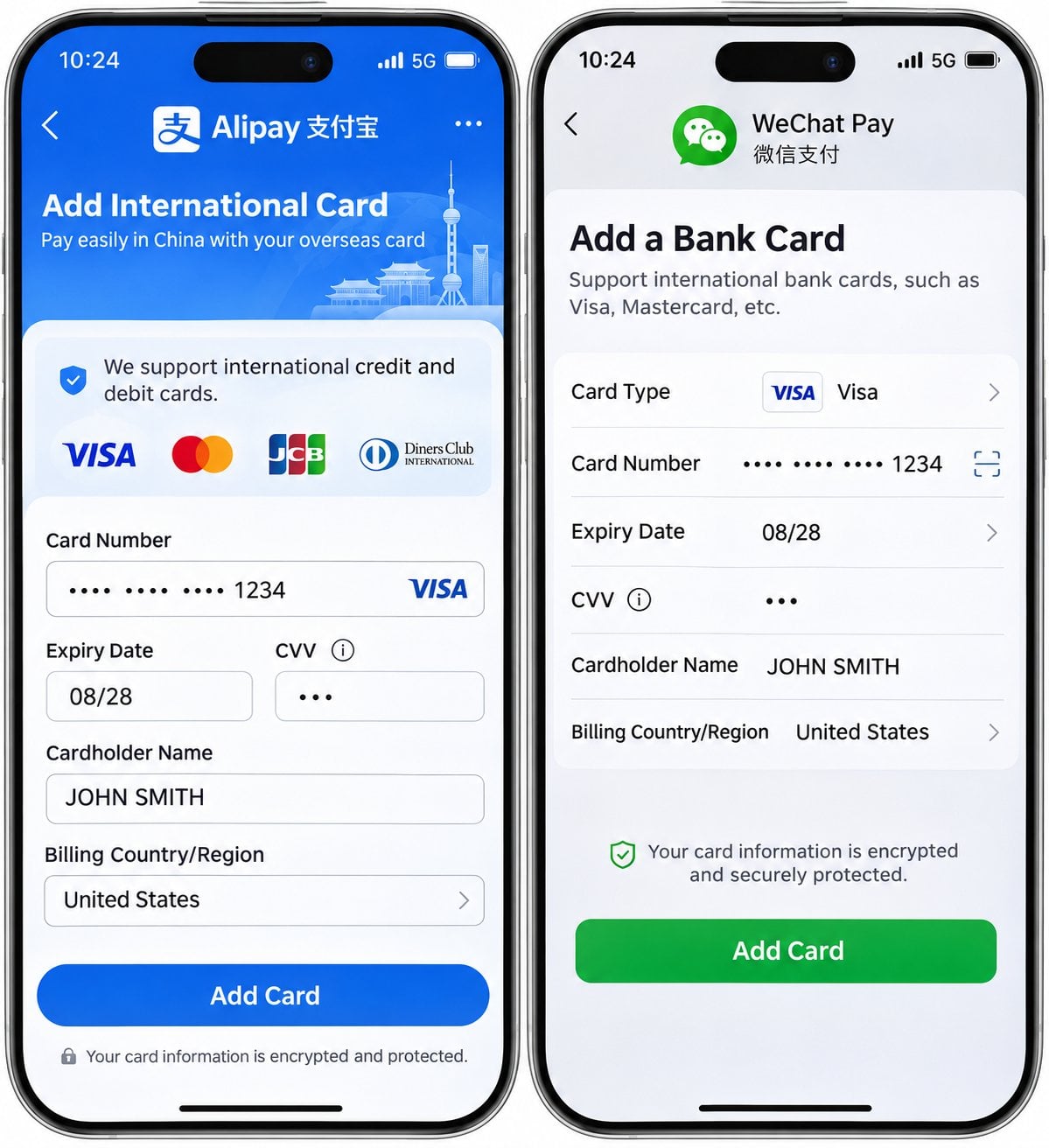
- Add your bank card under the bank cards section. Enter the card number, expiry date and security code, then complete any verification your bank sends.
- Verify your identity with your passport when the app asks. This usually means photographing the passport page and sometimes a face check.
- Make a small test payment, such as an in-app top-up for your phone or a small online purchase, so you know the card works before you land.
What you can pay for
- Scanning a merchant’s QR code, or showing your own payment code to the cashier
- Metro and bus rides through the transport ride code in the app
- Taxis and ride-hailing through the DiDi mini-programme inside Alipay
- Many attraction reservations and tickets through official mini-programmes
What you cannot do with a foreign card
A foreign card is meant for paying businesses. You cannot use it to send money to a friend, split a bill person to person or send a red envelope.
Option 2: WeChat Pay (Useful Backup)
WeChat Pay works in a similar way and is accepted almost everywhere Alipay is. Having both set up means that if one card is declined or one app asks for extra verification, you still have a way to pay.
How to set up WeChat Pay
- Download WeChat and register with your mobile number. New accounts sometimes need verification by an existing user; allow time for this.
- Open Me → Services → Wallet (the wording can vary by app version) and add your foreign card.
- Complete real-name verification with your passport.
- Test with a small payment before you travel if the app allows it.
WeChat Pay has also run fee waivers for new foreign-card users in 2026. Promotions change, so check what the app shows when you link your card.
Fees and Limits Explained
The fee rule is the same in both apps for a foreign Visa or Mastercard:
| Single payment | Service fee |
|---|---|
| 200 yuan or less | None |
| More than 200 yuan | 3% of the full amount |
The 200-yuan threshold applies to each payment, not to your daily total. A 250-yuan dinner is charged a fee of about 7.50 yuan, not 3% of the extra 50 yuan. Most meals, snacks, metro rides and taxi fares stay under the threshold, so many visitors pay very little in fees.
Your card issuer may also charge a foreign transaction fee, often 1–3%. A travel card with no foreign transaction fee keeps costs down.
For larger spending, such as hotel bills or ceramics in Jingdezhen, a foreign card used directly at the counter can work out cheaper than paying through an app. Ask before you pay.
In 2024, China’s central bank guided Alipay and WeChat Pay to raise foreign-card limits to about US$5,000 per payment and US$50,000 per year. That is more than enough for a typical holiday. The app shows your current limits in the payment settings.
Paying for Transport
Shanghai Metro
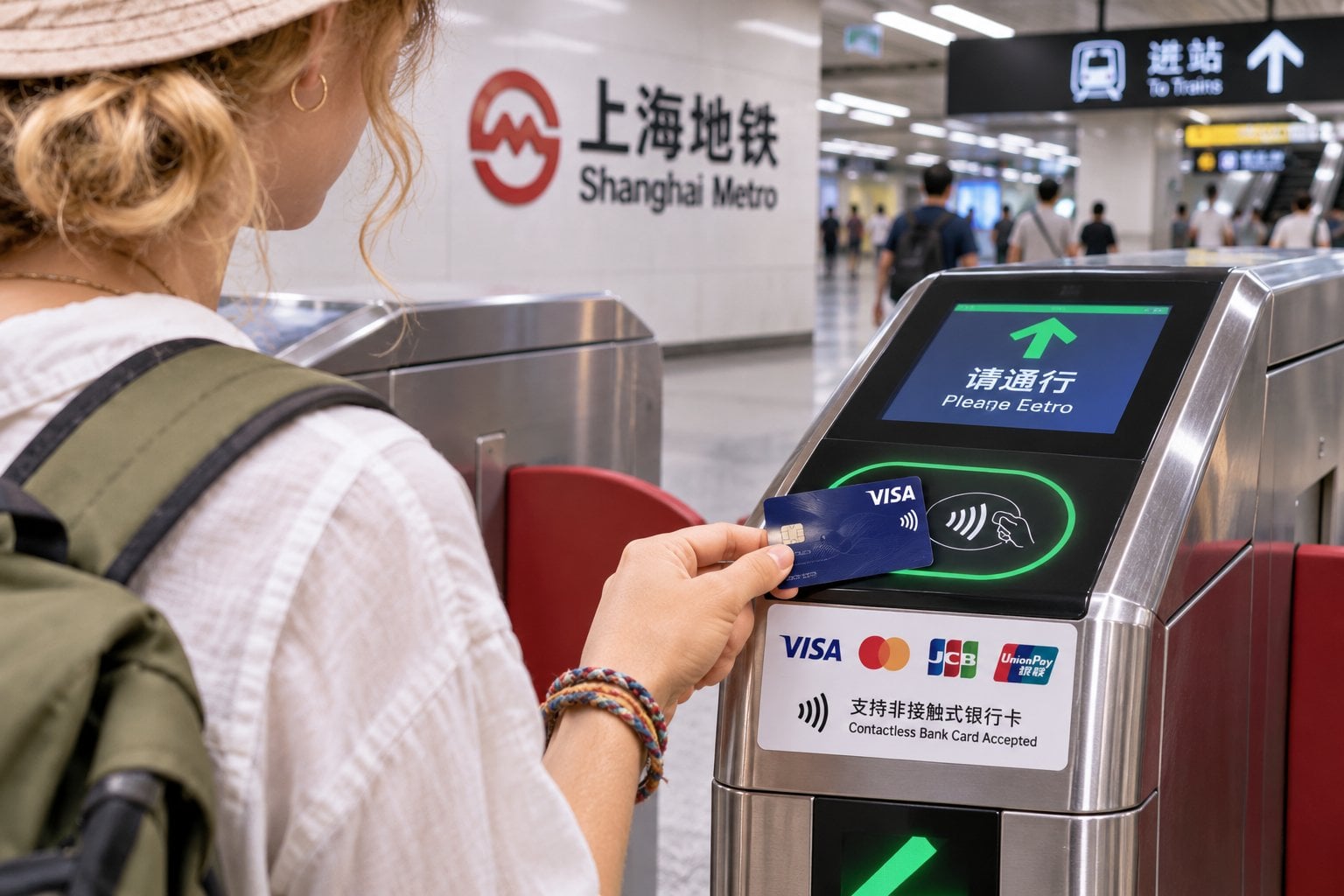
Shanghai Metro accepts contactless Visa, Mastercard, American Express and JCB cards at the gates on every line. Tap the same card in and out. Your card needs to support contactless payment, and some cards will not work at the gate, so keep the Alipay or WeChat ride code as a backup. Ticket counters at stations also accept foreign cards.
See our guide to getting around Shanghai for metro routes, airport lines and station tips.
Hangzhou, Suzhou and Other Cities
Outside Shanghai, the most reliable option is the transport ride code inside Alipay or WeChat. Search the app for the city’s metro service, open the ride code and scan it at the gate. Our Hangzhou transport guide covers local options in more detail.
Taxis and Ride-hailing
DiDi works inside Alipay and WeChat, and you can pay with your linked card. Street taxis also accept QR payment. Save your hotel’s Chinese name and address on your phone to show the driver.
High-speed Trains
Train tickets are bought through the 12306 railway app or website, or through a licensed booking agent. Your passport is your ticket. Our Shanghai to Suzhou by train guide explains the 12306 booking steps.
When to Use a Card or Cash
Foreign cards
International hotels, airports, larger department stores, international chain restaurants and many big-city shops have card terminals. Acceptance is widest in Shanghai and improving elsewhere. Small family-run places rarely have one.
Cash
China’s rules require businesses to accept cash, and cash is a sensible backup if your phone battery dies, the network is weak or a card is declined. Carry a modest amount of yuan, for example 500–1,000 yuan for a week, in smaller notes. Be aware that some small vendors may struggle to give change, especially for 100-yuan notes.
You can withdraw yuan at airport ATMs and at the major banks, such as Bank of China, ICBC and China Construction Bank. Check your bank’s overseas withdrawal fees first.
What About the Tour Card?
You may still see the prepaid “Tour Card” or “Tour Pass” in older guides. It charged a top-up fee and is now being wound down, so do not plan around it. Linking your card directly in Alipay or WeChat Pay is the current method.
Before-You-Fly Checklist
- Alipay installed, card linked, passport verified and a test payment made
- WeChat Pay set up as a backup
- Your bank told about your travel dates so it does not block payments from China
- A travel card with no foreign transaction fee, if you have one
- Your home number able to receive SMS while abroad, for bank and app verification codes
- Mobile data arranged for arrival (see our China eSIM and internet guide)
- A small amount of cash as a backup
- A power bank, because your phone is your wallet
Common Problems and Fixes
My card was declined when I tried to link it.
Try a different card, ideally a Visa or Mastercard credit card. Some debit and prepaid cards are not accepted. Call your bank: it may have blocked the transaction as unusual.
The app asks for a Chinese ID number.
Look for the option for a passport or other ID, and choose your passport.
I didn’t receive the SMS code.
Make sure roaming SMS is switched on for your home number. If you use a travel eSIM for data, keep your home SIM active as a second line so codes still arrive.
The cashier asks me to scan, but I see a scanner pointed at me.
Some shops scan your code instead. Open the app’s pay code and show it to the cashier.
A payment is over 200 yuan.
You will pay the 3% fee. For big bills, ask whether you can pay by card at the counter instead.
Frequently Asked Questions
Can I use Alipay or WeChat Pay without a Chinese bank account?
Yes. Since 2023, visitors can link an overseas Visa or Mastercard directly in the app and pay with a passport-verified account. No Chinese bank account is needed.
Is Alipay or WeChat Pay better for tourists?
Alipay is usually easier to set up and works almost everywhere, so set it up first. WeChat Pay is a useful backup and some small merchants prefer it.
How much does it cost to pay with a foreign card?
There is no service fee on a single payment of 200 yuan or less. Above that, a 3% fee applies to the whole amount. Your bank may add its own foreign transaction fee.
Can I tap my Visa card on the Shanghai Metro?
Yes. Shanghai Metro accepts contactless Visa, Mastercard, American Express and JCB cards at the gates on all lines. Other East China cities are less consistent, so use the Alipay or WeChat ride code there.
Do I still need cash in China?
Not much, but carry some as a backup for phone or network problems and for small vendors.
Will my phone payment work in smaller places like Wuzhen, Huangshan or Jingdezhen?
Yes. QR payment is the norm in these destinations, often more than in big cities. Foreign card terminals are less common there, so a working Alipay or WeChat Pay account matters even more.
Plan With Local Support
If you travel with us, your guide can help with tricky moments such as a declined card, a reservation mini-programme or a market purchase. Depending on your itinerary, entrance tickets, transfers and some meals can be included in your private or small-group tour, which reduces how often you need to pay on the spot. Your quote shows exactly what is included.
Prepared by: Discover East China Tours
Last updated: 11 November 2026
Fees, limits, accepted cards and app menus change. Check the current terms in the Alipay or WeChat app and with your bank before you travel.