
Lingyin Temple offers a different side of Hangzhou from the open waterfront of West Lake. Here, Buddhist halls, wooded slopes and stone carvings form a place where sightseeing and religious life share the same surroundings.
For a first visit, we recommend allowing half a day for Lingyin Temple and the main Feilai Peak carvings. This gives you time to explore without rushing through the halls or turning the visit into a demanding hillside walk.
The most important preparation is your reservation. Admission is currently free, but most visitors still need a confirmed real-name reservation for the appropriate date and time slot. Arriving at the entrance without one is not a reliable way to visit.
This guide explains the reservation process for international travellers, how the temple relates to the wider scenic area, and how to plan a comfortable visit.
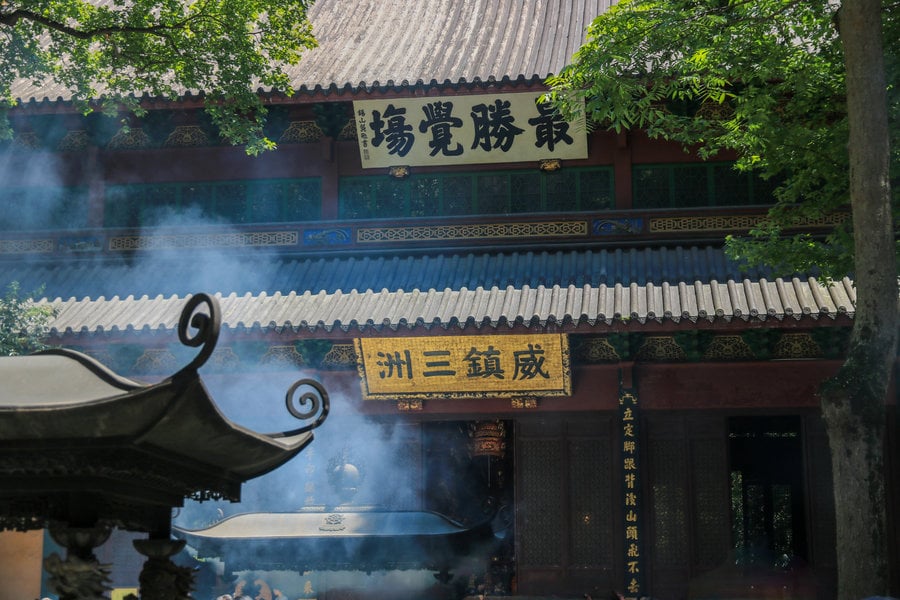
Lingyin Temple, Hangzhou.
Lingyin Temple at a Glance
| Question | Practical answer |
|---|---|
| Where is it? | In the hills west of West Lake, within the Lingyin–Feilai Peak scenic area |
| Is admission free? | Yes, under the current policy covering the scenic area and its included temples |
| Do I need a reservation? | Most visitors do; certain officially recognised exemptions apply |
| Can international visitors use a passport? | Yes, passports are accepted for non-mainland visitors under the published reservation rules |
| Where do I reserve? | The “杭州灵隐飞来峰” mini-program on WeChat or Alipay |
| Can I register at the entrance? | Ordinary on-site registration was discontinued from 1 February 2026 |
| How much time should I allow? | We suggest around three hours for the main carvings and temple, with additional time for transfers and breaks |
| Is the visit entirely step-free? | Do not assume so; routes include steps, uneven surfaces and changes in level |
Reservation arrangements and access can change during special events or operational adjustments. Check the live booking page before finalising your visit.
1. Understand Lingyin Temple and Feilai Peak
Lingyin Temple and Feilai Peak are closely connected, but they are not the same attraction.
Lingyin Temple — 灵隐寺 is the Buddhist monastery, with its halls, courtyards and religious activities.
Feilai Peak — 飞来峰, also written as Feilaifeng, is the surrounding scenic and cultural area known for its rock formations, grottoes and Buddhist stone carvings.
The wider scenic area also includes Yongfu Temple and Taoguang Temple. These can extend your visit, but you do not need to see every temple or climb every route to have a worthwhile experience.
For a first visit, our suggested priorities are:
- A selection of the Feilai Peak carvings.
- Lingyin Temple’s principal halls.
- Time to appreciate the setting without rushing.
A visit to Feilai Peak’s carvings does not require climbing to the summit. You can concentrate on the more accessible paths and leave steeper extensions for another trip.
2. Current Admission and Reservation Rules
Admission is free, but reservations remain important
Free admission began on 1 December 2025 for the Lingyin–Feilai Peak scenic area, including Lingyin Temple, Yongfu Temple and Taoguang Temple.
Older guides may still describe separate paid entry for Feilai Peak and Lingyin Temple. Those prices do not reflect the current admission policy.
Free entry does not mean unrestricted entry. Capacity is managed through reservations and time slots.
Opening hours and entry slots
The published standard opening hours are 7:30 am–5:30 pm, with entry verification ending at 5:00 pm.
The reservation system uses morning and afternoon sessions:
| Session | Published time period |
|---|---|
| Morning | 7:30 am–12:00 noon |
| Afternoon | 12:00 noon–5:00 pm |
Follow the permitted entry window on your confirmation. Do not build your plan around arriving at the last possible minute, and remember that closing time is not a sensible starting time for a full visit.
Reserve before the visit day
Standard reservations must be made at least one day ahead, with availability offered up to seven days in advance. The published release time is 8:00 am, China time.
Check the live reservation calendar to see when your intended date becomes available. Busy dates can fill quickly.
Same-day standard reservations are not accepted, and ordinary on-site registration has been discontinued.
3. How to Reserve with a Foreign Passport
Step 1: Find the correct mini-program
Open WeChat or Alipay and search for:
杭州灵隐飞来峰
The name refers to the Hangzhou Lingyin–Feilai Peak reservation service.
Use the official reservation mini-program rather than an unrelated account advertising paid booking assistance. Admission itself is free.
Step 2: Select the date and session
Choose the date that fits your Hangzhou itinerary and an available morning or afternoon session.
We generally recommend a morning visit when it works with your travel plans. It leaves more flexibility for lunch and a relaxed activity afterwards, although mornings are not guaranteed to be quiet.
Step 3: Enter each visitor’s details
Select the appropriate identity-document type and enter the requested information accurately.
For international visitors using a passport, check the name and passport number carefully. Follow the form’s instructions rather than guessing how to shorten or rearrange a name.
Make sure every member of your group is included through the correct process. Do not assume that one adult’s reservation automatically covers everyone travelling with them.
Step 4: Confirm that the reservation succeeded
Review the date, session and visitor details before submitting.
Afterwards, check that the booking shows a successful reservation. Save the confirmation information and keep access to the mini-program on the day.
A submitted form or pending application is not necessarily a confirmed entry reservation.
Step 5: Carry the original passport
Bring the original valid passport used for the reservation, along with the reservation confirmation.
A photograph of the passport may help you complete a form, but it should not be treated as a replacement for the original document at entry.
If you cannot complete the booking
Passport acceptance is included in the published rules, but this does not guarantee that every overseas phone number, account configuration or verification attempt will work smoothly.
If you encounter a problem, seek help before the visit day. Your hotel or guide may help you understand the interface; the scenic-area reservation enquiry number is +86 571 87969691.
Do not use another person’s identity details or assume that arriving in person will bypass an unresolved booking problem.
4. What to Do When Reservations Are Full
The reservation platform offers an online waitlist, which replaced ordinary on-site registration.
If your preferred date and session are full, check whether the platform allows a waitlist application. Applications must be submitted by 8:00 pm on the day before the intended visit.
Follow any identity or facial-verification prompts and monitor both the platform and its messages.
Joining the waitlist does not mean you have secured admission. Check for a successful allocation before travelling to the scenic area.
If your place remains unconfirmed, keep another plan available. A West Lake walk or an old-city visit can provide a more comfortable alternative than travelling to Lingyin and hoping for entry.
A guide or private transfer does not override capacity controls. If booking a tour, ask whether the reservation has actually been confirmed and what happens if no place becomes available.
5. Cancellations, Children and Exemptions
Cancel promptly if your plans change
The updated standard cancellation deadline is 5:00 pm on the day before entry.
Missed reservations can lead to restrictions on future bookings, and successful last-minute waitlist allocations may have different cancellation conditions. Read the terms attached to your booking.
Avoid reserving several dates simply to hold options. Choose a realistic plan and release a reservation promptly if you cannot use it.
Travelling with children
Use the mini-program’s current process for adding children and minors. Check the required document details and accompanying-adult arrangements.
Bring the children’s relevant original documents and allow more time at entry. A shorter route with breaks is often more enjoyable than trying to cover every part of the scenic area.
Travelling with older visitors
Published rules provide reservation exemptions for visitors aged 70 and above and certain other eligible groups.
Confirm how eligibility will be checked for your documents before relying on an exemption. An eligible traveller’s status does not automatically apply to accompanying family members.
6. Getting to Lingyin Temple
Lingyin is in the hills west of the lake, so plan the transfer separately from your lakeside sightseeing.
By taxi or ride-hailing
A taxi can be a practical choice from a central hotel, particularly for families or visitors carrying fewer items for the day.
Use the Chinese destination 灵隐寺 and confirm the current visitor drop-off point. The vehicle may not be able to stop immediately outside the temple entrance.
Allow time for the remaining walk, entry checks and possible traffic in the scenic area.
For ride-hailing, check the pickup or drop-off pin carefully. When leaving, go to the permitted pickup location before ordering so that you and the driver can find each other.
By public transport
Use a current journey planner to check services to the Lingyin visitor area from your exact starting point.
A metro journey may form part of the route, but you should not assume it takes you directly to the temple gate. Check the final bus connection or walk and allow time for transfers.
Avoid relying on old route numbers without checking that they still operate as described.
By private transfer
A pre-arranged transfer can simplify the journey, especially for a family or a group travelling at a slower pace.
Confirm the meeting point, reservation session and return arrangement. A driver may still need to use the designated vehicle access points, so ask about the walk from drop-off to entry.
How much transfer time should you allow?
The answer depends on your hotel, traffic and access arrangements.
Use a current route estimate, then leave a margin for the final approach and entry checks. Treat the estimate as a planning tool rather than a guaranteed arrival time.
7. Arriving and Entering the Scenic Area
Before leaving your hotel, check that you have:
- A confirmed reservation or successful waitlist allocation.
- The original identity documents used for booking.
- Access to the reservation confirmation.
- Comfortable walking shoes.
- Water and suitable weather protection.
On arrival, follow the current signs for reserved visitor entry and staff instructions.
Keep the group’s documents accessible. If your passport is not recognised by an automatic process, ask staff where to complete manual verification.
The scenic-area entrance and the temple’s internal access points are different parts of the visit. Follow the signs after entering rather than assuming the first gate takes you directly into the main temple halls.
Do not rely on leaving and re-entering. Plan meals, breaks and belongings around one continuous visit unless staff confirm otherwise.
8. A Practical First-Visit Walking Route
Our suggested route combines selected Feilai Peak carvings with Lingyin’s main halls. It is a planning outline, not a fixed route that overrides closures or on-site directions.
Stop 1: Get your bearings
After entry, check the visitor map and signs.
Locate Lingyin Temple, the main carving paths, toilets and the route back towards your exit. If you are visiting with a guide, agree on the walking pace before moving on.
Stop 2: Explore a selection of Feilai Peak carvings
Spend time looking at the carvings along the paths rather than trying to photograph every niche.
Notice how the figures sit within the rock and how their expressions, poses and scale differ. A little explanation can help, but you can also enjoy the visual details without specialist knowledge.
Stay on permitted paths. Do not touch the carvings or climb onto protected stonework for a photograph.
If a grotto or side path is crowded, uneven or slippery, move on to another accessible section.
Stop 3: Enter Lingyin Temple
Lingyin was founded in AD 326 and remains an active Buddhist monastery.
The visit is more rewarding when you leave time to observe the courtyards, architecture and worshippers respectfully. Religious activity may affect where visitors can stand or move.
Stop 4: Visit the principal halls
For a first visit, focus on the Hall of Heavenly Kings, the Mahavira Hall, also called the Grand Hall, and the Medicine Buddha Hall, subject to access on the day.
Take your time with the main sequence. You do not need to enter every side hall to understand the scale and atmosphere of the temple.
The Hall of Five Hundred Arhats is another worthwhile stop if open and if your group has the time and energy.
Stop 5: Decide whether to extend the visit
After the main temple, assess how everyone feels.
You may prefer to finish and have lunch. Alternatively, consider another temple or a longer scenic route if conditions and your remaining time allow.
Yongfu and Taoguang should be treated as optional extensions. Check the map for additional walking and climbing before committing.
9. How Long Should You Spend?
These are our suggested sightseeing allowances, excluding travel to and from the area.
| Visit style | Suggested allowance | Focus |
|---|---|---|
| Short introduction | Around two hours | Selected carvings and principal temple halls |
| Comfortable first visit | Around three hours | Carvings, main halls and an unhurried pace |
| Extended visit | Four hours or more | Additional temples, paths and longer breaks |
Queues, religious activity, weather and mobility needs can change the timing.
For most first-time visitors, we recommend reserving half a day in the itinerary. This leaves space for transfers and avoids forcing the visit into a tight schedule.
10. Visiting with Children or Limited Mobility
Families with children
Choose a few things to notice: a carved face, a roof detail, an old tree or the changing scale of the halls.
Build in toilet and water breaks. Explain beforehand that some people are praying and that the halls require quiet behaviour.
A pushchair may help on parts of the route, but steps and uneven sections can interrupt access. Ask about the most suitable route and be prepared to shorten the visit.
Older travellers and visitors with limited mobility
Do not assume the entire scenic area is step-free.
Plan around the lower carving paths and the temple sections that are manageable for your group. Ask about steps, slopes, seating and the distance from the vehicle drop-off.
If wheelchair access is essential, confirm the specific route and facilities in advance. General descriptions of an attraction as “accessible” may not cover every hall or path.
11. Temple Etiquette and Photography
Lingyin is a place of worship as well as a visitor attraction.
Wear clothing suitable for a religious setting and walk quietly through the halls. Give people space to pray, and avoid obstructing doorways or photographing worshippers at close range without permission.
Follow signs about photography. Where it is restricted, put the camera away. Avoid flash, and do not assume that every indoor statue or ceremony may be photographed.
You do not need to burn incense or take part in worship to visit respectfully. If you choose to do so, follow the temple’s instructions and use designated areas.
For outdoor photographs, focus on permitted views of architecture, trees, courtyards and rock details. Protect the carvings and leave paths clear for other visitors.
12. Food, Weather and What to Bring
Allow time for a meal after the visit rather than assuming a particular restaurant inside the area will be open.
If you want vegetarian food, check the venue and service hours. For allergies or dietary requirements, carry a clear written explanation in Chinese and confirm ingredients.
Wear shoes with a good grip. Stone surfaces can become slippery in rain, while warm weather makes water and breaks more important.
Travel light. Large bags are inconvenient on crowded paths and steps. If you need luggage storage, confirm its availability, location and hours before relying on it.
Check weather and access notices before setting out. Severe weather or other operational conditions may change which routes are available.
13. What to Combine with Lingyin
Lingyin and West Lake
This is a practical combination for a first visit.
Spend the morning at Lingyin, have lunch and choose one manageable part of West Lake for the afternoon. Leave time for the transfer and avoid planning to walk around the whole lake afterwards.
Lingyin and a tea-area visit
This can work well if tea is a genuine interest.
Choose one tea-growing area or a pre-arranged visit, confirm transport and leave enough time to enjoy it. Participation in a tasting and any purchase should remain optional.
Lingyin and additional temples
For visitors with a stronger interest in Buddhism, Yongfu or Taoguang may be a more satisfying extension than travelling elsewhere.
Assess the walking and climbing involved, and keep the route within your group’s comfort level.
Lingyin during a day trip from Shanghai
It is possible, but the day needs careful planning.
Secure the reservation first, then arrange trains and allow sufficient time for travel between the Hangzhou station and Lingyin. Keep any West Lake stop modest and protect the return transfer.
An overnight stay offers more flexibility if you want to enjoy both Lingyin and the lake at a slower pace.
Frequently Asked Questions
Is Lingyin Temple free to visit?
Yes, under the current admission policy for the Lingyin–Feilai Peak scenic area. Most visitors still need a confirmed reservation.
Do I need separate paid tickets for Feilai Peak and Lingyin Temple?
The current policy includes both within the free-admission arrangements. Older descriptions of separate entrance charges are outdated.
Can international visitors reserve with a passport?
Yes. Passports are accepted under the published rules for non-mainland visitors. Enter accurate details and bring the original document.
Can I arrive without a reservation and register there?
Ordinary on-site registration was discontinued from 1 February 2026. Most visitors should secure a reservation or successful waitlist allocation before travelling.
Does joining the waitlist guarantee entry?
No. Check that a place has been successfully allocated. A pending waitlist application is not admission confirmation.
Do I need to climb Feilai Peak?
No. You can focus on selected carvings and the main temple. Longer climbing routes are optional.
Is Lingyin worth visiting if I am not Buddhist?
Yes, if you are interested in architecture, stone carving, cultural history or religious life. You can visit respectfully without participating in worship.
Do I need a guide?
Independent visits are possible with preparation. A guide can help explain the carvings and Buddhist imagery, manage the pace and coordinate transport. Guiding does not remove reservation requirements.
Plan a Comfortable Lingyin Visit
A good Lingyin visit starts with a confirmed reservation and enough time to explore at your own pace.
For a first visit, concentrate on the main Feilai Peak carvings and Lingyin Temple. Add other temples or hillside routes only when your time, energy and the conditions make them worthwhile.
Read our Hangzhou Travel Guide to fit Lingyin into a wider city itinerary.
If you would like help arranging a guided visit and local transfers, tell us about your trip. Discover East China Tours can help plan a private Hangzhou journey around your interests, walking comfort and preferred pace, with sightseeing arrangements subject to confirmed reservations and current access conditions.