
Hangzhou and Huangshan make a rewarding combination: lakeside walks and tea culture in Hangzhou, followed by Yellow Mountain scenery and the ancient villages of southern Anhui. High-speed rail makes the journey between the regions practical, but a good plan starts with more than the train timetable.
You need to choose the right Hangzhou departure station, the right Huangshan arrival station and an onward transfer that fits your first activity. Hangzhou East and Hangzhou West are separate stations. Huangshan North and Huangshan West are separate arrival points. None of these names tells you, on its own, how quickly you can reach your hotel or begin a mountain walk.
For most first-time visitors, start by comparing direct services from Hangzhou East and Hangzhou West to Huangshan North. Then check whether a different arrival point better suits your specific route. Choose the journey with the best overall timing from your Hangzhou accommodation to your Huangshan destination.
This guide explains how to make that choice, book with a foreign passport, navigate the station and connect the train journey with mountain, village or city time.
The Journey at a Glance
| Planning question | Practical answer |
|---|---|
| Can I travel from Hangzhou to Huangshan by high-speed train? | Yes. Compare direct services available for your date |
| Which Hangzhou stations should I compare? | Hangzhou East and Hangzhou West; confirm the actual station on each result |
| Where should a first-time search begin? | Huangshan North, followed by a transfer to your chosen base |
| What about Huangshan West? | It may suit a different mountain approach, but needs a separate transfer assessment |
| How long is the rail journey? | Around one to two hours is a useful starting estimate for many services; check the selected train |
| Does the train take me to Yellow Mountain? | It takes you to the booked railway station, not a cable-car station or mountain hotel |
| Can overseas visitors book with a passport? | Yes, using a supported booking channel and accurate passenger details |
| Is a paper ticket normally needed? | Not for an ordinary confirmed railway e-ticket; carry the original booking document |
| Should I take a morning train? | It is useful for an arrival-day village visit or a carefully planned mountain ascent |
| Is Huangshan suitable as a relaxed day trip? | A local overnight gives much more time for the mountain and reduces transfer pressure |
The time estimate refers only to the rail leg. Station access, boarding, road transfers, scenic transport and walking are additional. This guide is not a live timetable or fare list.
Start with Your Huangshan Destination
Before searching trains, decide where you want to be after arrival.
Tangkou is the gateway town for many visits using Yellow Mountain’s South Gate. It is a useful first-night base if you plan to ascend the following morning.
Tunxi is Huangshan City’s main urban centre. Choose it for restaurants, Old Street, an urban hotel or a comfortable arrival evening.
Hongcun and Xidi are ancient villages in Yi County. They are separate from Yellow Mountain and need their own road transfers and admission arrangements.
A mountain hotel is reached through the appropriate scenic transport, cable car or trail and further walking. It is not a normal road-transfer destination.
Your final destination should determine the arrival station and train timing. Choosing the fastest rail service first can leave you with an awkward local journey afterwards.
Hangzhou East or Hangzhou West?
Hangzhou East Railway Station
Hangzhou East, often shown as Hangzhoudong, is a major rail hub on the eastern side of the city. It is a practical departure point for many visitors staying in central Hangzhou, depending on the hotel’s location and the available train.
The station is large. Allow time to move from a taxi drop-off or metro arrival to the railway departure area, complete security and find the boarding gate.
If using the metro, check the exact stop and exit for the railway station. Some routes use the East Square side, which still involves walking through the hub.
Hangzhou West Railway Station
Hangzhou West, often shown as Hangzhouxi, is a separate hub in the western part of the wider city. It is also an important option to compare for the Huangshan direction.
It may suit travellers staying nearby or a service with particularly useful timing. However, being closer to the westward rail route does not automatically make it the best choice from a central hotel.
Compare the hotel-to-station journey as carefully as the train duration. An attractive rail time can be offset by a longer trip across Hangzhou.
Hangzhou Railway Station Is a Third Place
Hangzhou Railway Station, also known locally as Chengzhan, is separate from both East and West. Do not ask a driver for “Hangzhou Station” when your ticket says Hangzhou East or Hangzhou West.
A city-wide search can show options using different stations. Use the station name on the issued ticket as the final instruction for your transfer.
A Practical Comparison
| Factor | What to check |
|---|---|
| Your hotel | Current road or metro journey to each station |
| Departure time | Whether you can arrive with a comfortable station buffer |
| Rail duration | The actual service, rather than an advertised fastest time |
| Huangshan arrival | Whether onward transport and sightseeing still fit |
| Group needs | Luggage, children, walking speed and transfer convenience |
| Total cost | Rail fare plus local transport and any booking fee |
We suggest choosing a direct service with sensible hotel access and arrival timing. A small saving in rail time is rarely worth a much less convenient first or final stage.
Huangshan North or Huangshan West?
Huangshan North: A Useful First Search
Huangshan North, often shown as Huangshanbei, is a common arrival point for regional trips combining the mountain, Tunxi and ancient villages.
It connects to visitor destinations by road, but it is not at the South Gate and is not in the middle of Tunxi Old Street. You still need a transfer.
For a first trip with a Tangkou hotel or an arrival-day village visit, use Huangshan North as a starting search and compare the available onward arrangements.
Huangshan West: Choose It for a Specific Plan
Huangshan West, often shown as Huangshanxi, is a different station. It can suit a deliberately arranged mountain approach, including north-side plans.
Do not book it simply because it appears closer to “Huangshan” or has a convenient train time. Check the actual entrance, hotel, road service and luggage arrangements you need.
Some mountain itineraries enter on one side and exit on another. In that case, your return rail station may differ from your arrival station. Design both transfers before buying the tickets.
Other Stations in the Region
Stations such as Yixian East may appear when considering village-focused travel. They deserve attention if a confirmed local transfer makes them useful for your itinerary.
For a general first-time trip, do not assume every station labelled as serving the Huangshan region offers the same onward convenience. A hotel or organiser can help compare the real destination-to-station journey.
Names to Save on Your Phone
| Place | Chinese name | Use |
|---|---|---|
| Hangzhou East Railway Station | 杭州东站 | One principal departure option |
| Hangzhou West Railway Station | 杭州西站 | A separate departure option |
| Hangzhou Railway Station / Chengzhan | 杭州站 / 城站 | A different station; do not confuse it with East or West |
| Huangshan North Railway Station | 黄山北站 | A common regional arrival point |
| Huangshan West Railway Station | 黄山西站 | A separate arrival point for a route-specific choice |
| Yixian East Railway Station | 黟县东站 | A regional option to assess for particular village plans |
| Tangkou | 汤口 | Gateway town for South Gate visits |
| Tunxi | 屯溪 | Main urban centre |
| Hongcun | 宏村 | Ancient village |
| Xidi | 西递 | Ancient village |
Save your hotel’s full Chinese address as well. A broad destination name is not enough for the final drop-off.
How Long Does the Whole Journey Take?
Many direct services can fit within an initial rail-planning range of around one to two hours, but stops, route and station choice matter. Some trains take longer, so use the duration displayed for your actual service.
The complete journey is:
Hangzhou hotel → departure station → entry and boarding → train → arrival station → road transfer → hotel or attraction.
If ascending the mountain, add luggage handling, admission checks, designated scenic transport, the selected cable car and walking to your accommodation.
Treat the day as a travel-and-arrival day with selected sightseeing, rather than assuming a short train ride leaves an unlimited amount of time afterwards.
An Example of Comparing Two Options
Suppose one direct train is faster, but its departure station takes much longer to reach from your hotel. Another takes a little longer on the railway but gives you simpler city access and a similar arrival time.
The second may be the more comfortable choice. Compare the full sequence rather than ranking trains by the rail column alone.
This is a planning example, not a claim about a particular current service.
Choose Your Arrival-Day Plan
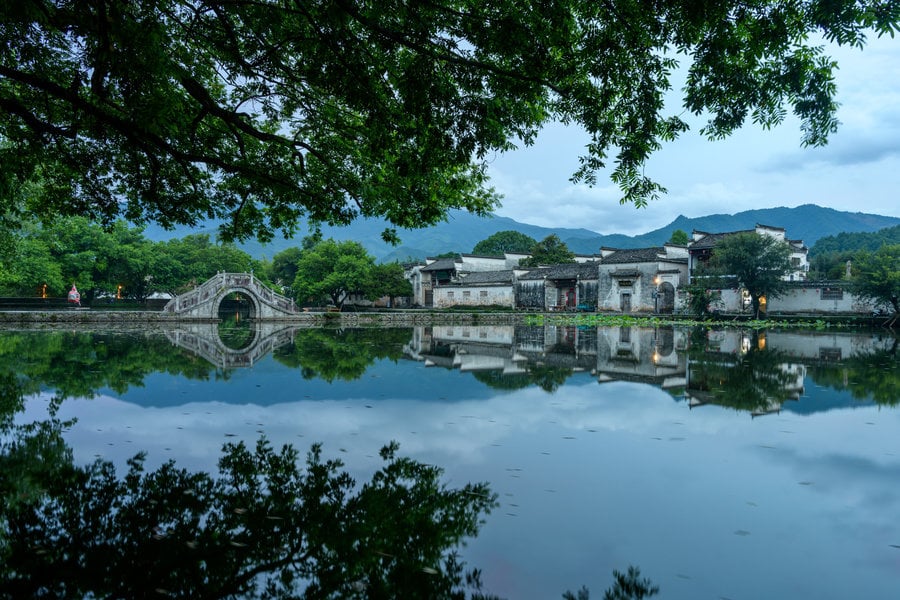
Option 1: Visit One Village, Then Stay in Tangkou
This suits a three-day itinerary with two mountain days to follow.
Choose a morning departure that leaves a useful block of time after reaching the village. Arrange:
Arrival station → Hongcun or Xidi → Tangkou hotel.
Allow for luggage, lunch and an unhurried village visit. If using public services, verify the second transfer as well as the first. A train arriving early does not guarantee convenient transport from the village to Tangkou later.
For most first-time travellers, choose one village. Adding both can turn the arrival day into a rush and leave little time to prepare for the mountain.
Option 2: Go Directly to Tangkou
This is a straightforward choice when the mountain is your priority or you prefer a slower first day.
Travel during the day, check in, confirm the next morning’s transport and reservations, and prepare a light mountain bag. Ask the hotel about storing your main suitcase if you will sleep on the mountain.
An afternoon train can work with this plan if the onward service is confirmed. For a late arrival, arrange transport before booking the rail ticket.
Option 3: Stay in Tunxi
Choose this for an urban arrival night, dining and a relaxed walk in Old Street or beside the river.
You can leave Hangzhou later if the hotel and transfer arrangements allow, but the mountain remains a separate journey on a subsequent day.
Do not select a Tunxi hotel expecting to walk to the mountain entrance the next morning.
Option 4: Ascend the Mountain Immediately
An early train can make same-day ascent possible for an appropriately designed route. Confirm the complete chain before committing to a mountain hotel:
- Train arrival and time to exit the station.
- Road journey to the correct gateway.
- Luggage storage or onward luggage transfer.
- Reserved admission direction and time slot.
- Scenic transport and cable-car operation.
- Walking time to the exact hotel.
Do not add a village on the way unless the itinerary has been explicitly checked to accommodate it. A mountain hotel is a fixed walking destination you must reach, not simply a place to check in whenever the road journey ends.
Which Option Fits Your Trip?
| Your priority | Suggested arrival-day approach |
|---|---|
| A village plus two days on the mountain | Morning train, one village and Tangkou overnight |
| A comfortable start to mountain walking | Transfer directly to Tangkou and ascend next morning |
| Food, culture and an urban base | Transfer to Tunxi |
| Maximum mountain time with a well-planned route | Carefully coordinated same-day ascent |
| Late departure from Hangzhou | Transfer and hotel check-in only |
Can You Sightsee in Hangzhou Before the Train?
Yes, if the train is later and you leave enough time for luggage collection and the station journey. Keep the final activity near your accommodation or transfer route.
A short breakfast outing or local walk can fit more comfortably than a new excursion to a distant temple or tea village. West Lake is a broad area, so even a lakeside outing needs a defined finish point.
Decide on a firm time to return, collect the bags and leave for the station. If using a different departure station from your arrival station, reassess the journey rather than repeating the earlier transfer estimate.
If you want a substantial Huangshan activity after arrival, prioritise an earlier train and enjoy Hangzhou sightseeing on another day.
Booking with a Foreign Passport
Use a Supported Booking Channel
China Railway 12306 provides an official English booking route. Register and follow the current passport and identity-verification prompts before the date you need to buy tickets.
An established English-language booking service is another option. Check the total fare, service fees, optional extras and who handles changes or refunds.
A staffed railway counter can assist with purchases or document issues. Bring the original passport and the train details. Do not rely on departure-day availability for a fixed itinerary if you can book ahead.
Enter Details from the Passport You Will Carry
Use the correct document type, number, name and other required information. Follow the platform’s surname and given-name fields rather than assuming every system uses the same order.
Do not use a nickname or invented Chinese name. Update saved information if a passenger has a new passport.
Check all passengers, including children, and confirm the necessary seating and registration arrangements. A free-travel entitlement, where applicable, does not mean the child can simply be omitted from the booking process.
Confirm the Ticket Has Been Issued
A submitted order, advance purchase request or waiting-list entry is not the same as an issued reservation.
After confirmation, check:
- Travel date and train number.
- Exact departure and arrival stations.
- Whether the service is direct.
- Passenger details.
- Carriage, seat and class.
- Ticket-change and refund conditions.
Save the details offline. You still need the original passport for the journey; a screenshot is useful for reference but is not a replacement document.
When to Book
Standard ticket sales generally use a 15-day advance-sales window, with station-specific release times. Check the current sale date and release time in 12306.
Earlier request features may be offered under separate conditions by an official service or booking platform. Read the terms and follow the request until you know whether a ticket has been issued.
For holidays, weekends or a group that wants to sit together, prepare passport details early and identify alternative departures. Do not let an unconfirmed rail request be the only foundation for a fixed mountain booking.
Seat Classes, Fares and Travelling Together
Second class is a practical choice for most visitors. First class usually offers more space, while business class may be available on some trains at a higher price.
Check the layout and facilities of the actual service if these are important to you. Make sure your order includes a reserved seat rather than a standing option.
Use the live fare shown for your chosen train and class. Prices can differ between services, and booking platforms may add fees or optional extras.
For a family or group, request adjacent seats where supported, then check the issued seat numbers. Booking together does not guarantee every passenger will sit together.
The most useful comparison is the total trip cost: rail tickets, transport to the departure station, onward road transfer and any service charges. A lower rail fare does not necessarily produce the lowest complete cost.
Getting to Your Hangzhou Departure Station
By Metro
The metro can be useful when your hotel has a straightforward connection and your bags are manageable. Check the current route and hours, then follow signs to railway departures after leaving the metro.
East and West stations have different access journeys. At a large hub, arriving at the metro stop is not the same as reaching the railway boarding gate.
By Taxi or Arranged Transfer
A taxi or hotel-arranged transfer can make luggage handling easier. Show the exact station name and ask for the appropriate departure entrance.
Allow for traffic and approach roads. If the hotel is near a pedestrian area or inside a scenic district, confirm where a vehicle can collect you.
How Much Station Time Should You Allow?
For a first visit with a foreign passport, we suggest reaching the station about 60–90 minutes before departure. Allow more for peak crowds, assistance needs or unresolved booking issues.
This is our planning recommendation, not a universal railway deadline. Boarding closes before the scheduled departure, so a train’s departure time should never be your target station-arrival time.
Add your hotel-to-station journey separately. The short rail journey to Huangshan does not reduce the time needed to board correctly in Hangzhou.
Entering the Station and Boarding
Entry and Document Check
Keep the original booking passport ready. Use a compatible reader where available or ask staff for the manual inspection channel.
If an automated gate does not recognise your document, seek assistance. Have the reservation details available to help staff locate the booking.
Security
Put your bags through security and collect all belongings before continuing. Keep the passport accessible afterwards.
Railway restricted-item rules apply. If travelling with unusual equipment, aerosols, large quantities of liquids or oversized bags, check the current requirements before leaving the hotel.
Find the Train by Its Number
Use the train number on your ticket to find the gate and boarding status. The service may continue beyond Huangshan North, so the final destination shown on the main display can be different from your stop.
Check again before boarding in case the gate changes. Wait close enough to return promptly when boarding begins.
Platform, Carriage and Seat
Follow the displayed platform guidance and staff instructions. Locate the booked carriage and seat, then store your bags without blocking the aisle.
Some services call at Hangzhou rather than starting there. Have the group and luggage ready to board efficiently, and do not assume the train will wait while you locate the right carriage.
Do You Need a Paper Ticket?
For an ordinary confirmed railway e-ticket, you normally travel using the original valid document associated with the reservation. An itinerary printout or reimbursement document does not replace it.
Follow any specific instructions if your booking involves a document or verification issue that needs assistance. Resolve such issues before the departure day where possible.
Luggage and Onboard Preparation
Bring bags you can lift and manage through the station. Train travel does not automatically include airline-style checked luggage.
Current railway baggage size, weight and restricted-item rules apply. Check requirements if your luggage is unusually large or heavy rather than assuming rack space makes it permitted.
For a mountain overnight, travel to Huangshan with your normal bag, then repack a light backpack below. Confirm who stores or transfers the larger suitcase before ascending.
Bring water and a snack, especially if the next transfer postpones lunch. Keep booking details and your hotel’s address offline, and charge your phone before travelling.
As the train approaches your arrival stop, gather bags and prepare the onward contact. Do not assume the train terminates at Huangshan.
Arrival and Onward Transfers
At Huangshan North
Follow the arrivals route and keep your passport ready for an exit check if needed. Use staff assistance if an automated reader does not recognise it.
Gather the group before finding the driver or scheduled service. Allow time for station exit and luggage handling; do not book a road connection that depends on leaving the platform instantly.
To Tangkou
Check current tourist road services or arrange a transfer to the exact hotel. The gateway journey is separate from transport inside the scenic area.
Ask where the service ends and whether another local journey is needed to reach the property. If arriving late, verify the final service or arrange a pickup in advance.
To Tunxi
Use the actual hotel address. A transfer to Tunxi is a city journey rather than a mountain-entry service.
If planning an evening walk, first settle in and consider the location of the hotel, the weather and the group’s energy.
To Hongcun or Xidi
Confirm the village, admission arrangements and luggage plan. If continuing to Tangkou afterwards, book or verify that second leg as well.
Village accommodation may involve a final walk with luggage. Ask whether a vehicle can reach the property or whether someone meets you at a designated entrance.
At Huangshan West or Another Regional Station
Use a transfer arranged for that specific arrival point. Do not assume a Huangshan North pickup or bus instruction applies.
If your route uses the North Gate or Taiping cable car, confirm how the rail arrival, road service and entrance reservation fit together. A South Gate hotel requires a different final destination even though you are visiting the same mountain.
Connecting from Hangzhou Xiaoshan International Airport
An airport-to-train journey needs a separate plan. Allow for landing, immigration where applicable, baggage collection, movement to transport, the correct railway station and boarding procedures.
The airport has metro access, but check the actual route, service hours and walking within the railway hub. A connection should be evaluated from your terminal and flight, not from a rail timetable alone.
If arriving on an international flight, avoid a tight, separately booked train reservation. Delays and entry formalities can change when you are ready to leave the airport.
Spending a night in Hangzhou before continuing can be the more comfortable choice, particularly for families or travellers arriving after a long flight.
Should You Stop at Qiandao Lake or Another Place on the Way?
An intermediate rail stop can be worthwhile if it is an intentional part of a longer itinerary. It is rarely an effortless add-on to a transfer day.
For Qiandao Lake, the station and the lakefront activities are separate. A visit needs local transport and enough time for the chosen experience. The same principle applies to other countryside stops.
Do not assume a normal point-to-point train ticket allows you to get off, sightsee and resume the journey on a later train. Arrange the appropriate separate legs or a specifically applicable ticket product, and confirm its conditions.
With a fixed Huangshan mountain booking, travelling directly is usually the simpler way to preserve time and energy.
Hangzhou–Huangshan in a Wider East China Route
Shanghai → Hangzhou → Huangshan
This can make sense when you want city experiences, West Lake and tea culture, then mountains and ancient villages. Finish the Hangzhou activities before moving on, and use the arrival day in Huangshan selectively.
Hangzhou → Huangshan → Another Destination
You do not have to return to Hangzhou if your wider route continues elsewhere. Compare the onward rail and road options before choosing the final Huangshan hotel and departure point.
For a journey continuing toward Jingdezhen or another regional destination, the last activity and station transfer should be planned together rather than automatically returning to the first base.
Should You Keep the Hangzhou Hotel While Visiting Huangshan?
Keeping a room can reduce repacking if you are returning, but it adds accommodation cost and another return journey. Checking out can be more efficient for a route that continues onward.
If considering luggage storage in Hangzhou, confirm the hotel’s policy and how collection fits your route. You will still need suitable bags for the train, villages and mountain section.
Choose according to the full itinerary rather than assuming every Huangshan visit must be a return excursion.
Planning the Return to Hangzhou
Choose the return train after reviewing your final Huangshan activity.
If descending Yellow Mountain, include walking to the cable car, queues, the ride, scenic transport, luggage collection, the road journey and station entry. A late service may be workable; a tight departure can force the entire mountain day to revolve around catching the train.
If leaving from a village, confirm the transfer and any luggage collection. If leaving from Tunxi, calculate the hotel-to-station journey separately.
Check the Hangzhou arrival station too. It may differ from the outward departure point, affecting your transfer to the hotel or airport.
If an international flight follows, allow a robust connection or stay in Hangzhou overnight. Do not depend on a weather-sensitive mountain descent, train and airport transfer all running quickly.
Changes, Refunds and Delays
Ticket changes depend on timing, rules, booking history and available seats. A booking service may have a separate handling process or fee.
Read the conditions before paying, particularly if the mountain plan might change with weather. Do not assume you can freely move a reservation to the next train.
If you expect to miss the departure, contact the original booking service or railway staff promptly. Keep the booking reference and passenger documents ready.
If the railway changes or cancels the service, follow the official notice and assistance process. Update your onward driver or hotel once the new arrival arrangement is clear.
Common Mistakes to Avoid
- Choosing East or West without checking hotel access. Compare the full departure journey.
- Going to Chengzhan when the ticket says East or West. Save the exact station name in Chinese.
- Confusing Huangshan North with Huangshan West. Confirm the arrival station before arranging a pickup.
- Reading only the search heading. A result can use another station or include a connection.
- Treating an early purchase request as a confirmed seat. Follow the order status until issuance.
- Assuming the rail journey ends at the mountain entrance. Plan the road and scenic-area stages.
- Adding too much sightseeing before or after the train. Protect luggage handling, meals and transfer time.
- Booking an early return after descent. Include the entire route to the station.
A Short Departure Checklist
Before leaving your Hangzhou accommodation, confirm:
- Travel date, train number and issued ticket status.
- Correct Hangzhou departure station and Huangshan arrival station.
- Original passports and accessible reservation details.
- Carriage, seats and all passenger arrangements.
- Current city-transfer plan and a comfortable station buffer.
- Onward pickup or bus connection, hotel address and contact.
- Luggage storage or transfer for a mountain overnight.
Frequently Asked Questions
Is there a direct train from Hangzhou to Huangshan?
Yes, direct high-speed travel is a practical option. Compare the services available on your date from Hangzhou East and Hangzhou West, and check the exact Huangshan arrival station.
Should I leave from Hangzhou East or Hangzhou West?
Choose according to your hotel, train timing, total cost and onward arrangements. Neither station is automatically best for every visitor.
How long does the journey take?
Around one to two hours is a useful initial guide for many rail services, but some take longer. Add hotel access, station procedures and the transfer after arrival to understand the whole journey.
Which Huangshan station should I book?
Huangshan North is a useful starting search for a first regional visit. Huangshan West or another station may suit a specific itinerary if the train and local transfer have been checked.
Can overseas visitors buy tickets with a passport?
Yes. Use a supported booking channel, complete required verification and enter the correct passenger details. Carry the original passport used for the reservation.
How early can I book?
Standard sales generally use a 15-day window, with station-specific release times. Earlier requests are separate arrangements and do not necessarily confirm a seat. Check the current rules and issued status.
Do I need to collect a paper ticket?
Normally not for an ordinary confirmed e-ticket. Use the original booking document for the journey and keep reservation details available for assistance.
Can I visit a village on the arrival day?
Yes if the train and transfers leave enough time for luggage, lunch and a proper visit. A morning departure is useful. Confirm the later transfer to your hotel before setting out.
Can I stay on Yellow Mountain the same day?
It can work with an early arrival and a route designed around the hotel’s location and current access. Check the road, admission, scenic transport, cable car and walking stages before booking.
Is Huangshan a good day trip from Hangzhou?
A local overnight is usually more comfortable for a first-time mountain visit. The short rail leg can hide a much longer day of station access, road transfers, scenic transport and walking.
Can I travel directly from Hangzhou Airport?
You need to transfer from the airport to the booked railway station. Allow time for flight arrival, baggage, entry formalities where applicable and station procedures; avoid a tight connection.
Can I stop at Qiandao Lake on the way?
Yes as a deliberately planned itinerary stop, with local transport and suitable rail bookings. Do not assume a normal through ticket allows you to resume later after sightseeing.
Can I return after coming down the mountain?
Yes with a suitably timed train and a generous buffer through every descent and transfer stage. Add a local night if the connection would make the final day rushed.
Plan the Journey around the Experience You Want
The best Hangzhou–Huangshan journey is the one that fits your accommodation, luggage and first activity. A convenient train should make the rest of the day easier, whether you are heading to an ancient village, a Tangkou hotel or a carefully planned mountain overnight.
Discover East China Tours can help coordinate the rail journey, local transfers and a mountain or village itinerary within a wider East China trip. Tell us your dates, group size, arrival and departure plans, and preferred walking pace so the stages work together.
Our approach keeps shopping voluntary, with no forced shopping stops, and leaves time for the experiences you choose.