
Hangzhou’s Grand Canal offers a different view of the city from West Lake. Here, stone bridges, former warehouses, craft museums and narrow residential streets sit beside a waterway that still carries working boats. You can spend an afternoon walking along the canal, stop for tea in a historic neighborhood, or see the bridges and waterfront from a passenger boat.
For a first visit, start around Gongchen Bridge, explore the Qiaoxi Historic and Cultural Block, and continue to Xiaohe Street if you have time. This gives you a manageable introduction to the canal’s history and the neighborhoods around it. A boat trip can complement the walk, but the experience depends on the service you choose: a public water bus, a sightseeing cruise and an evening cruise serve different purposes.
This guide explains where to go, how to connect the main areas, and how to choose a boat trip that fits your plans.
Hangzhou Grand Canal at a Glance
| Planning question | Practical answer |
|---|---|
| Best starting point for a first visit | Gongchen Bridge and the surrounding museum and historic-street area |
| Best short visit | Gongchen Bridge, Qiaoxi and one museum or a café stop |
| Best half-day visit | Gongchen Bridge, Qiaoxi, Xiaohe Street and an optional stop at Xiaohe Park |
| Main sightseeing-cruise boarding area to investigate | Wulinmen Wharf; check the departure pier on your actual ticket |
| Main metro station for Gongchen Bridge | Gongchenqiao East on Metro Line 5, followed by a walk |
| Suggested time | Around 2–3 hours for the bridge area; 4–5 hours for a broader neighborhood walk |
| Admission | Public streets and ordinary canal-side walks do not require a general area ticket; boats, some attractions and workshops have separate arrangements |
| Best fit | Travelers interested in urban history, walking, photography, crafts and a slower afternoon |
These visit lengths are planning estimates. Allow more time if you visit several museums, stop for a meal, or add a boat trip.
Why Visit the Grand Canal in Hangzhou?
West Lake is usually the first place visitors associate with Hangzhou. The Grand Canal adds another part of the city’s story: transport, trade, craftsmanship and the neighborhoods that developed around the movement of goods.
The appeal is in the details. From Gongchen Bridge, you can look along the canal and watch boats pass beneath you. In Qiaoxi, the walk becomes more intimate, with traditional street-front buildings and former industrial spaces. Around Xiaohe Street, cafés and shops share a setting shaped by older waterways and trading routes.
The area also rewards a flexible pace. You do not need to enter every museum or follow a long checklist. One bridge, one exhibition and a neighborhood walk can make a satisfying visit.
Expect a mix of heritage, contemporary businesses and ordinary city life. Some streets are popular visitor destinations, especially on weekends, while the main canal remains an active waterway. The experience will feel different from visiting a small water town such as Tongli or Zhouzhuang.
A Brief History of the Grand Canal
The Grand Canal is a vast historic waterway system linking northern and southern China. Over centuries, it supported the movement of grain, goods and people, helping connect regional economies and cities. The Grand Canal was inscribed on the UNESCO World Heritage List in 2014.
Hangzhou forms part of the canal’s southern story. Its waterways supported commerce, storage, production and transport, leaving traces in bridges, warehouses, residential streets and industrial sites.
Today, visitors can see both historic structures and buildings adapted for museums, shops and public spaces. The World Heritage designation relates to the canal’s designated components as a wider heritage property; it does not mean that every nearby shopping street or renovated building is individually UNESCO-listed.
Understanding the Area Before You Go
The main places in this guide are spread along and around the canal. They work best as a few connected clusters, rather than one continuous attraction.
Gongchen Bridge, Qiaoxi and the museums
This is the strongest starting point for most first-time visitors. The Beijing–Hangzhou Grand Canal Museum is on the east side of the canal near Gongchen Bridge. Qiaoxi and the craft-museum area are on the west side.
You can explore both sides by crossing the bridge, although its steps may affect your route if you have limited mobility or a stroller.
Xiaohe Street and Xiaohe Park
Xiaohe Street is a historic neighborhood associated with smaller waterways and trading activity. Xiaohe Park is a separate place developed from a former oil-depot site beside the Grand Canal.
They can be combined with the Gongchen Bridge area, but they are not two names for the same attraction. Search for each separately on your map.
Dadou Road and Xiangji Temple
Farther south, Dadou Road offers another canal-side historic-street area near Xiangji Temple. This is a useful additional stop if you have a longer afternoon or want to build a fuller canal day.
It should not be treated as an effortless extra on a short Gongchen Bridge visit. Leave time for the transfer and for exploring the area once you arrive.
Wulinmen Wharf
Wulinmen is a useful place to investigate boat departures from the more central part of Hangzhou. It is a boarding location, and the service you book determines whether you can get off elsewhere or must return to the starting pier.
A boat passing Gongchen Bridge does not automatically give you time to explore Qiaoxi or Xiaohe Street on foot.
What to See Around the Hangzhou Grand Canal
1. Gongchen Bridge: Start with the Canal’s Landmark
Gongchen Bridge — 拱宸桥
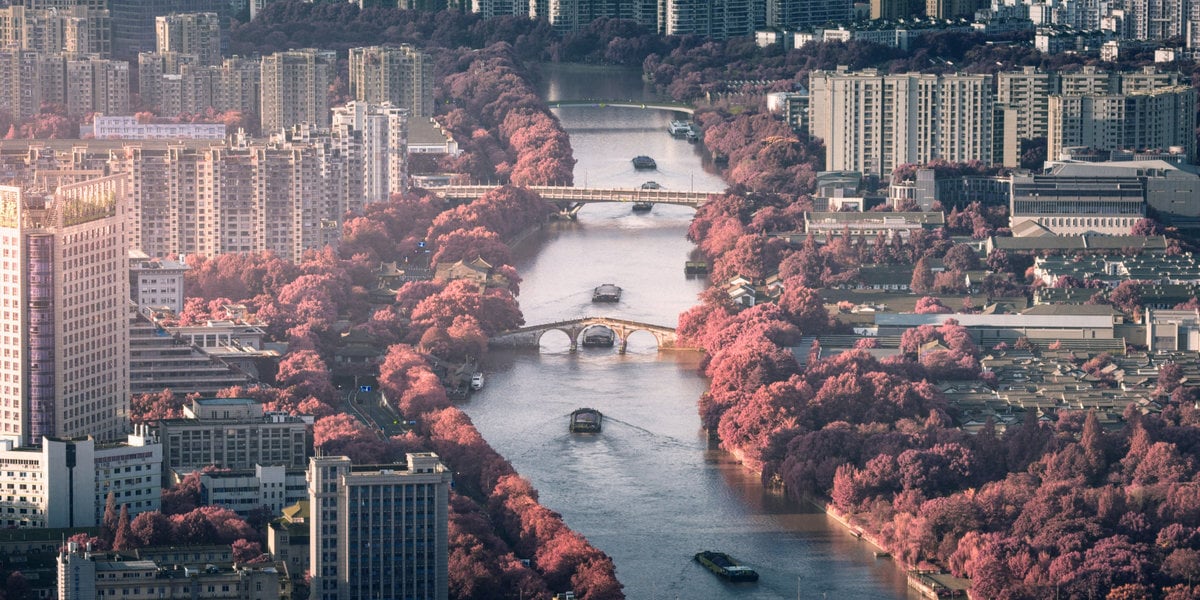
Gongchen Bridge is the most recognizable landmark in this part of the canal. Its stone arches, raised walkway and waterfront setting make it a good place to understand the scale of the waterway before exploring the surrounding streets.
Walk onto the bridge, pause where it is safe to do so, and look in both directions. The view brings together old architecture, modern waterfront buildings and boats using the canal today.
For photographs, try the banks as well as the bridge itself. From the side, you can see the arches and the relationship between the bridge and the water. Keep clear of other pedestrians when stopping on the narrower parts of the crossing.
How much time to allow: Approximately 20–30 minutes for the bridge and nearby viewpoints, longer if you enjoy photography.
Practical note: The historic crossing has steps. If steps are difficult, enjoy the bridge from the bank and plan an alternative crossing using a current map.
2. Beijing–Hangzhou Grand Canal Museum: Give the Walk Some Context
Beijing–Hangzhou Grand Canal Museum — 中国京杭大运河博物馆
Near the east side of Gongchen Bridge, this museum provides context for what you see outside. Its subject is the canal: how it functioned, the communities it supported, and its relationship with Hangzhou.
It is a useful first stop if you are interested in history or want more than a scenic walk. The exhibits help make sense of why warehouses, workshops and residential neighborhoods grew around the waterway.
Do not confuse this museum with the China Grand Canal Museum in Yangzhou. They are different institutions in different cities.
How much time to allow: Around 60–90 minutes for a selective visit.
Practical note: Check this museum’s own opening and entry arrangements. English interpretation may vary between displays, so a little background reading or a translation app can help.
3. Qiaoxi Historic and Cultural Block: Explore the West Bank
Qiaoxi Historic and Cultural Block — 桥西历史文化街区
Qiaoxi lies on the west side of Gongchen Bridge. It is a convenient place to slow down after visiting the bridge or museum, with traditional streets, residential architecture and cultural venues close together.
The pleasure here is in walking rather than rushing between individual landmarks. Look at the building fronts, the smaller passages and the way the neighborhood connects with the canal. Some places operate as visitor businesses, while others have a more everyday character.
A café or tea stop fits naturally into this part of the visit. Choose somewhere you would like to spend time rather than assuming every waterfront venue offers a traditional cultural experience.
How much time to allow: Around 45–60 minutes for a walk, plus any café or museum time.
Practical note: Respect residential doorways and private interiors. A photogenic lane is still a place where people live and work.
4. The Craft Museums: Choose a Subject You Enjoy
The west-bank museum area includes venues devoted to knives and scissors, fans, umbrellas, and Hangzhou arts and crafts. Former industrial buildings provide a fitting setting for collections about making and working.
For a first visit, choose one museum according to your interests. Umbrellas and fans can appeal to visitors interested in design, materials and decorative detail. Tools and scissors offer another way to explore the city’s craft and industrial history.
Trying to visit every collection can use most of an afternoon. If your main goal is to experience the canal neighborhoods, keep the museum visit focused and leave time for walking.
Some venues or programs may offer demonstrations and hands-on activities. These are separate from ordinary exhibition viewing and should be confirmed in advance if they are an important part of your trip.
How much time to allow: Approximately 45–75 minutes for one selected museum.
Opening-hours note: Published visitor information for the China Umbrella Museum in May 2026 listed opening hours of 9:00 a.m.–4:30 p.m., with Monday closure except on public holidays, free admission, and reservations on weekends and public holidays. Recheck before visiting. Other museums may follow different arrangements.
5. Xiaohe Street: Historic Lanes, Shops and a Tea Break
Xiaohe Street Historic Block — 小河直街历史文化街区
Xiaohe Street is a good addition when you want a longer neighborhood walk. Its historic setting reflects the area’s earlier role in commerce and distribution, while today’s cafés, restaurants and small shops bring a contemporary visitor scene.
Walk slowly through the main lanes and notice how the buildings relate to the smaller waterways. This is a place for a tea break, browsing and street photography rather than a large monument with a single viewing point.
The area can be lively on weekends and holidays. If you prefer fewer people, a weekday visit will usually give you more room to walk, although individual businesses may keep their own schedules.
How much time to allow: Around 45–90 minutes, depending on whether you stop for food or drinks.
Practical note: A sightseeing boat on the main canal does not necessarily enter these smaller waterways or stop at the street itself. Confirm the landing point before planning to arrive by boat.
6. Xiaohe Park: A Different Waterfront Setting
Xiaohe Park — 小河公园
Xiaohe Park occupies the former Xiaohe Oil Depot site beside the Grand Canal. Its public spaces and contemporary architectural additions offer a different setting from the historic streets nearby.
It is worth considering if you enjoy industrial reuse, architecture or a more open waterfront stop. After walking through narrower lanes, the park can provide a welcome change of pace.
Treat it as an optional addition. If you have only a few hours, the bridge, Qiaoxi and Xiaohe Street already make a substantial visit.
How much time to allow: Around 30–60 minutes.
Practical note: Use the park’s own map pin. “Xiaohe” can refer to several places in this area, and searching only the neighborhood name may not take you to the entrance you want.
7. Dadou Road and Xiangji Temple: Extend the Canal Day
Dadou Road Historic Block — 大兜路历史街区
Xiangji Temple — 香积寺
Dadou Road follows another historic stretch beside the canal, with buildings and streets that recall the area’s commercial past. Xiangji Temple gives this part of the visit a different focus from the bridge and museum cluster.
This combination suits travelers who have extra time or prefer a historic-street walk with a temple visit. You might come here for lunch, a late-afternoon stroll or a separate outing rather than trying to fit everything into one short canal walk.
Public access to the street does not imply free access to the temple. Check the temple’s opening and admission arrangements separately.
How much time to allow: Around 1–2 hours for the neighborhood and a selective temple visit, plus travel time.
Practical note: Follow the temple’s rules on photography and behavior, particularly around active worship areas.
The Best Walking Routes for a First Visit
These routes are suggested ways to organize your time, rather than fixed tours. Use a current map for entrances and crossings, and leave room for a stop that interests you.
Route 1: A Short Introduction Around Gongchen Bridge
Suggested time: 2–3 hours
Route: Gongchen Bridge → Qiaoxi → one craft museum or a café stop.
This is the easiest option if you want to add the canal to a busy Hangzhou itinerary. Spend time around the bridge, cross to the west bank if the steps are manageable, and explore Qiaoxi at an unhurried pace.
Choose one indoor stop. A museum adds historical or craft context; a café makes the visit more relaxed. If you prefer the canal-history museum on the east bank, visit it before crossing and reduce the time allocated to other indoor stops.
Route 2: A Half-Day Neighborhood Walk
Suggested time: 4–5 hours
Route: Gongchen Bridge area → Qiaoxi → Xiaohe Street → optional Xiaohe Park.
This is a good default for travelers who want to see more than the landmark bridge. Start with either the canal-history museum or one craft museum, then continue through the west-bank neighborhood and toward Xiaohe Street.
Include a lunch or tea stop. Add Xiaohe Park if you still have time and energy, or finish at Xiaohe Street and take a taxi back to your hotel.
The connections are ordinary urban routes with streets, crossings and different waterfront sections. Do not assume there is a single uninterrupted pedestrian path along the water for the entire itinerary.
Route 3: A Fuller Canal Day with a Boat Trip
Suggested time: Most of a day
Begin with a walk around Gongchen Bridge and the historic neighborhoods. Add Dadou Road and Xiangji Temple if those interest you, then organize the boat portion around the service you have actually booked.
There are two sensible approaches:
- A daytime boat with an allowed landing: Use a confirmed one-way, multi-stop or day-pass service to connect parts of the visit. Check the stops, operating window and boarding rules before committing to the route.
- A separate evening cruise: Complete the neighborhood walk first, then travel to the departure pier. Allow time for dinner, the transfer and boarding.
A round-trip cruise can be enjoyable, but it returns you to its starting point. It will not function as transport to your next neighborhood unless the operator explicitly permits that landing.
Boat Trips on the Hangzhou Grand Canal
The most important decision is whether you want transport, sightseeing or an evening experience. Different boats may travel along similar water, but the tickets and stopping arrangements can be quite different.
| Service | Best use | What to check before boarding |
|---|---|---|
| Public water bus | A practical ride on the canal, when the route and queue fit your plans | Current route, stops, fare, boarding queue and final service |
| Daytime sightseeing cruise | Seeing the canal from the water | Departure pier, duration, one-way or return operation, and allowed landings |
| Canal day-pass or multi-stop product | Combining boat rides with time on land | Participating piers, validity, service frequency and reboarding rules |
| Evening sightseeing cruise | Bridges, waterfront lighting and a seated end to the day | Departure time, return pier, seating and whether any stops are included |
| Themed cruise | Tea, performance or another advertised onboard experience | Exact route, inclusions, language, duration and any separate charges |
Public Water Buses
Public water buses are transport services rather than guided tours. They can be appealing if you want a simple boat ride and are comfortable organizing the journey yourself.
However, a low fare does not guarantee a quick departure. Popular services can attract substantial queues on busy days, and route arrangements can change. If you have a fixed museum booking or dinner reservation, avoid making the rest of your schedule depend on boarding a particular public boat immediately.
Look for 水上巴士 or 水上公交 when checking local information. Confirm that the service you have found is the public route you intend to use.
Daytime Sightseeing Cruises and Day Passes
A daytime cruise is useful for understanding the canal’s broader waterfront. It also gives you a seated break after walking.
Operators have offered a canal day-pass product connecting places such as Wulinmen, Dadou Road, Xiaohe Park and Gongchen Bridge. Treat this as a product to check for your travel date, rather than assuming that every sightseeing ticket allows unlimited rides or stops at all these locations.
Before paying, establish whether you can get off, how often another boat will arrive, and what happens if the last sailing is full or you miss it. A day pass only helps your itinerary if its timetable leaves enough time ashore.
Evening Cruises
An evening cruise suits travelers who enjoy illuminated waterfront views and want a less active finish to the day. The view emphasizes bridges, reflections and the city around the canal.
Check whether the sailing returns to the departure pier. Many evening products are designed as round-trip experiences, so plan your onward taxi or metro journey from the return location.
If your priority is exploring museums, shops and historic lanes, visit those during the day. Looking at a neighborhood from a boat will give you a different experience from walking through it.
How to Book as an Overseas Visitor
For sightseeing products, check the 杭州运河游船 mini-program or information published through the 杭州水上巴士 official WeChat account. Booking channels can differ between products. Public water-bus boarding may use a queue and local payment process rather than an advance sightseeing reservation.
Before confirming a ticket:
- Check the date, departure time and exact pier.
- Confirm the route, duration and return or landing arrangement.
- Read the cancellation terms and any weather-related notice.
- Check the passenger-identification requirements. If passport details are requested, enter them exactly as required and bring the document specified for boarding.
- Save the ticket, booking number and pier location on your phone.
If the platform does not accept your passport type, international number or payment method, ask your hotel or travel provider to help confirm the available booking option. Do not enter a substitute Chinese identity number.
Allow a boarding buffer, especially if the pier is unfamiliar. Around 20–30 minutes is a useful starting point, but follow the operator’s own instructions if they require earlier arrival.
Getting to the Canal and Between the Main Areas
By Metro
For Gongchen Bridge, use Gongchenqiao East Station — 拱宸桥东站 — on Metro Line 5, then walk toward the bridge and museum area. Check your chosen attraction on a map before selecting an exit.
For a boat departure around Wulinmen, Wulin Square Station — 武林广场站 — on Lines 1 and 3 is one central station to investigate. Compare the walking route to the precise pier on your ticket. Wulin Square, Wulinmen Station and Wulinmen Wharf are distinct places, so choosing a familiar-sounding name is not enough.
By Taxi or Ride-Hailing
A taxi is useful when you are traveling from West Lake, returning after a cruise, or connecting parts of the canal area without a long walk.
Use a specific destination: a museum entrance, a historic-street entrance or the actual departure pier. “Grand Canal” is too broad for a reliable drop-off.
Vehicles may have to stop outside pedestrian streets. Check where the driver can legally stop, then walk the final section.
Useful Chinese Names to Save
| English name | Chinese name |
|---|---|
| Gongchen Bridge | 拱宸桥 |
| Gongchenqiao East Metro Station | 拱宸桥东站 |
| Beijing–Hangzhou Grand Canal Museum | 中国京杭大运河博物馆 |
| Qiaoxi Historic and Cultural Block | 桥西历史文化街区 |
| Xiaohe Street Historic Block | 小河直街历史文化街区 |
| Xiaohe Park | 小河公园 |
| Dadou Road Historic Block | 大兜路历史街区 |
| Xiangji Temple | 香积寺 |
| Wulinmen Wharf | 武林门码头 |
Save the map pin as well as the name. A large district or waterfront can have several entrances and boarding points.
Tickets, Opening Hours and Budgeting
You do not need one general ticket to explore the canal neighborhoods. Public streets, bridge viewpoints and ordinary waterfront walks can be enjoyed independently.
Your main optional expenses are boat tickets, food and drinks, transport, any separately ticketed attraction, and workshops or special activities.
For boats, check the live price of the specific product. Public transport fares, sightseeing tickets, day passes and themed cruises should not be compared as if they include the same experience.
For museums, verify the individual venue’s opening day, last admission and reservation rules. Avoid applying one museum’s Monday closure or booking policy to the entire area.
A walking-focused visit can be simple to budget: decide whether you want one museum, a meal, a taxi transfer and a boat ride. Add paid experiences only where they contribute to the day you want.
Food, Tea and Everyday Experiences
A meal or tea break is one of the best ways to give this visit a comfortable pace. Qiaoxi, Xiaohe Street and Dadou Road offer opportunities to stop, although business openings and menus vary.
You can look for a noodle lunch, a local restaurant, a tea house or a café with a setting you enjoy. Check the menu and prices before sitting down, especially at venues where drinks are part of the main experience.
There is no need to turn every stop into a formal cultural activity. Watching boats from a public viewpoint, looking through a craft exhibition and sitting down for tea can provide a rewarding afternoon.
If you want a structured experience, such as a craft workshop or tea session, book the actual activity and confirm its length, language and inclusions. A museum shop selling handmade items does not necessarily offer a class, and a tea-themed cruise is different from a tea-village visit.
For travelers especially interested in tea production and tea-growing landscapes, combine the canal with a separate Longjing-area outing on another part of the trip.
When to Visit: Season, Time of Day and Weather
Spring and autumn are generally comfortable seasons for a longer walk, though rain and busy holiday periods can affect the experience. In summer, plan walking for cooler parts of the day and use museums or cafés for breaks. In winter, allow for damp, chilly conditions near the water.
A daytime visit works best for museums, architectural details and exploring lanes. Late afternoon can suit photography and a relaxed meal. An evening boat trip offers another view of the waterfront, provided the sailing fits your schedule.
Weekend and holiday visits require more flexibility, particularly around museum reservations and popular boat queues. If the forecast is poor, prioritize a museum and a short neighborhood walk, then decide whether a cruise still appeals.
Boat operations may change because of weather or navigation conditions. Check notices before traveling to the pier.
Visiting with Children or Limited Mobility
Families can keep the outing manageable by choosing one museum, a short bridge-area walk and a food stop. A long sequence of museums and historic streets may be tiring for younger children.
Gongchen Bridge’s steps, uneven surfaces in older streets and boat boarding arrangements deserve attention if anyone in your group has limited mobility. Do not assume that the historic crossing or every vessel is step-free.
Contact the relevant venue or operator if you need wheelchair access, assistance boarding or a suitable toilet. For a simpler visit, focus on accessible bank-side views and one confirmed accessible attraction, with taxis between areas as needed.
Keep children away from the water’s edge and follow staff instructions at piers. Working waterfronts and boarding areas need more care than an enclosed visitor attraction.
Photography and Respectful Visiting
The bridge arches, canal traffic and smaller street scenes offer different photographic subjects. Try a few viewpoints on land instead of relying entirely on photographs taken from a moving boat.
Keep your route practical: a distant view of a bridge may be more useful than standing in a busy crossing, and a public bank-side viewpoint is preferable to entering a restricted dock.
Ask before photographing people closely, working inside shops or religious activity. Avoid blocking narrow lanes, shop entrances and residential doors. Stay out of private courtyards unless access is clearly offered.
How to Combine the Canal with the Rest of Hangzhou
The canal works well as a half-day component of a longer Hangzhou stay.
For a two-day first visit, give West Lake enough time and add a focused Gongchen Bridge outing if your schedule allows. A longer canal walk, several museums and an evening cruise together would take a substantial share of the trip.
With three days, a separate canal afternoon becomes easier. You could spend one day around West Lake, another on Lingyin Temple and a tea-area visit, and a third combining the canal with city time and meals.
If your priority is scenery, consider how much time you want at West Lake before choosing a canal route. If you enjoy urban history, crafts and neighborhood walks, the canal deserves more than a brief photo stop.
Frequently Asked Questions
Is the Hangzhou Grand Canal worth visiting on a first trip?
Yes, especially if you want to understand Hangzhou beyond West Lake. Gongchen Bridge, Qiaoxi and a selected museum make a useful introduction without requiring a full day.
Where should I start?
Start around Gongchen Bridge for a land-based visit. Start at the departure pier on your ticket if the boat trip is the main purpose of your outing.
How long should I spend there?
Allow around 2–3 hours for the bridge area or 4–5 hours for a broader neighborhood walk. Add boat time, boarding and transfers separately.
Can I see everything from a cruise?
A cruise gives you canal and waterfront views. Museums, historic lanes, shops and cafés require time on land, and the boat may not stop where you want to explore.
Can I get off a boat at Gongchen Bridge?
Only if your service permits it. Check the landing arrangements before booking; a round-trip sightseeing cruise may return to its starting pier without allowing you to continue on foot midway.
Is Xiaohe Street the same as Xiaohe Park?
No. Xiaohe Street is a historic-street area, while Xiaohe Park is a separate public space developed from a former oil-depot site. Use separate map pins.
Is the area suitable for a rainy day?
A museum-focused visit can work in rain, with shorter walks between stops. Older paving and bridge steps can be slippery, and boat services may be affected by weather.
Are all the museums open on Mondays?
Do not assume they share one schedule. Check each museum separately, including holiday exceptions and reservation requirements.
Do I need a guide?
You can organize a bridge and neighborhood walk independently. A guide can add historical context and help arrange transport or a specific activity if those are important to your visit.
Should I visit in the daytime or evening?
Choose daytime for museums and street exploration. Choose an evening cruise if you want illuminated waterfront views. You can combine them if you allow enough time between the walk and boarding.
Plan Your Hangzhou Canal Visit
A good canal visit leaves time to notice the waterway and the neighborhoods around it. For most first-time visitors, Gongchen Bridge, Qiaoxi and Xiaohe Street offer a satisfying starting route. Add a museum for context, a tea stop for a break, and a boat trip if its route and timetable suit your day.
If you would like help combining the Grand Canal with West Lake, Lingyin Temple, the Longjing tea area or other destinations in East China, Discover East China Tours can help arrange a trip around your interests and pace.